Science · Book club
Gödel, Escher, Bach book club questions
Here are 12 book club questions for Gödel, Escher, Bach by Douglas Hofstadter, ordered to open easily and end somewhere worth arguing about. Copy them, print them, or bring them up one at a time.
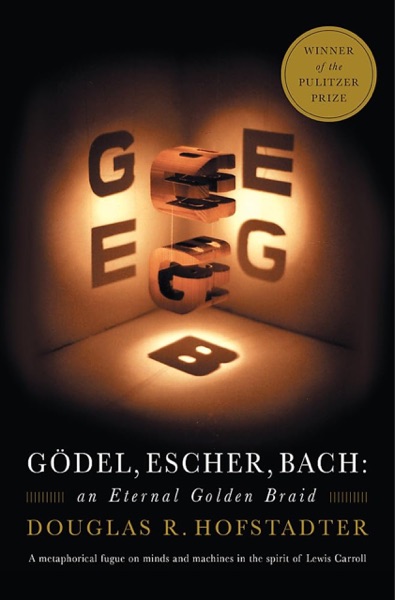
Douglas Hofstadter's Pulitzer Prize-winning debut, published in 1979, asks how meaning can arise from formal rules — how a biological machine can think, feel, and experience self-awareness.
Douglas Hofstadter · 1979 · 13h 15m
Full summary and key takeaways →The 12 questions
- 1.
Hofstadter argues that the 'I' is an emergent strange loop rather than a foundational entity. Does that claim feel liberating, disturbing, or simply correct to you?
- 2.
Gödel showed that no formal system can be both complete and consistent. Does this limit feel threatening to mathematics and science, or does it feel like an interesting quirk with no practical importance?
- 3.
The book uses Bach's music as a structural model for how recursive self-reference creates depth. Do you hear Bach differently after reading GEB? What do you notice?
- 4.
Hofstadter was writing about AI in 1979, before the current wave of machine learning. How have his predictions and concerns held up? What did he get right and what did he miss?
- 5.
The dialogues between Achilles and the Tortoise are themselves strange loops — they enact what they describe. Did you find them illuminating or frustrating? Why?
- 6.
Hofstadter argues consciousness requires a certain level of self-representational complexity. Does that claim give you any intuition about whether AI systems today are conscious or not?
- 7.
The book connects Gödel, Escher, and Bach as illustrators of the same deep principle. Do you find that connection illuminating or forced? Are there other figures who belong in the same grouping?
- 8.
Escher's drawings create loops that are visually compelling but logically impossible. What is the emotional effect of an impossible loop? Why does it feel significant?
- 9.
GEB is partly about the limits of formal systems. Do you think there are genuine limits to what AI can do — problems it cannot solve even in principle — or do you think the incompleteness results don't apply to machine learning?
- 10.
The book is famously difficult and rewarding. Did you feel the difficulty was justified — that the complexity was necessary — or did parts feel unnecessarily obscure?
- 11.
Hofstadter's central claim about consciousness being a strange loop is a philosophical position, not an established scientific fact. How much weight do you give it? What would count as evidence for or against it?
- 12.
If the self is an emergent pattern rather than a substance, what implications does that have for personal identity over time? Are you the same person you were ten years ago in any meaningful sense?
How to run the discussion
- Pick six to eight, not all of them. An hour of real discussion covers fewer questions than anyone expects, and racing the list is what makes a book club feel like homework.
- Open with what people noticed, not what they concluded. Asking for a verdict first hardens opinions before anyone has heard each other.
- Let the disagreement run. The questions below that split a room are the ones worth the time; the ones everyone answers the same way can be skipped.
- Ask the quiet person a specific question. A direct, narrow question is far easier to answer than an open invitation to contribute.
Themes worth steering toward
If the conversation stalls, these are the threads that usually restart it.
Common questions
What are good book club questions for Gödel, Escher, Bach?
Here are 12 book club questions for Gödel, Escher, Bach by Douglas Hofstadter, ordered to open easily and end somewhere worth arguing about. The strongest openers ask what each reader noticed rather than what they concluded, and the discussion usually turns on self-reference, consciousness, formal systems.
How long should a book club discussion of Gödel, Escher, Bach last?
Most groups run 60 to 90 minutes of actual discussion. That is roughly six to eight questions, not all of them, so pick the ones that suit your group rather than working down the list in order.
What are the main themes in Gödel, Escher, Bach?
Self-reference, Consciousness, Formal systems, Recursion, Artificial intelligence. Those are the threads most likely to divide a room, which makes them the useful places to steer a discussion that has gone quiet.
Picking the next one? See books like Gödel, Escher, Bach or questions for other book club picks.
