History · Book club
Genghis Khan and the Making of the Modern World book club questions
Here are 12 book club questions for Genghis Khan and the Making of the Modern World by Jack Weatherford, ordered to open easily and end somewhere worth arguing about. Copy them, print them, or bring them up one at a time.
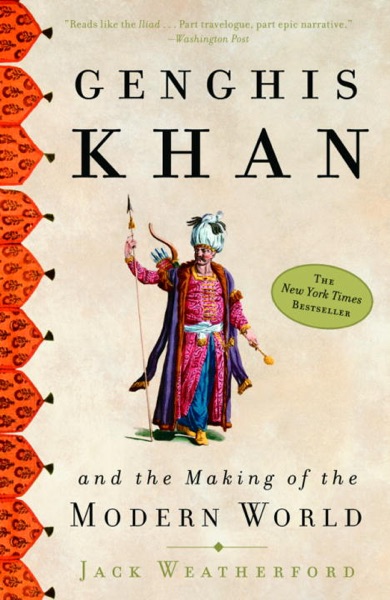
Jack Weatherford's argument is that Genghis Khan has been badly misread by history.
Jack Weatherford · 2004 · 6h 45m
Full summary and key takeaways →The 12 questions
- 1.
Weatherford argues that Western narratives about the Mongols are shaped entirely by their victims' accounts. How should historians weigh evidence from conquered peoples versus the perspectives of conquerors?
- 2.
Genghis Khan promoted on merit, offered religious tolerance, and formalized trade protections. Does that change how you assess his legacy given the massive violence of his conquests?
- 3.
The Pax Mongolica created the first Eurasian trading network. What parallels do you see between Mongol-era globalization and the kind of globalization we debate today?
- 4.
The Black Death traveled the same routes that enabled trade and cultural exchange. What does that dual nature of connected networks tell us about the costs of openness?
- 5.
Weatherford suggests that the Renaissance was partly downstream of technologies that arrived via Mongol trade routes. How much does origin matter when evaluating a civilization's achievements?
- 6.
Genghis Khan was illiterate but delegated writing and administration to conquered specialists. What does that tell us about the relationship between formal education and effective leadership?
- 7.
The Mongol Empire collapsed partly from internal succession struggles. What structural problems made a merit-based empire built by one extraordinary leader hard to sustain?
- 8.
The book's revisionism about Genghis Khan is fairly explicit. Where does the line sit between legitimate historical correction and romantic rehabilitation of a brutal figure?
- 9.
How would Eurasian history have unfolded differently if the Mongol expansion had stopped at China or Persia? What subsequent events depended on their westward movement?
- 10.
Weatherford spent years researching in Mongolia. How do you think the experience of living in the subject's homeland shapes historical writing, for better or worse?
- 11.
Genghis Khan offered conquered cities a choice: surrender and be spared, resist and be destroyed. Is that a rational policy, a moral one, both, or neither?
- 12.
The book argues that Genghis Khan's role in history was systematically erased. Why would subsequent empires and historians have motivation to minimize that legacy?
How to run the discussion
- Pick six to eight, not all of them. An hour of real discussion covers fewer questions than anyone expects, and racing the list is what makes a book club feel like homework.
- Open with what people noticed, not what they concluded. Asking for a verdict first hardens opinions before anyone has heard each other.
- Let the disagreement run. The questions below that split a room are the ones worth the time; the ones everyone answers the same way can be skipped.
- Ask the quiet person a specific question. A direct, narrow question is far easier to answer than an open invitation to contribute.
Themes worth steering toward
If the conversation stalls, these are the threads that usually restart it.
Common questions
What are good book club questions for Genghis Khan and the Making of the Modern World?
Here are 12 book club questions for Genghis Khan and the Making of the Modern World by Jack Weatherford, ordered to open easily and end somewhere worth arguing about. The strongest openers ask what each reader noticed rather than what they concluded, and the discussion usually turns on conquest and empire, trade and globalization, leadership.
How long should a book club discussion of Genghis Khan and the Making of the Modern World last?
Most groups run 60 to 90 minutes of actual discussion. That is roughly six to eight questions, not all of them, so pick the ones that suit your group rather than working down the list in order.
What are the main themes in Genghis Khan and the Making of the Modern World?
Conquest and empire, Trade and globalization, Leadership, Cultural exchange, Historical revisionism. Those are the threads most likely to divide a room, which makes them the useful places to steer a discussion that has gone quiet.
Picking the next one? See books like Genghis Khan and the Making of the Modern World or questions for other book club picks.
