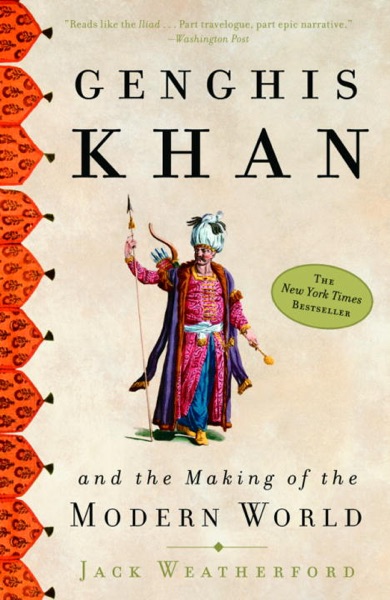
Genghis Khan and the Making of the Modern World by Jack Weatherford is a 2004 history book about conquest and empire, trade and globalization, leadership. Genghis Khan built the largest contiguous land empire in history through military innovation, institutional design, and a merit-based leadership structure that defied birth-order aristocracy.
Summary
Jack Weatherford's argument is that Genghis Khan has been badly misread by history. The West received its image of the Mongols through the pen of their enemies — Persian, Chinese, and European chroniclers who described the empire as a wave of savage destruction. Weatherford, an anthropologist who spent years in Mongolia, sets out to recover what the historical record actually shows: that the Mongol Empire created the largest contiguous land empire in history, and in doing so, accelerated trade, law, communication, and cultural exchange across Eurasia in ways that shaped the modern world.
The first part of the book covers Temujin's rise from a kidnapped child and abandoned clan survivor to supreme leader of the Mongol steppe confederation. Weatherford emphasizes the institutional innovations: promotion based on merit rather than birth, religious tolerance across Christian, Buddhist, Muslim, and shamanist subjects, a written legal code, and diplomatic immunity for ambassadors long before those norms existed elsewhere. Genghis Khan was illiterate but systematic. He recruited skilled specialists — engineers, administrators, translators — from conquered populations and put them to work.
The middle section follows the empire's expansion under Genghis and his successors, including the conquest of China, Persia, and Eastern Europe. Weatherford does not minimize the violence — the destruction of cities like Samarkand and Nishapur was catastrophic — but he contextualizes it against the established norms of warfare at the time and argues that the Mongols were often more calculated than purely savage, offering surrender terms and sparing those who submitted. The Pax Mongolica that followed the conquests enabled the first true Eurasian trading network, the movement of plague, paper money, pasta, gunpowder, and printing from one end of the continent to the other.
The final chapters trace Mongol influence on the Renaissance, the plague's demographic catastrophe, and the reason why Genghis Khan's role in world history was systematically written out. The revisionist case is largely persuasive, though Weatherford's enthusiasm for his subject occasionally tips into advocacy. The book is best read as a corrective to received Western narratives rather than a balanced final word.
Talk to Genghis Khan and the Making of the Modern World like its author wrote you back.
Get the ideas that fit your life — not generic summaries.
- Chat with the book
- Audiobook-style main ideas
- Adapts to your life and goals
- Helps you take action
Key takeaways
- 1.
Genghis Khan built the largest contiguous land empire in history through military innovation, institutional design, and a merit-based leadership structure that defied birth-order aristocracy.
- 2.
Religious and ethnic tolerance was official Mongol policy — subjects of any faith could practice freely, a pragmatic stance that made governing a vast polyglot empire possible.
- 3.
The Mongols created the Pax Mongolica, a period of relative peace and open trade routes that enabled unprecedented cultural and material exchange across Eurasia.
- 4.
The Black Death spread from Central Asia to Europe partly via the Mongol trading network — the same infrastructure that connected civilizations also facilitated catastrophic disease transmission.
- 5.
Western historical memory of the Mongols was written almost entirely by their victims and enemies, which explains why the record is so uniformly negative and selective.
- 6.
Genghis Khan formalized diplomatic immunity, free trade agreements, and postal relay systems — administrative innovations that shaped governance long after the empire's collapse.
- 7.
Paper money, gunpowder, printing, and the compass moved from China westward under Mongol rule, reaching Europe in time to enable the Renaissance and the age of exploration.
- 8.
Temujin's childhood — captured, enslaved, abandoned — gave him an unusual perspective on loyalty and ability over lineage. He systematically promoted on merit across ethnic and religious lines.
Discussion questions
Use these on your own, with a book club, or as chat starters in Superbook. Book club version, ready to copy or print →
- 1.
Weatherford argues that Western narratives about the Mongols are shaped entirely by their victims' accounts. How should historians weigh evidence from conquered peoples versus the perspectives of conquerors?
- 2.
Genghis Khan promoted on merit, offered religious tolerance, and formalized trade protections. Does that change how you assess his legacy given the massive violence of his conquests?
- 3.
The Pax Mongolica created the first Eurasian trading network. What parallels do you see between Mongol-era globalization and the kind of globalization we debate today?
- 4.
The Black Death traveled the same routes that enabled trade and cultural exchange. What does that dual nature of connected networks tell us about the costs of openness?
- 5.
Weatherford suggests that the Renaissance was partly downstream of technologies that arrived via Mongol trade routes. How much does origin matter when evaluating a civilization's achievements?
- 6.
Genghis Khan was illiterate but delegated writing and administration to conquered specialists. What does that tell us about the relationship between formal education and effective leadership?
- 7.
The Mongol Empire collapsed partly from internal succession struggles. What structural problems made a merit-based empire built by one extraordinary leader hard to sustain?
- 8.
The book's revisionism about Genghis Khan is fairly explicit. Where does the line sit between legitimate historical correction and romantic rehabilitation of a brutal figure?
- 9.
How would Eurasian history have unfolded differently if the Mongol expansion had stopped at China or Persia? What subsequent events depended on their westward movement?
- 10.
Weatherford spent years researching in Mongolia. How do you think the experience of living in the subject's homeland shapes historical writing, for better or worse?
- 11.
Genghis Khan offered conquered cities a choice: surrender and be spared, resist and be destroyed. Is that a rational policy, a moral one, both, or neither?
- 12.
The book argues that Genghis Khan's role in history was systematically erased. Why would subsequent empires and historians have motivation to minimize that legacy?
Themes
Frequently asked questions
-
Is Genghis Khan and the Making of the Modern World historically accurate?
Mostly yes, though some historians argue Weatherford overstates the Mongols' positive contributions and understates the severity of the destruction. His core thesis — that Western accounts are one-sided and that Mongol administrative innovations were significant — is broadly accepted. The book is revisionist in intent and should be read alongside more balanced accounts.
-
How long is Genghis Khan and the Making of the Modern World?
Around 270 pages of text, which reads in roughly six to seven hours at average pace. The narrative moves quickly and is accessible to general readers with no prior background in Mongol history.
-
What is the central argument of the book?
That Genghis Khan and the Mongol Empire were far more consequential and far more administratively sophisticated than Western history has recognized, and that the trade networks and cultural exchanges the Mongols enabled helped produce the conditions for the Renaissance and the modern world.
-
Who should read this book?
Readers interested in world history, the origins of globalization, or leadership under conditions of radical uncertainty. It's also useful for anyone who wants a corrective to the purely genocidal narrative most Western education provides about the Mongols.
-
What's the most surprising claim in the book?
That paper money, gunpowder, printing, and the compass all passed from China to Europe via the Mongol trade network in time to fuel the Renaissance. The idea that the Mongol conquests are a hidden cause of Europe's early modern transformation is striking and well-supported.
Similar books
Sapiens: A Brief History of Humankind
Yuval Noah Harari
Guns, Germs, and Steel
Jared Diamond
1491: New Revelations of the Americas Before Columbus
Charles C. Mann
The Silk Roads: A New History of the World
Peter Frankopan
