Biography · Book club
Genius Makers book club questions
Here are 12 book club questions for Genius Makers by Cade Metz, ordered to open easily and end somewhere worth arguing about. Copy them, print them, or bring them up one at a time.
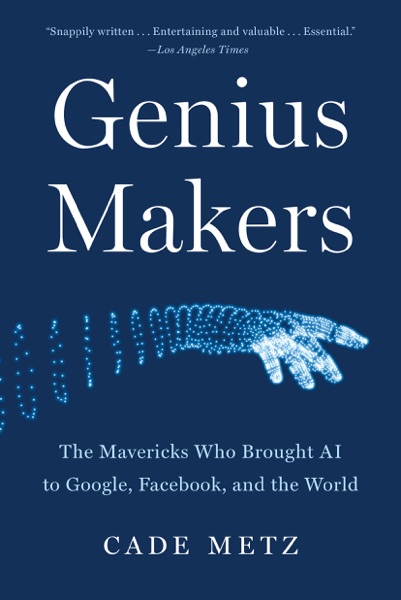
Genius Makers is New York Times technology reporter Cade Metz's account of the people who built modern artificial intelligence — primarily the deep learning revolution that ran from roughly 2009 to 2020.
Cade Metz · 2021 · 6h 15m
Full summary and key takeaways →The 12 questions
- 1.
The book portrays Hinton, Bengio, and LeCun as researchers who held a minority view for decades and were eventually vindicated. What does this suggest about how scientific communities evaluate heterodox ideas?
- 2.
OpenAI's founding premise was that safety-focused researchers should lead the frontier. By the time of the book's publication, that premise was already under strain. What went wrong?
- 3.
Several researchers in the book express genuine concern about the systems they're building while continuing to build them. How do you read that — as cognitive dissonance, or as a rational response to a collective action problem?
- 4.
Google's acquisition of DeepMind removed a potentially independent research institution from the landscape. What might a world look like where frontier AI research stayed outside of big tech?
- 5.
The book describes an arms race between Google, Facebook, and OpenAI that drove both acceleration and risk. What structural changes would be needed to slow that race without conceding ground to less safety-conscious actors?
- 6.
Metz shows that concerns about AI bias and military applications were raised internally at multiple labs and repeatedly overridden. Who or what has the leverage to change that pattern?
- 7.
The 'genius makers' of the title are overwhelmingly male and mostly from a handful of elite universities. What does the demographic homogeneity of the field tell us about how it developed?
- 8.
The book ends in roughly 2020. How much has the picture changed since then — and does it change the moral of Metz's story?
- 9.
Hinton later became one of AI's most prominent public critics. Does his earlier role as a core builder of the technology affect how you weigh his warnings?
- 10.
The compute threshold for competitive AI research has made it effectively impossible for academic labs to keep pace with corporate ones. What are the consequences of that shift for the field?
- 11.
Metz is a reporter, not a technologist. Do you think that shapes what the book gets right and what it gets wrong?
- 12.
If you were advising a young researcher deciding between an academic career and a frontier AI lab, what would you tell them — and what does the book tell you about that choice?
How to run the discussion
- Pick six to eight, not all of them. An hour of real discussion covers fewer questions than anyone expects, and racing the list is what makes a book club feel like homework.
- Open with what people noticed, not what they concluded. Asking for a verdict first hardens opinions before anyone has heard each other.
- Let the disagreement run. The questions below that split a room are the ones worth the time; the ones everyone answers the same way can be skipped.
- Ask the quiet person a specific question. A direct, narrow question is far easier to answer than an open invitation to contribute.
Themes worth steering toward
If the conversation stalls, these are the threads that usually restart it.
Common questions
What are good book club questions for Genius Makers?
Here are 12 book club questions for Genius Makers by Cade Metz, ordered to open easily and end somewhere worth arguing about. The strongest openers ask what each reader noticed rather than what they concluded, and the discussion usually turns on artificial intelligence, tech industry competition, scientific ambition.
How long should a book club discussion of Genius Makers last?
Most groups run 60 to 90 minutes of actual discussion. That is roughly six to eight questions, not all of them, so pick the ones that suit your group rather than working down the list in order.
What are the main themes in Genius Makers?
Artificial intelligence, Tech industry competition, Scientific ambition, Ethics in technology, Deep learning. Those are the threads most likely to divide a room, which makes them the useful places to steer a discussion that has gone quiet.
Picking the next one? See books like Genius Makers or questions for other book club picks.
