Biography · Book club
Genius: The Life and Science of Richard Feynman book club questions
Here are 12 book club questions for Genius: The Life and Science of Richard Feynman by James Gleick, ordered to open easily and end somewhere worth arguing about. Copy them, print them, or bring them up one at a time.
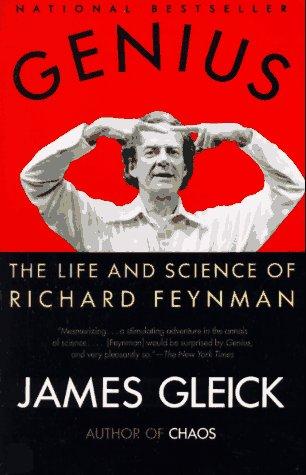
Genius is James Gleick's biography of Richard Feynman, the Nobel Prize-winning physicist who developed quantum electrodynamics, cracked safes at Los Alamos, played bongo drums in bars, and became the twentieth century's most celebrated scientific personality.
James Gleick · 1992 · 11h 45m
Full summary and key takeaways →The 12 questions
- 1.
Gleick suggests Feynman's genius lay partly in his refusal to simply accept established results. Is that skeptical approach universally useful or only valuable in certain scientific contexts?
- 2.
Feynman worked through graduate school at MIT and then Princeton during the Depression. How does historical context — the Depression, World War II, the Cold War — shape the science in this book?
- 3.
How do you evaluate Feynman's relationship with women as Gleick describes it? Does separating the science from the person seem possible or necessary?
- 4.
His father gave him a deep love of inquiry and his own way of seeing the world. What does that relationship suggest about how scientific curiosity is formed?
- 5.
Feynman claimed he learned best by deriving things himself rather than reading others' work. Is that a replicable learning strategy or a feature of an unusual mind?
- 6.
The Challenger investigation made Feynman famous to a new generation as someone willing to challenge NASA bureaucracy. How do institutional pressures typically distort expert judgment?
- 7.
Feynman won the Nobel Prize for work done in his mid-twenties. Did his later career match the promise of that early work, or is there a pattern of declining productivity after early genius?
- 8.
The book covers Feynman diagrams in some detail. Before reading, had you encountered them? What makes a scientific tool like that genuinely useful?
- 9.
Gleick distinguishes Feynman from Julian Schwinger, who developed an equivalent but more abstract formalism. What decided which approach physicists adopted?
- 10.
Feynman was famously skeptical of philosophy and of using words rather than mathematics to describe physics. Is that skepticism justified or limiting?
- 11.
Several of Feynman's own books — including Surely You're Joking, Mr. Feynman! — are also widely read. How does the biography differ in its portrait from the self-portrait?
- 12.
What does Gleick seem to admire most about Feynman, and what does he seem to find troubling?
How to run the discussion
- Pick six to eight, not all of them. An hour of real discussion covers fewer questions than anyone expects, and racing the list is what makes a book club feel like homework.
- Open with what people noticed, not what they concluded. Asking for a verdict first hardens opinions before anyone has heard each other.
- Let the disagreement run. The questions below that split a room are the ones worth the time; the ones everyone answers the same way can be skipped.
- Ask the quiet person a specific question. A direct, narrow question is far easier to answer than an open invitation to contribute.
Themes worth steering toward
If the conversation stalls, these are the threads that usually restart it.
Common questions
What are good book club questions for Genius: The Life and Science of Richard Feynman?
Here are 12 book club questions for Genius: The Life and Science of Richard Feynman by James Gleick, ordered to open easily and end somewhere worth arguing about. The strongest openers ask what each reader noticed rather than what they concluded, and the discussion usually turns on physics, scientific genius, quantum electrodynamics.
How long should a book club discussion of Genius: The Life and Science of Richard Feynman last?
Most groups run 60 to 90 minutes of actual discussion. That is roughly six to eight questions, not all of them, so pick the ones that suit your group rather than working down the list in order.
What are the main themes in Genius: The Life and Science of Richard Feynman?
Physics, Scientific genius, Quantum electrodynamics, Curiosity, American science. Those are the threads most likely to divide a room, which makes them the useful places to steer a discussion that has gone quiet.
Picking the next one? See books like Genius: The Life and Science of Richard Feynman or questions for other book club picks.
