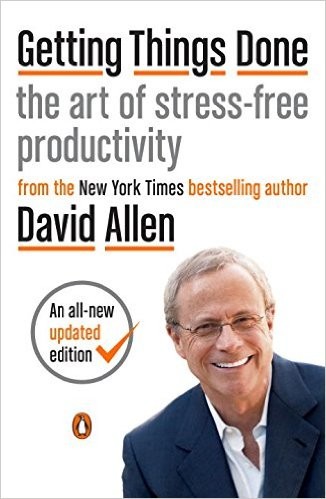
Talk to Getting Things Done like its author wrote you back.
Get the ideas that fit your life — not generic summaries.
- Chat with the book
- Audiobook-style main ideas
- Adapts to your life and goals
- Helps you take action
What it argues
Getting Things Done is David Allen's argument that the main source of stress in modern knowledge work isn't the volume of tasks — it's having commitments that live only in your head. When your brain is trying to remember everything it also needs to do, it can't focus on what it's actually doing. The fix Allen proposes is deceptively simple: get everything out of your head and into a trusted external system. From that moment on, your mind is free to think rather than to track.
The core of the GTD method is a five-step workflow: capture, clarify, organize, reflect, and engage. Capture means collecting every open loop — every task, idea, and commitment — into inboxes you process regularly. Clarify means deciding, for each item, what it actually is and what, if anything, you need to do about it. The two-minute rule applies here: if an action takes less than two minutes, do it immediately. Organize means sorting everything into the right lists — a next actions list, a projects list, a waiting-for list, a someday-maybe list. Reflect means reviewing your system weekly so it stays current and trustworthy. Engage means choosing what to work on with full attention, because the system has already done the triage.
What it gets right
- 1.
The mind is for having ideas, not for holding them. Every open loop you store mentally degrades your ability to focus on the task in front of you.
- 2.
The five-step workflow — capture, clarify, organize, reflect, engage — gives every incoming commitment a defined path so nothing slips through and nothing clutters your attention.
- 3.
The two-minute rule: if an action takes less than two minutes, do it immediately rather than adding it to a list. The overhead of tracking it costs more than doing it.
What it covers
Who wrote it
David Allen is an American productivity consultant who developed the Getting Things Done methodology over decades of coaching executives and knowledge workers. He founded the David Allen Company and has advised organizations ranging from Fortune 500 firms to governments. Allen has written several follow-up books including Ready for Anything and Making It All Work, and he has updated GTD in a revised second edition (2015) to reflect digital workflows. He is widely credited with influencing a generation of productivity software, from OmniFocus to Notion.
