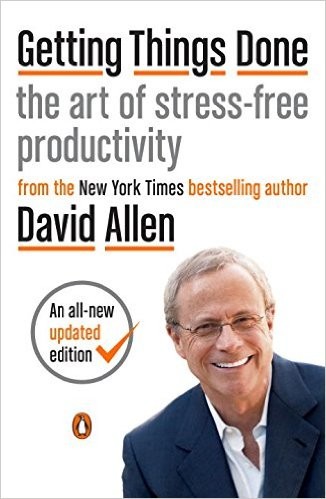
Getting Things Done by David Allen is a 2001 self-help book about productivity, organization, stress reduction. The mind is for having ideas, not for holding them. Every open loop you store mentally degrades your ability to focus on the task in front of you.
Summary
Getting Things Done is David Allen's argument that the main source of stress in modern knowledge work isn't the volume of tasks — it's having commitments that live only in your head. When your brain is trying to remember everything it also needs to do, it can't focus on what it's actually doing. The fix Allen proposes is deceptively simple: get everything out of your head and into a trusted external system. From that moment on, your mind is free to think rather than to track.
The core of the GTD method is a five-step workflow: capture, clarify, organize, reflect, and engage. Capture means collecting every open loop — every task, idea, and commitment — into inboxes you process regularly. Clarify means deciding, for each item, what it actually is and what, if anything, you need to do about it. The two-minute rule applies here: if an action takes less than two minutes, do it immediately. Organize means sorting everything into the right lists — a next actions list, a projects list, a waiting-for list, a someday-maybe list. Reflect means reviewing your system weekly so it stays current and trustworthy. Engage means choosing what to work on with full attention, because the system has already done the triage.
Allen's central claim is that the weekly review is the hinge the whole system swings on. Without it, lists go stale, the system stops being trusted, and the brain reverts to trying to hold everything again. The review is also where you step back from individual tasks and ask whether your projects are still aligned with your goals. Allen organizes this kind of altitude review across five levels: individual actions, current projects, areas of responsibility, multi-year goals, and long-term purpose. Most people, he argues, spend almost all their time at the lowest altitude.
GTD is denser with mechanics than most productivity books, and that's both its strength and its limitation. Readers who want a philosophy will find the system somewhat neutral about values — Allen doesn't tell you what to work on, only how to work on it reliably. The book is also dated in places: it was written for paper-based systems and pre-smartphone inboxes, and while the second edition (2015) updated the language, some examples still feel anachronistic. None of that undermines the core insight. The feeling Allen describes — a clear mind, a trusted list, full presence on the current task — remains one of the most useful ideas in the productivity literature.
Talk to Getting Things Done like its author wrote you back.
Get the ideas that fit your life — not generic summaries.
- Chat with the book
- Audiobook-style main ideas
- Adapts to your life and goals
- Helps you take action
Key takeaways
- 1.
The mind is for having ideas, not for holding them. Every open loop you store mentally degrades your ability to focus on the task in front of you.
- 2.
The five-step workflow — capture, clarify, organize, reflect, engage — gives every incoming commitment a defined path so nothing slips through and nothing clutters your attention.
- 3.
The two-minute rule: if an action takes less than two minutes, do it immediately rather than adding it to a list. The overhead of tracking it costs more than doing it.
- 4.
Projects are any outcome requiring more than one action step. Most people underestimate how many projects they have, which means they also underestimate how many next actions they owe themselves.
- 5.
The weekly review is the linchpin of the system. Without a regular pass through your lists, they go stale, the system loses your trust, and the mental load returns.
- 6.
Next actions must be concrete physical steps, not vague intentions. 'Call Sarah about the Q3 budget' gets done. 'Deal with Q3 budget' does not.
- 7.
The someday-maybe list captures ideas you don't want to act on now but don't want to lose. Parking them there closes the loop without committing to them.
- 8.
Allen's altitude model asks you to zoom out periodically from individual tasks to projects, areas of responsibility, multi-year goals, and long-term purpose. Most people operate almost entirely at task level.
Discussion questions
Use these on your own, with a book club, or as chat starters in Superbook. Book club version, ready to copy or print →
- 1.
How many open loops are currently living in your head rather than a trusted system? What does it cost you to keep them there?
- 2.
Allen says the weekly review is the hinge the entire system swings on. Have you ever tried a weekly review consistently? What broke it down for you?
- 3.
The two-minute rule sounds trivial, but many people resist it. What kinds of small tasks do you tend to defer even when they'd take less than two minutes?
- 4.
Allen distinguishes between next actions and projects. Pick a 'task' on your current list. Is it actually a project in disguise? What's the real next physical action?
- 5.
What's your current capture system? Does it cover all the places commitments arrive in your life, or are there channels that reliably fall through the cracks?
- 6.
The someday-maybe list is where good ideas go when you can't act on them now. What's been on your mental someday-maybe list for years that you've never written down?
- 7.
Allen argues the system works only if you trust it completely, and you only trust it if you review it regularly. Which comes first for you — trust or discipline?
- 8.
GTD is neutral about values. It will help you execute whatever you've decided to work on more reliably. Is there a risk that it makes you more efficient at the wrong things?
- 9.
Allen's altitude model — tasks, projects, goals, purpose — asks you to operate at multiple levels. At which level do you spend almost no time? What would it take to change that?
- 10.
The book was written before smartphones. How has your capture system adapted, or failed to adapt, to the number of inboxes modern life creates?
- 11.
Think of a time when your system broke down and the mental load returned. What triggered it, and how long did it take to recover?
- 12.
Some people find GTD liberating; others find it feels like maintenance overhead that costs more than it saves. Which camp do you fall into, and why?
Themes
Frequently asked questions
-
Is Getting Things Done still worth reading?
Yes, with some patience for dated examples. The core insight — that your brain is not a reliable storage system and suffers when you use it as one — holds as well in 2026 as it did in 2001. The mechanics around paper tickler files and physical inboxes feel anachronistic, but the underlying workflow translates cleanly to modern tools.
-
How long does it take to read Getting Things Done?
Roughly four to five hours for the 352-page book at average reading pace. The first third, which lays out the theory and the five-step workflow, is the most important. Many readers find they get the core ideas by chapter six and treat the rest as reference material.
-
What is the GTD method in plain terms?
Write down every commitment, task, and open loop in one place. Decide what each one means and what the next physical action is. Organize everything into the right lists. Review those lists weekly. Then work from them with a clear head. The system's value is that it moves decisions out of your head and into a trusted external process.
-
Who should read Getting Things Done?
Knowledge workers whose job involves managing many simultaneous projects, or anyone who ends the day feeling busy but uncertain whether the important things got done. Less useful if your work is primarily reactive and externally paced — shift workers, most customer-facing roles — where what to do next is determined by incoming demand rather than personal judgment.
-
What's the single most useful idea in Getting Things Done?
The distinction between a next action and a project. If you look at your to-do list and most items are vague nouns ('budget', 'doctor', 'presentation'), you're storing projects rather than actions, and those items will never get done because there's no clear physical step attached to them. Rewriting each item as a concrete verb changes that.