History · Book club
Ghost Soldiers: The Forgotten Epic Story of World War II's Most Dramatic Mission book club questions
Here are 12 book club questions for Ghost Soldiers: The Forgotten Epic Story of World War II's Most Dramatic Mission by Hampton Sides, ordered to open easily and end somewhere worth arguing about. Copy them, print them, or bring them up one at a time.
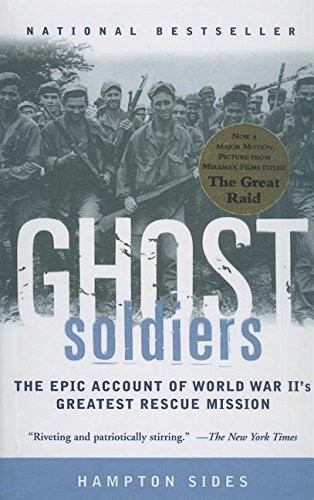
Ghost Soldiers tells the story of the January 1945 raid on the Cabanatuan prisoner-of-war camp in the Philippines — a mission to rescue 513 American and Allied prisoners, survivors of the Bataan Death March, before the retreating Japanese army could execute them.
Hampton Sides · 2001 · 6h 45m
Full summary and key takeaways →The 12 questions
- 1.
The prisoners developed elaborate social structures and moral codes inside the camp. What do you think those structures preserved, and what did they cost the men who lived under them?
- 2.
Filipino civilians took enormous risks to help American prisoners and the rescue mission. How should we weigh their contribution against the way postwar narratives — and the book's title — center American soldiers?
- 3.
The decision to launch the raid was made on limited intelligence and with significant uncertainty. How do military commanders — or any leader — decide when imperfect information is enough to act?
- 4.
Sides reconstructs individual experiences of the Death March in detail. What ethical obligations does a writer have when reconstructing atrocities from survivors' testimony?
- 5.
The Palawan massacre was a major factor in the decision to raid Cabanatuan. How does the prospect of imminent execution change the calculation of risk for a rescue mission?
- 6.
Many of the rescued men were too damaged to recover fully. Does that change how you read the raid — as rescue or as survival of a different kind of ordeal?
- 7.
The rangers and scouts operated with near-total surprise and minimal casualties. When does military success depend on luck rather than skill, and how do we tell the difference in retrospect?
- 8.
Sides notes that the Cabanatuan raid is barely remembered in popular accounts of World War II. Why do you think some military operations become cultural touchstones while others are forgotten?
- 9.
The book traces institutional failures that led to Bataan — bureaucratic delay, inadequate supply, political miscalculation. How do organizational failures and individual heroism coexist in the same event?
- 10.
Have you read other accounts of prisoner-of-war experience? How does the Cabanatuan story compare, and what does it add to your understanding of captivity as a specific form of war?
- 11.
Sides ends with what happened to the survivors after the war. What does that epilogue add to the book's argument, and what does it say about how we talk about trauma and recovery?
- 12.
If this mission had failed, it likely would have been remembered as a reckless gamble. Success defined it as heroism. How should we evaluate decisions that could have gone either way?
How to run the discussion
- Pick six to eight, not all of them. An hour of real discussion covers fewer questions than anyone expects, and racing the list is what makes a book club feel like homework.
- Open with what people noticed, not what they concluded. Asking for a verdict first hardens opinions before anyone has heard each other.
- Let the disagreement run. The questions below that split a room are the ones worth the time; the ones everyone answers the same way can be skipped.
- Ask the quiet person a specific question. A direct, narrow question is far easier to answer than an open invitation to contribute.
Themes worth steering toward
If the conversation stalls, these are the threads that usually restart it.
Common questions
What are good book club questions for Ghost Soldiers: The Forgotten Epic Story of World War II's Most Dramatic Mission?
Here are 12 book club questions for Ghost Soldiers: The Forgotten Epic Story of World War II's Most Dramatic Mission by Hampton Sides, ordered to open easily and end somewhere worth arguing about. The strongest openers ask what each reader noticed rather than what they concluded, and the discussion usually turns on war, survival, leadership.
How long should a book club discussion of Ghost Soldiers: The Forgotten Epic Story of World War II's Most Dramatic Mission last?
Most groups run 60 to 90 minutes of actual discussion. That is roughly six to eight questions, not all of them, so pick the ones that suit your group rather than working down the list in order.
What are the main themes in Ghost Soldiers: The Forgotten Epic Story of World War II's Most Dramatic Mission?
War, Survival, Leadership, Courage, Liberation. Those are the threads most likely to divide a room, which makes them the useful places to steer a discussion that has gone quiet.
Picking the next one? See books like Ghost Soldiers: The Forgotten Epic Story of World War II's Most Dramatic Mission or questions for other book club picks.
