Influence: The Psychology of Persuasion by Robert B. Cialdini is a 1984 psychology book about persuasion, social influence, decision-making. The six principles of influence — reciprocity, commitment, social proof, authority, liking, and scarcity — are cognitive shortcuts that evolved to work, which is why they are so easy to exploit.
Summary
Influence is Robert Cialdini's account of why people say yes, and how that agreement is manufactured. Cialdini spent years studying compliance professionals — salespeople, fundraisers, recruiters, con artists — and identified six principles they reliably exploit: reciprocity, commitment and consistency, social proof, authority, liking, and scarcity. The book's argument is that these principles work not because people are stupid, but because they usually work. They are cognitive shortcuts that evolved to help us navigate a complex world, and that fact is precisely what makes them dangerous when someone else learns to trigger them deliberately.
Each principle gets its own chapter with both the mechanism and the countermeasures. Reciprocity is the obligation to return a favor, even an uninvited one — which is why a free sample is never really free. Commitment and consistency explains why people who sign a small petition are more likely to agree to a larger request later: once we've taken a position, we feel internal pressure to behave consistently with it. Social proof is the tendency to look at what others are doing when we are uncertain what to do ourselves. Authority is the tendency to defer to credentials and titles even when the underlying expertise is absent. Liking explains why a friend's recommendation works better than any advertisement. Scarcity is the pull of "limited time only."
Cialdini is careful to distinguish automatic compliance from conscious agreement. Most of the time the six principles lead us to good decisions — following an authority usually is the sensible move, and social proof is often reliable. The problem arises when someone engineers those triggers artificially. The book's practical goal is to help readers recognize when a weapon of influence is being used against them: when the "scarce" item is not actually rare, when the "authority" is costumed rather than qualified, when the free gift was given precisely because reciprocity is hard to resist.
Influence has held up unusually well for a book nearly four decades old. Cialdini added a seventh principle, unity, in the 2021 revised edition. The prose is accessible, the case studies are drawn from real compliance campaigns, and the frameworks transfer cleanly to modern contexts — digital marketing, dark patterns, political persuasion. The book is most useful as a defensive read: once the six principles are named, they become visible everywhere. The limitation is that Cialdini is documenting the machinery of persuasion, not giving a full account of human judgment. Readers wanting more on the cognitive architecture behind these tendencies will want to follow it with Kahneman.
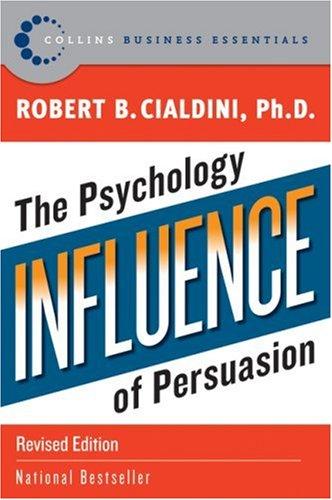
Talk to Influence: The Psychology of Persuasion like its author wrote you back.
Get the ideas that fit your life — not generic summaries.
- Chat with the book
- Audiobook-style main ideas
- Adapts to your life and goals
- Helps you take action
Key takeaways
- 1.
The six principles of influence — reciprocity, commitment, social proof, authority, liking, and scarcity — are cognitive shortcuts that evolved to work, which is why they are so easy to exploit.
- 2.
Reciprocity is powerful even when the gift was uninvited. Free samples, small favors, and holiday cards all activate the same obligation to return something.
- 3.
Commitment and consistency: once people take a small public stand, they feel internal pressure to behave in ways that are consistent with it. The foot-in-the-door technique depends entirely on this.
- 4.
Social proof does the most work when we are uncertain. When people don't know what to do, they look at what others are doing — which is why manufactured consensus is so effective.
- 5.
Authority triggers deference to titles, uniforms, and credentials regardless of whether the underlying expertise is real. The appearance of authority is often enough.
- 6.
Liking scales compliance. We are more easily persuaded by people we find attractive, similar to ourselves, or who have paid us compliments — even when we know this shouldn't be relevant.
- 7.
Scarcity frames value. Items and opportunities feel more desirable when they are described as rare or disappearing, whether or not the scarcity is genuine.
- 8.
The best defense against these principles is recognition. Once you can name the technique being used on you, its automatic power weakens and deliberate evaluation becomes possible.
Discussion questions
Use these on your own, with a book club, or as chat starters in Superbook. Book club version, ready to copy or print →
- 1.
Cialdini argues these principles exploit shortcuts that normally serve us well. Can you think of a recent decision where one of the six principles led you to a genuinely good outcome?
- 2.
Which of the six principles do you think you are most susceptible to, and why?
- 3.
The foot-in-the-door technique uses small commitments to build toward larger ones. Where in your own life have you been moved in a direction you didn't intend by a series of small yeses?
- 4.
Social proof is most powerful under uncertainty. What area of your life right now is most shaped by what the people around you are doing rather than by your own reasoning?
- 5.
Cialdini spent years studying compliance professionals. Does knowing the mechanics of persuasion actually change how you respond to it, or does the automatic reaction still fire?
- 6.
The reciprocity principle creates obligation from uninvited gifts. How do you personally decide when to accept something for free and when to decline because the obligation isn't worth it?
- 7.
Authority shortcuts work even when the authority is costumed rather than real. What credentials or signals of authority do you find hardest to question in practice?
- 8.
The liking principle means physical attractiveness and perceived similarity increase compliance. Is there a professional context in your life where you've seen this play out in ways that concerned you?
- 9.
Scarcity framing — limited time, limited supply — is used constantly in retail, media, and politics. Where outside of shopping do you notice this principle being used most aggressively?
- 10.
Cialdini is writing a defense manual as much as an explanation. Has reading or knowing about these principles actually made you harder to persuade, or just more cynical?
- 11.
The 2021 edition adds unity — shared identity — as a seventh principle. What groups or identities do marketers and politicians use most effectively to trigger compliance in you specifically?
- 12.
If you were designing a process — hiring, fundraising, product launches — and wanted to use these principles ethically, where would you draw the line between persuasion and manipulation?
Themes
Frequently asked questions
-
Is Influence still worth reading in 2026?
Yes. The six principles Cialdini identified in 1984 haven't stopped working — if anything they're more visible in an era of algorithmic feeds, dark patterns, and personalized advertising. The 2021 revised edition adds a seventh principle and updates the examples. It remains one of the most useful single-volume defenses against being manipulated.
-
How long does it take to read Influence?
About six to seven hours at average reading pace for the roughly 320-page book. The chapters are self-contained, so it works well to read one principle at a time and look for examples in your own life before moving to the next.
-
What are the six principles of influence?
Reciprocity, commitment and consistency, social proof, authority, liking, and scarcity. Cialdini added a seventh — unity, or shared identity — in the 2021 revised edition. Each principle is a cognitive shortcut that generally produces good decisions but can be triggered artificially to produce compliance.
-
Who should read Influence?
Anyone who negotiates, sells, manages, markets, or makes significant decisions under social pressure. It's equally useful as a defensive read for people who want to recognize when these techniques are being used on them. It's less useful if you're looking for a broad theory of human judgment — for that, pair it with Kahneman's Thinking, Fast and Slow.
-
What's the most actionable idea in Influence?
Recognition as defense. Cialdini argues that simply naming the technique being used — this is scarcity framing, this is reciprocity pressure — interrupts the automatic compliance response and gives you time to evaluate the actual merits. You don't need to refuse; you need to slow down and decide consciously.
Similar books
Thinking, Fast and Slow
Daniel Kahneman
Predictably Irrational
Dan Ariely
Nudge: Improving Decisions About Health, Wealth, and Happiness
Richard H. Thaler and Cass R. Sunstein
Never Split the Difference
Chris Voss
