Psychology · Book club
Give and Take: Why Helping Others Drives Our Success book club questions
Here are 12 book club questions for Give and Take: Why Helping Others Drives Our Success by Adam Grant, ordered to open easily and end somewhere worth arguing about. Copy them, print them, or bring them up one at a time.
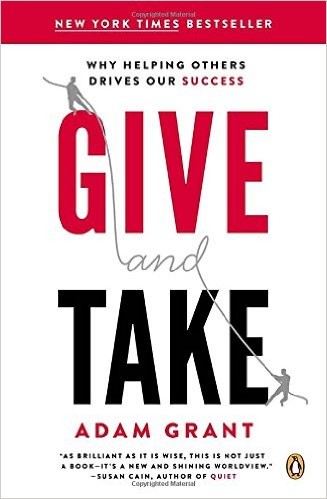
Give and Take is Adam Grant's argument that the least intuitive kind of person — the giver, who helps others without expecting immediate return — actually ends up at the top of most social and professional hierarchies, not just the bottom.
Adam Grant · 2013 · 5h 45m
Full summary and key takeaways →The 12 questions
- 1.
Grant's typology divides people into givers, matchers, and takers. Which do you default to at work? Does that change in personal relationships?
- 2.
The burnout givers and the successful givers both help generously. What distinguishes them in practice?
- 3.
Think of someone you've worked with who was a taker. How did it affect the behavior of people around them?
- 4.
Grant argues that asking for advice creates reciprocity and connection. Is there a current situation where asking for help more explicitly might serve you better than trying to figure it out alone?
- 5.
The five-minute favor — small, low-cost help — is described as disproportionately powerful. What's the equivalent in your professional or personal context?
- 6.
The book claims givers at the bottom of outcomes fail because they give too broadly. Where in your life might selective generosity serve both you and others better than indiscriminate helping?
- 7.
Have you ever experienced the compounding network effect Grant describes — a reputation for generosity opening doors you didn't expect? What generated it?
- 8.
Grant says matchers enforce social norms by punishing takers. Do you see that operating in organizations or communities you're part of?
- 9.
Takers often look like givers in one-on-one interactions. How do you identify them more reliably? What signals do they send when they feel they have nothing to gain?
- 10.
Is there a relationship in your life where you're consistently acting as a matcher because you don't trust the other person? What would change if you shifted?
- 11.
Grant suggests that vulnerability — sharing your needs and struggles — makes you more likely to receive help than projecting competence. Does that hold in your experience?
- 12.
The research shows that givers end up both at the top and the bottom of outcomes. What does it take for a giver to move from the bottom cluster to the top?
How to run the discussion
- Pick six to eight, not all of them. An hour of real discussion covers fewer questions than anyone expects, and racing the list is what makes a book club feel like homework.
- Open with what people noticed, not what they concluded. Asking for a verdict first hardens opinions before anyone has heard each other.
- Let the disagreement run. The questions below that split a room are the ones worth the time; the ones everyone answers the same way can be skipped.
- Ask the quiet person a specific question. A direct, narrow question is far easier to answer than an open invitation to contribute.
Themes worth steering toward
If the conversation stalls, these are the threads that usually restart it.
Common questions
What are good book club questions for Give and Take: Why Helping Others Drives Our Success?
Here are 12 book club questions for Give and Take: Why Helping Others Drives Our Success by Adam Grant, ordered to open easily and end somewhere worth arguing about. The strongest openers ask what each reader noticed rather than what they concluded, and the discussion usually turns on generosity, reciprocity, success.
How long should a book club discussion of Give and Take: Why Helping Others Drives Our Success last?
Most groups run 60 to 90 minutes of actual discussion. That is roughly six to eight questions, not all of them, so pick the ones that suit your group rather than working down the list in order.
What are the main themes in Give and Take: Why Helping Others Drives Our Success?
Generosity, Reciprocity, Success, Networking, Organizational behavior. Those are the threads most likely to divide a room, which makes them the useful places to steer a discussion that has gone quiet.
Picking the next one? See books like Give and Take: Why Helping Others Drives Our Success or questions for other book club picks.
