Economics · Book club
Goliath book club questions
Here are 12 book club questions for Goliath by Matt Stoller, ordered to open easily and end somewhere worth arguing about. Copy them, print them, or bring them up one at a time.
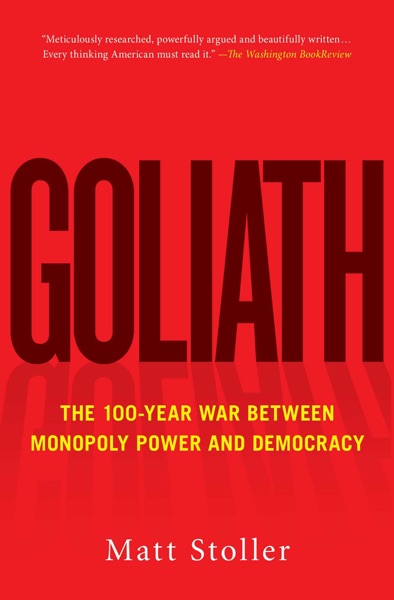
Goliath is Matt Stoller's history of monopoly power in America, arguing that the concentration of corporate power in the late twentieth and early twenty-first centuries is not a novel development but a return to a pattern that Americans once recognized as a fundamental threat to democratic governance — and successfully resisted through antitrust law.
Matt Stoller · 2019 · 8h 45m
Full summary and key takeaways →The 12 questions
- 1.
Stoller argues that the consumer welfare standard is too narrow to capture the harms of monopoly. Do you find the alternative — a broader structural concern about power — convincing as a legal and policy standard?
- 2.
The anti-monopoly tradition Stoller describes was bipartisan. Why does that kind of politics seem harder to sustain today, and what would it take to revive it?
- 3.
The Chicago School revolution happened partly through targeted funding of legal education and judicial appointments. What does that story suggest about how policy change actually works?
- 4.
Think about an industry you know well. Is concentration in that industry a problem, and if so, what kind — price harm, quality reduction, labor market effects, political power, something else?
- 5.
Stoller is sympathetic to the anti-monopoly tradition. Are there places where he understates the benefits of scale economies or network effects that make concentration genuinely efficient?
- 6.
Wright Patman fought big banking for decades and largely lost. What does his story suggest about the relationship between correct analysis and political success?
- 7.
Big Tech platforms are different from old industrial monopolies in significant ways — their services are often free, and their network effects create genuine value. Does antitrust law designed for railroads and oil companies apply to them?
- 8.
Stoller argues that concentration reduces the dignity of work as well as consumer welfare. Is labor market harm a compelling antitrust justification, or should workers' concerns be addressed through separate policy?
- 9.
The book covers a long historical arc. Which period do you think Stoller explains most persuasively, and which feels like a stretch?
- 10.
The language of antitrust shifted from political economy to microeconomics. Does the restoration of political-economy language make the argument stronger or does it risk being dismissed as ideological?
- 11.
What would a serious bipartisan anti-monopoly policy agenda look like today, and what industries would be its primary targets?
- 12.
Stoller's analysis implies that the problem is political will, not missing policy tools. Do you agree, or are there genuine legal and institutional barriers that would need to be rebuilt?
How to run the discussion
- Pick six to eight, not all of them. An hour of real discussion covers fewer questions than anyone expects, and racing the list is what makes a book club feel like homework.
- Open with what people noticed, not what they concluded. Asking for a verdict first hardens opinions before anyone has heard each other.
- Let the disagreement run. The questions below that split a room are the ones worth the time; the ones everyone answers the same way can be skipped.
- Ask the quiet person a specific question. A direct, narrow question is far easier to answer than an open invitation to contribute.
Themes worth steering toward
If the conversation stalls, these are the threads that usually restart it.
Common questions
What are good book club questions for Goliath?
Here are 12 book club questions for Goliath by Matt Stoller, ordered to open easily and end somewhere worth arguing about. The strongest openers ask what each reader noticed rather than what they concluded, and the discussion usually turns on monopoly power, political economy, antitrust.
How long should a book club discussion of Goliath last?
Most groups run 60 to 90 minutes of actual discussion. That is roughly six to eight questions, not all of them, so pick the ones that suit your group rather than working down the list in order.
What are the main themes in Goliath?
Monopoly power, Political economy, Antitrust, Corporate power, American democracy. Those are the threads most likely to divide a room, which makes them the useful places to steer a discussion that has gone quiet.
Picking the next one? See books like Goliath or questions for other book club picks.
