Health · Book club
Good Calories, Bad Calories book club questions
Here are 12 book club questions for Good Calories, Bad Calories by Gary Taubes, ordered to open easily and end somewhere worth arguing about. Copy them, print them, or bring them up one at a time.
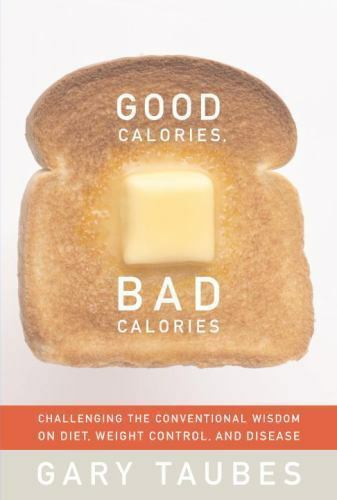
Good Calories, Bad Calories is Gary Taubes's five-hundred-page argument that the conventional wisdom on diet and weight — specifically the idea that fat makes you fat and that eating less while exercising more is the path to weight loss — is not only wrong but has been maintained in the face of decades of contradictory evidence.
Gary Taubes · 2007 · 10h 40m
Full summary and key takeaways →The 12 questions
- 1.
Taubes argues that the scientific consensus on dietary fat was built on weak evidence and defended through institutional pressure. Can you think of other scientific consensuses where the history looks similar?
- 2.
If the carbohydrate-insulin hypothesis is correct, it explains why so many people struggle to lose weight through calorie restriction. Does that reframing of obesity as a hormonal condition rather than a behavioral one change how you think about weight?
- 3.
He argues that eating less and exercising more fails as dietary advice because it ignores hormonal regulation of hunger. Does that match your experience or that of people you know who have tried to lose weight?
- 4.
Taubes spends a lot of time on Ancel Keys's influence on dietary guidelines. Is it concerning that one researcher's advocacy could shape public health policy for decades?
- 5.
The book is long and dense with history and methodology. Did the depth of evidence convince you more than a shorter argument would have, or did you find it overwhelming?
- 6.
Low-fat foods became a major food category partly because of the guidelines Taubes criticizes. What would have to change for dietary guidelines to be revised based on new evidence?
- 7.
Critics of the carbohydrate-insulin hypothesis note that controlled trials have not found the dramatic metabolic advantage that the theory predicts. How does that complicate Taubes's argument?
- 8.
He argues that sugar and refined grains are uniquely harmful in a way that unrefined carbohydrates are not. Is that distinction coherent to you given your own eating?
- 9.
If you could ask one question of the nutritional science establishment, what would it be after reading this book?
- 10.
Taubes's argument implies that decades of low-fat dietary advice may have made Americans sicker. Who bears responsibility for that, if true?
- 11.
What would a properly conducted nutrition trial look like? What are the obstacles to running one?
- 12.
Has the book changed how you think about any food you currently eat or avoid? What would you need to see to act on that change?
How to run the discussion
- Pick six to eight, not all of them. An hour of real discussion covers fewer questions than anyone expects, and racing the list is what makes a book club feel like homework.
- Open with what people noticed, not what they concluded. Asking for a verdict first hardens opinions before anyone has heard each other.
- Let the disagreement run. The questions below that split a room are the ones worth the time; the ones everyone answers the same way can be skipped.
- Ask the quiet person a specific question. A direct, narrow question is far easier to answer than an open invitation to contribute.
Themes worth steering toward
If the conversation stalls, these are the threads that usually restart it.
Common questions
What are good book club questions for Good Calories, Bad Calories?
Here are 12 book club questions for Good Calories, Bad Calories by Gary Taubes, ordered to open easily and end somewhere worth arguing about. The strongest openers ask what each reader noticed rather than what they concluded, and the discussion usually turns on nutrition science, obesity, carbohydrates.
How long should a book club discussion of Good Calories, Bad Calories last?
Most groups run 60 to 90 minutes of actual discussion. That is roughly six to eight questions, not all of them, so pick the ones that suit your group rather than working down the list in order.
What are the main themes in Good Calories, Bad Calories?
Nutrition science, Obesity, Carbohydrates, Dietary fat, Scientific consensus. Those are the threads most likely to divide a room, which makes them the useful places to steer a discussion that has gone quiet.
Picking the next one? See books like Good Calories, Bad Calories or questions for other book club picks.
