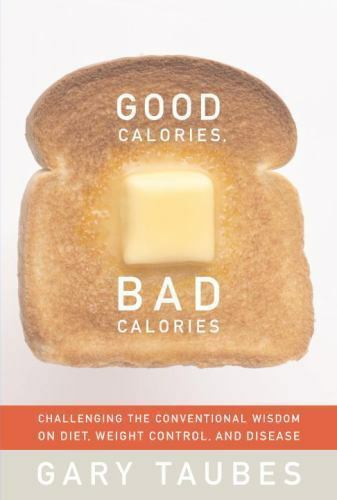
Good Calories, Bad Calories by Gary Taubes is a 2007 health book about nutrition science, obesity, carbohydrates. The carbohydrate-insulin hypothesis proposes that refined carbohydrates and sugar — not dietary fat or total calories — are the primary drivers of obesity and metabolic disease.
Summary
Good Calories, Bad Calories is Gary Taubes's five-hundred-page argument that the conventional wisdom on diet and weight — specifically the idea that fat makes you fat and that eating less while exercising more is the path to weight loss — is not only wrong but has been maintained in the face of decades of contradictory evidence. Taubes is a science journalist who has covered physics, medicine, and nutrition, and the book applies the rigor of a science journalist to a field he argues has been unusually resistant to revising its foundational assumptions.
The book's central thesis is the carbohydrate-insulin hypothesis of obesity: that refined carbohydrates and sugar elevate insulin, insulin directs fat cells to store rather than release energy, and the resulting energy deficit in the rest of the body drives hunger and inactivity rather than the other way around. On this model, the fundamental cause of obesity and the chronic diseases associated with it is not caloric excess but carbohydrate quality. Fat is rehabilitated; sugar and refined grains are indicted.
Taubes spends much of the book in the history of nutritional science, tracing how the lipid hypothesis — that dietary fat causes heart disease — came to dominate medical thinking in the 1950s and 60s through Ancel Keys's advocacy and became entrenched despite weak and contested evidence. He argues that science sociology explains much of the nutritional consensus: careers, institutions, and regulatory agencies were built on the fat hypothesis, making revision enormously costly even as evidence accumulated against it.
The book is demanding. It covers decades of research in detail, often going further into methodology and institutional history than popular science books typically venture. Critics note that Taubes is selective in his own evidence presentation — the carbohydrate-insulin hypothesis has since been tested directly in controlled trials and the results have been more modest than his thesis implies. But the historical critique — that the fat hypothesis was adopted prematurely and defended too confidently — has held up better. The book's core contribution is not a settled answer to the diet question but a compelling account of how nutritional science went wrong.
Talk to Good Calories, Bad Calories like its author wrote you back.
Get the ideas that fit your life — not generic summaries.
- Chat with the book
- Audiobook-style main ideas
- Adapts to your life and goals
- Helps you take action
Key takeaways
- 1.
The carbohydrate-insulin hypothesis proposes that refined carbohydrates and sugar — not dietary fat or total calories — are the primary drivers of obesity and metabolic disease.
- 2.
Insulin regulates fat storage: when insulin is elevated by refined carbohydrate consumption, fat cells preferentially store energy, creating a deficit that drives hunger independent of how much has been eaten.
- 3.
The lipid hypothesis — that dietary fat causes heart disease — was promoted by Ancel Keys based on data that was selectively chosen and vigorously defended against contradictory evidence.
- 4.
Low-fat dietary guidelines in the United States were implemented before the evidence supporting them was established, and the resulting increase in refined carbohydrate consumption may have worsened the obesity and diabetes epidemics.
- 5.
Nutritional science is structurally prone to premature consensus: funding, career incentives, and institutional momentum can entrench hypotheses that would not survive more rigorous scrutiny.
- 6.
Exercise does not appear to produce meaningful weight loss in most people, and the conventional advice to eat less and move more fails to account for the hormonal regulation of hunger and energy expenditure.
- 7.
Traditional diets that were largely animal-based and low in refined carbohydrates — including Arctic indigenous diets — produced little of the chronic disease associated with Western eating patterns.
- 8.
The evidence that saturated fat causes heart disease is far weaker than public health messaging has implied; the substitution of carbohydrates for fat in the American diet may have been a net harm.
Discussion questions
Use these on your own, with a book club, or as chat starters in Superbook. Book club version, ready to copy or print →
- 1.
Taubes argues that the scientific consensus on dietary fat was built on weak evidence and defended through institutional pressure. Can you think of other scientific consensuses where the history looks similar?
- 2.
If the carbohydrate-insulin hypothesis is correct, it explains why so many people struggle to lose weight through calorie restriction. Does that reframing of obesity as a hormonal condition rather than a behavioral one change how you think about weight?
- 3.
He argues that eating less and exercising more fails as dietary advice because it ignores hormonal regulation of hunger. Does that match your experience or that of people you know who have tried to lose weight?
- 4.
Taubes spends a lot of time on Ancel Keys's influence on dietary guidelines. Is it concerning that one researcher's advocacy could shape public health policy for decades?
- 5.
The book is long and dense with history and methodology. Did the depth of evidence convince you more than a shorter argument would have, or did you find it overwhelming?
- 6.
Low-fat foods became a major food category partly because of the guidelines Taubes criticizes. What would have to change for dietary guidelines to be revised based on new evidence?
- 7.
Critics of the carbohydrate-insulin hypothesis note that controlled trials have not found the dramatic metabolic advantage that the theory predicts. How does that complicate Taubes's argument?
- 8.
He argues that sugar and refined grains are uniquely harmful in a way that unrefined carbohydrates are not. Is that distinction coherent to you given your own eating?
- 9.
If you could ask one question of the nutritional science establishment, what would it be after reading this book?
- 10.
Taubes's argument implies that decades of low-fat dietary advice may have made Americans sicker. Who bears responsibility for that, if true?
- 11.
What would a properly conducted nutrition trial look like? What are the obstacles to running one?
- 12.
Has the book changed how you think about any food you currently eat or avoid? What would you need to see to act on that change?
Themes
Frequently asked questions
-
Is Good Calories, Bad Calories still relevant?
Yes, primarily for its historical argument. The claim that the low-fat dietary consensus was built on weak evidence and institutional inertia is well-supported and has held up. The specific carbohydrate-insulin hypothesis of obesity is more contested — controlled trials have been more ambiguous than Taubes anticipated. The book is a necessary corrective to overconfident dietary science even if it overcorrects in its own direction.
-
What is the core argument of Good Calories, Bad Calories?
That refined carbohydrates and sugar, not dietary fat, drive obesity and metabolic disease through insulin-mediated fat storage, and that the low-fat dietary consensus that dominated medicine for decades was built on prematurely adopted and poorly tested evidence.
-
Is Good Calories, Bad Calories worth reading if you're not a scientist?
Potentially, but it demands patience. At over five hundred pages and dense with epidemiological and institutional history, it is not a casual read. Why We Get Fat covers the same core argument in a shorter and more accessible format. Read that first if you want to evaluate the thesis before committing to the full work.
-
Has the carbohydrate-insulin hypothesis been proven?
No, and subsequent controlled trials have produced more modest results than the theory predicts. The strongest recent test — by Kevin Hall at the NIH — found no significant metabolic advantage for low-carbohydrate diets when calories are matched. The debate continues, but the simple version of the hypothesis appears overstated.
-
Who should read Good Calories, Bad Calories?
Readers who want a serious historical and scientific account of how dietary guidelines went wrong. Also useful for anyone interested in how scientific consensus forms and resists revision. Not useful as a practical dietary guide — for that, Taubes's Why We Get Fat or The Case Against Sugar are more accessible.