Fantasy · Book club
Good Omens book club questions
Here are 12 book club questions for Good Omens by Terry Pratchett & Neil Gaiman, ordered to open easily and end somewhere worth arguing about. Copy them, print them, or bring them up one at a time.
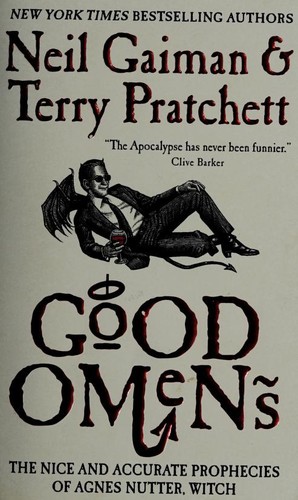
Good Omens is a comic fantasy novel about the impending apocalypse and the attempts of an angel and a demon — Aziraphale and Crowley, who have been stationed on Earth since the Beginning — to prevent it.
Terry Pratchett & Neil Gaiman · 1990 · 9h 0m
Full summary and key takeaways →The 12 questions
- 1.
Aziraphale and Crowley have been at cross-purposes for six thousand years and ended up, functionally, on the same side. What does the novel suggest about the relationship between institutional loyalty and personal values?
- 2.
Both Heaven and Hell want the war to happen. What does the novel imply about why institutions sometimes need conflict even when it's against their stated purpose?
- 3.
Adam has the power to rebuild the world according to his whims and instead chooses to leave it as it is. Is that a conservative choice, a radical one, or something else?
- 4.
The book is a comedy, but its central emotional investment — Aziraphale and Crowley's friendship — is sincere. Did the tonal mixture work for you? Is there anything the comedy prevents the novel from doing?
- 5.
The witchfinder Shadwell and the medium Madame Tracy are comic characters who nonetheless drive the plot's emotional resolution. What does their story add to the novel's argument about ordinary people versus cosmic forces?
- 6.
Pratchett and Gaiman both claim they can barely remember who wrote what. Does the collaboration feel seamless to you, or can you detect different registers?
- 7.
The novel's treatment of Aziraphale and Crowley has been read as queerness by most modern readers and most definitively by the Amazon adaptation. Does making that explicit change how the novel works?
- 8.
The prophecies of Agnes Nutter are presented as perfectly accurate but perfectly useless because no one can interpret them until after the fact. What does that device say about the relationship between prophecy and free will?
- 9.
Compare the novel's theological argument — that the agents of good and evil cannot know God's actual plan — with a book like C.S. Lewis's The Screwtape Letters, which makes a different use of the same territory. What does each book think theology is for?
- 10.
The environmental subplot — the Horseman Pollution replacing Pestilence — lands quite differently in 2026 than it would have in 1990. Has the novel's satire aged into something more serious? Does that improve or complicate it?
- 11.
The Antichrist is raised to be a normal English boy and turns out to have normal English values. Is the novel arguing that ordinary human values are good enough, or is it saying something more specific about childhood and moral formation?
- 12.
Good Omens is frequently compared to Douglas Adams's Hitchhiker's Guide in terms of comic register. Where do they overlap, and where is Pratchett and Gaiman's sensibility different?
How to run the discussion
- Pick six to eight, not all of them. An hour of real discussion covers fewer questions than anyone expects, and racing the list is what makes a book club feel like homework.
- Open with what people noticed, not what they concluded. Asking for a verdict first hardens opinions before anyone has heard each other.
- Let the disagreement run. The questions below that split a room are the ones worth the time; the ones everyone answers the same way can be skipped.
- Ask the quiet person a specific question. A direct, narrow question is far easier to answer than an open invitation to contribute.
Themes worth steering toward
If the conversation stalls, these are the threads that usually restart it.
Common questions
What are good book club questions for Good Omens?
Here are 12 book club questions for Good Omens by Terry Pratchett & Neil Gaiman, ordered to open easily and end somewhere worth arguing about. The strongest openers ask what each reader noticed rather than what they concluded, and the discussion usually turns on free will and destiny, good versus evil, friendship across difference.
How long should a book club discussion of Good Omens last?
Most groups run 60 to 90 minutes of actual discussion. That is roughly six to eight questions, not all of them, so pick the ones that suit your group rather than working down the list in order.
What are the main themes in Good Omens?
Free will and destiny, Good versus evil, Friendship across difference, Bureaucracy and absurdity, Humanity and what it means. Those are the threads most likely to divide a room, which makes them the useful places to steer a discussion that has gone quiet.
Picking the next one? See books like Good Omens or questions for other book club picks.
