Business · Book club
Good Strategy Bad Strategy book club questions
Here are 12 book club questions for Good Strategy Bad Strategy by Richard Rumelt, ordered to open easily and end somewhere worth arguing about. Copy them, print them, or bring them up one at a time.
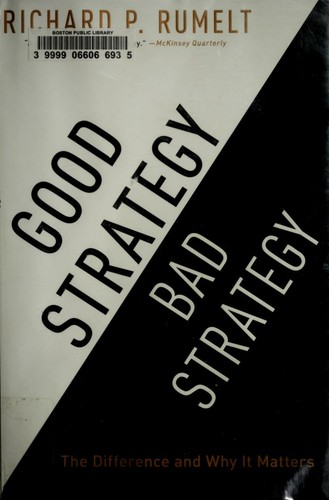
Good Strategy Bad Strategy is Richard Rumelt's indictment of the strategic planning process as it is practiced in most organizations, and his articulation of what genuine strategy actually requires.
Richard Rumelt · 2011 · 6h 20m
Full summary and key takeaways →The 12 questions
- 1.
Rumelt identifies four hallmarks of bad strategy: fluff, failure to face the challenge, goals mistaken for strategy, and bad strategic objectives. Which of these do you see most often in organizations you know?
- 2.
Apply Rumelt's kernel — diagnosis, guiding policy, coherent actions — to a strategic decision you've seen recently. Were all three elements present? What was missing?
- 3.
Why is diagnosis so often skipped or rushed in strategic planning? What organizational pressures push teams to jump from challenge to solution?
- 4.
Rumelt says strategy requires making choices that rule things out. What does a company lose — politically, emotionally, practically — when it makes a real strategic choice?
- 5.
Can an organization have too much strategic coherence? What happens when the guiding policy is correct but every action is too tightly aligned to it?
- 6.
Rumelt argues that the strategic planning process itself generates bad strategy because it invites everyone to contribute goals rather than forcing diagnosis. How would you redesign a typical planning cycle to produce better strategy?
- 7.
What's the difference between a guiding policy and a mission statement? Why does one guide action and the other often doesn't?
- 8.
Rumelt's Apple and Nvidia case studies show strategies that worked because they bet on specific technical advantages. How do you identify a genuine leverage point before its value is proven?
- 9.
He is critical of academic strategy frameworks, including aspects of Porter's Five Forces. Do you agree that they sometimes substitute analysis for thinking? What would you add or change?
- 10.
What is proximate versus distant objectives in Rumelt's framework, and how do you calibrate the right level of ambition in strategic objectives?
- 11.
Military strategy features prominently in the book. What transfers cleanly from military strategy to business strategy, and where does the analogy break down?
- 12.
If you had to write a one-page strategy for something you care about right now — a company, a project, your career — using Rumelt's kernel, what would your diagnosis be?
How to run the discussion
- Pick six to eight, not all of them. An hour of real discussion covers fewer questions than anyone expects, and racing the list is what makes a book club feel like homework.
- Open with what people noticed, not what they concluded. Asking for a verdict first hardens opinions before anyone has heard each other.
- Let the disagreement run. The questions below that split a room are the ones worth the time; the ones everyone answers the same way can be skipped.
- Ask the quiet person a specific question. A direct, narrow question is far easier to answer than an open invitation to contribute.
Themes worth steering toward
If the conversation stalls, these are the threads that usually restart it.
Common questions
What are good book club questions for Good Strategy Bad Strategy?
Here are 12 book club questions for Good Strategy Bad Strategy by Richard Rumelt, ordered to open easily and end somewhere worth arguing about. The strongest openers ask what each reader noticed rather than what they concluded, and the discussion usually turns on strategy, leadership, competition.
How long should a book club discussion of Good Strategy Bad Strategy last?
Most groups run 60 to 90 minutes of actual discussion. That is roughly six to eight questions, not all of them, so pick the ones that suit your group rather than working down the list in order.
What are the main themes in Good Strategy Bad Strategy?
Strategy, Leadership, Competition, Organizational design, Decision-making. Those are the threads most likely to divide a room, which makes them the useful places to steer a discussion that has gone quiet.
Picking the next one? See books like Good Strategy Bad Strategy or questions for other book club picks.
