Business · Book club
Good to Great book club questions
Here are 12 book club questions for Good to Great by Jim Collins, ordered to open easily and end somewhere worth arguing about. Copy them, print them, or bring them up one at a time.
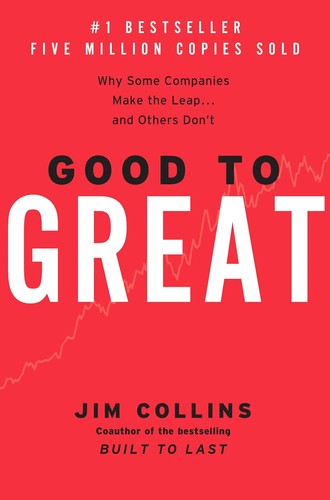
Good to Great is Jim Collins's attempt to answer a deceptively simple question: why do some good companies make the leap to sustained greatness while most don't?
Jim Collins · 2001 · 5h 45m
Full summary and key takeaways →The 12 questions
- 1.
Collins argues that who comes before what — getting the right people precedes setting strategy. In your organization or team, is the sequence actually followed, or does it get inverted?
- 2.
Think of a leader you've worked under or observed closely. Where would you place them on Collins's Level 5 hierarchy, and what evidence leads you there?
- 3.
The Hedgehog Concept asks what you can be best in the world at, not just good at. For your own career, what honest answer do you give to that question?
- 4.
Collins's great companies confronted brutal facts while maintaining faith they would prevail. Is there a brutal fact in your current work life that you're avoiding or softening?
- 5.
The book found that charismatic, celebrity leadership often correlates with short-term results and long-term fragility. Does your own experience confirm or complicate that finding?
- 6.
How would you describe the Flywheel dynamic in a project or initiative you've been part of? At what point did consistent effort start to feel like momentum?
- 7.
Collins says great companies are disciplined about what they stop doing as much as what they start. What's something in your work or life that you should stop doing but haven't?
- 8.
The research found that great companies rarely used large acquisitions to drive their transformations. Why do you think companies reach for acquisitions instead of the slower Flywheel approach?
- 9.
Technology as accelerator, not cause: Collins says great companies adopt new technology selectively, only when it fits their core concept. How does your organization actually make technology decisions?
- 10.
Several companies Collins labeled great — Circuit City, Fannie Mae — later collapsed badly. Does that undermine the book's findings, or does it say something else?
- 11.
If you applied the Hedgehog Concept to your personal career — what you can be best at, what drives your economic engine, and what you're passionate about — where do those three circles actually overlap right now?
- 12.
Collins says good is the enemy of great. Where in your life are you settling for good and telling yourself it's enough?
How to run the discussion
- Pick six to eight, not all of them. An hour of real discussion covers fewer questions than anyone expects, and racing the list is what makes a book club feel like homework.
- Open with what people noticed, not what they concluded. Asking for a verdict first hardens opinions before anyone has heard each other.
- Let the disagreement run. The questions below that split a room are the ones worth the time; the ones everyone answers the same way can be skipped.
- Ask the quiet person a specific question. A direct, narrow question is far easier to answer than an open invitation to contribute.
Themes worth steering toward
If the conversation stalls, these are the threads that usually restart it.
Common questions
What are good book club questions for Good to Great?
Here are 12 book club questions for Good to Great by Jim Collins, ordered to open easily and end somewhere worth arguing about. The strongest openers ask what each reader noticed rather than what they concluded, and the discussion usually turns on leadership, organizational excellence, strategy.
How long should a book club discussion of Good to Great last?
Most groups run 60 to 90 minutes of actual discussion. That is roughly six to eight questions, not all of them, so pick the ones that suit your group rather than working down the list in order.
What are the main themes in Good to Great?
Leadership, Organizational excellence, Strategy, Discipline, Corporate culture. Those are the threads most likely to divide a room, which makes them the useful places to steer a discussion that has gone quiet.
Picking the next one? See books like Good to Great or questions for other book club picks.
