History · Book club
Gulag: A History book club questions
Here are 12 book club questions for Gulag: A History by Anne Applebaum, ordered to open easily and end somewhere worth arguing about. Copy them, print them, or bring them up one at a time.
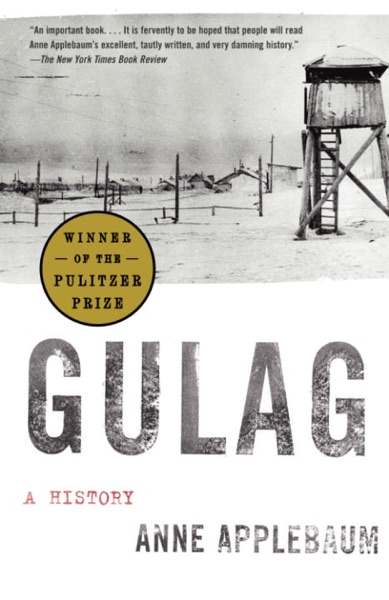
Anne Applebaum's Gulag is the first comprehensive English-language history of the Soviet forced labor camp system, drawing on KGB archives opened briefly after 1991, survivor memoirs, and interviews with former prisoners and guards.
Anne Applebaum · 2003 · 19h 22m
Full summary and key takeaways →The 12 questions
- 1.
Applebaum argues the Gulag was structurally necessary to the Soviet system, not a deviation from it. What implications does that have for how we evaluate Soviet ideology?
- 2.
The arrest campaigns were quota-driven: officials had to arrest a certain number, so they did. What does that reveal about how bureaucratic systems can become instruments of atrocity?
- 3.
Survivor memoirs vary enormously in how they describe life in the camps. What accounts for those differences, and how should historians weigh contradictory testimony?
- 4.
Why did the Gulag receive so much less international attention than the Nazi concentration camps, and do you find any of those reasons defensible?
- 5.
Applebaum traces how memory of the camps was suppressed within the Soviet Union. What happens to a society when it cannot account for mass atrocities in its own recent past?
- 6.
The book documents cultural life inside the camps — performances, poetry, friendship. What does that say about human resilience, and what are its limits?
- 7.
Many foreign communists who went to the Soviet Union out of genuine idealism ended up in the camps. How do you evaluate their political choices in retrospect?
- 8.
The Gulag's economic function was often inefficient — camp labor was less productive than free labor. Why did the system persist even on its own economic terms?
- 9.
What does the history of the Gulag suggest about how warning signs of political repression should be recognized and responded to?
- 10.
Applebaum says the absence of a Russian reckoning with the Gulag has consequences for Russian political culture today. Do you find that argument convincing?
- 11.
Which individual story or episode from the book stayed with you most, and why?
- 12.
How does reading this book change, if at all, how you think about the political movements in your own country that promise radical social transformation?
How to run the discussion
- Pick six to eight, not all of them. An hour of real discussion covers fewer questions than anyone expects, and racing the list is what makes a book club feel like homework.
- Open with what people noticed, not what they concluded. Asking for a verdict first hardens opinions before anyone has heard each other.
- Let the disagreement run. The questions below that split a room are the ones worth the time; the ones everyone answers the same way can be skipped.
- Ask the quiet person a specific question. A direct, narrow question is far easier to answer than an open invitation to contribute.
Themes worth steering toward
If the conversation stalls, these are the threads that usually restart it.
Common questions
What are good book club questions for Gulag: A History?
Here are 12 book club questions for Gulag: A History by Anne Applebaum, ordered to open easily and end somewhere worth arguing about. The strongest openers ask what each reader noticed rather than what they concluded, and the discussion usually turns on soviet history, political repression, totalitarianism.
How long should a book club discussion of Gulag: A History last?
Most groups run 60 to 90 minutes of actual discussion. That is roughly six to eight questions, not all of them, so pick the ones that suit your group rather than working down the list in order.
What are the main themes in Gulag: A History?
Soviet history, Political repression, Totalitarianism, Survival, Memory. Those are the threads most likely to divide a room, which makes them the useful places to steer a discussion that has gone quiet.
Picking the next one? See books like Gulag: A History or questions for other book club picks.
