Science · Book club
Guns, Germs, and Steel book club questions
Here are 12 book club questions for Guns, Germs, and Steel by Jared Diamond, ordered to open easily and end somewhere worth arguing about. Copy them, print them, or bring them up one at a time.
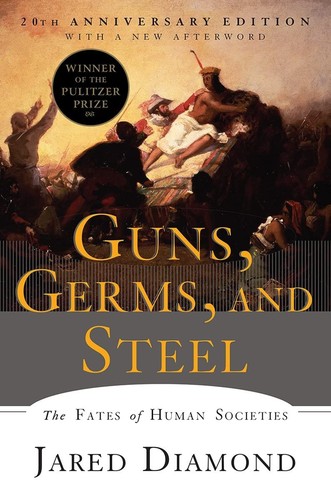
Guns, Germs, and Steel is Jared Diamond's attempt to answer a question posed to him by a Papua New Guinean politician named Yali: why did Europeans end up with so much cargo — wealth, technology, power — while other peoples had comparatively little?
Jared Diamond · 1997 · 11h 15m
Full summary and key takeaways →The 12 questions
- 1.
Diamond argues that geography determined civilizational outcomes more than culture or intelligence. Where does that argument feel most convincing to you, and where does it feel like an oversimplification?
- 2.
Yali's question — why do some people have more cargo than others — still resonates today. How does Diamond's answer change the way you think about modern global inequality?
- 3.
The book claims that if the Americas had been oriented east-west and Eurasia north-south, the direction of conquest might have been reversed. Does that reframing change anything about how you understand history?
- 4.
Diamond separates proximate causes from ultimate causes throughout the book. Pick a major historical event or current pattern of inequality and try to apply that same proximate-versus-ultimate distinction yourself.
- 5.
The argument that germs killed more people than guns in the conquest of the Americas is now widely accepted. What does it mean, morally, that so much destruction was unintentional?
- 6.
Diamond's thesis is environmental and geographic, not cultural. What does the argument leave out that you think matters for explaining why some societies developed the way they did?
- 7.
The fourteen domesticated large mammals were almost all Eurasian. Does knowing that feel satisfying as an explanation, or does it push the question back a level rather than answering it?
- 8.
Historians have criticized Diamond for glossing over the agency of colonized peoples and the specific decisions of colonizers. Is that a fair criticism of a book working at this scale of analysis?
- 9.
Range and Outliers both argue that success depends heavily on circumstance rather than innate talent. How does Diamond's civilizational argument compare to those individual-scale arguments?
- 10.
What aspect of the world you live in today looks different to you after reading this book? Is there anything you'd explain differently now?
- 11.
Diamond spent years in Papua New Guinea and opens the book with Yali's question from that context. How does the choice of starting point shape the argument that follows?
- 12.
The book was published in 1997. What has happened since then — in economics, climate, or technology — that either strengthens or complicates Diamond's framework?
How to run the discussion
- Pick six to eight, not all of them. An hour of real discussion covers fewer questions than anyone expects, and racing the list is what makes a book club feel like homework.
- Open with what people noticed, not what they concluded. Asking for a verdict first hardens opinions before anyone has heard each other.
- Let the disagreement run. The questions below that split a room are the ones worth the time; the ones everyone answers the same way can be skipped.
- Ask the quiet person a specific question. A direct, narrow question is far easier to answer than an open invitation to contribute.
Themes worth steering toward
If the conversation stalls, these are the threads that usually restart it.
Common questions
What are good book club questions for Guns, Germs, and Steel?
Here are 12 book club questions for Guns, Germs, and Steel by Jared Diamond, ordered to open easily and end somewhere worth arguing about. The strongest openers ask what each reader noticed rather than what they concluded, and the discussion usually turns on geography, civilization, evolution of societies.
How long should a book club discussion of Guns, Germs, and Steel last?
Most groups run 60 to 90 minutes of actual discussion. That is roughly six to eight questions, not all of them, so pick the ones that suit your group rather than working down the list in order.
What are the main themes in Guns, Germs, and Steel?
Geography, Civilization, Evolution of societies, Inequality, Domestication. Those are the threads most likely to divide a room, which makes them the useful places to steer a discussion that has gone quiet.
Picking the next one? See books like Guns, Germs, and Steel or questions for other book club picks.
