Science · Book club
Happy City book club questions
Here are 12 book club questions for Happy City by Charles Montgomery, ordered to open easily and end somewhere worth arguing about. Copy them, print them, or bring them up one at a time.
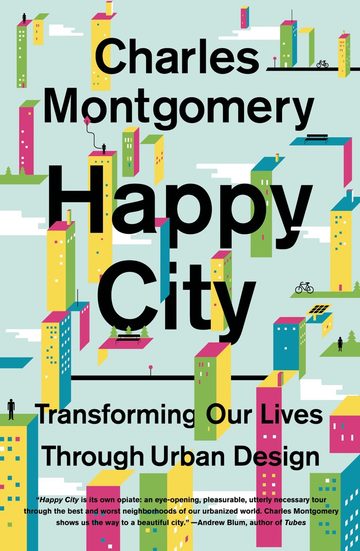
Happy City is Charles Montgomery's investigation into the relationship between the design of cities and the psychological well-being of their inhabitants.
Charles Montgomery · 2013 · 7h 0m
Full summary and key takeaways →The 12 questions
- 1.
Montgomery argues that the daily commute is uniquely resistant to adaptation. Does your own experience confirm or challenge this? What conditions make a commute more or less bearable?
- 2.
Enrique Peñalosa framed public space as a democratic right. Do you think the design of your city reflects a similar belief, or a different set of priorities?
- 3.
The book suggests that car-dependent sprawl was not inevitable but the result of specific political choices in the mid-twentieth century. What would need to change politically for those choices to be revisited now?
- 4.
Montgomery describes weak and strong social ties in urban settings. Which type of connection does your neighborhood support, and what would need to be different to support more of each?
- 5.
The research on walkability and health outcomes is robust. Why do you think that evidence has so little influence on mainstream housing and urban development decisions?
- 6.
Happy City is largely about North American cities. To what extent do its arguments apply to European or Asian urban contexts where car dependence was never as complete?
- 7.
Tactical urbanism — pop-up interventions before permanent change — is one of Montgomery's more actionable suggestions. Have you seen examples in your own city? Did they work?
- 8.
The book argues that the suburbs, as typically built, are bad for happiness. How would you respond to someone who grew up in a suburb and disputes that?
- 9.
Montgomery argues that a long commute is worse for well-being than a pay cut of equivalent economic magnitude. How would you weigh those factors in a job decision?
- 10.
How does Montgomery's framing of urban design as a public health issue change — or not change — how you think about planning disputes in your own community?
- 11.
What is the single change to the street, block, or building where you live that would most improve your daily experience? Is there anything stopping you from pursuing it?
- 12.
The relationship between urban form and greenhouse gas emissions is significant. Does Montgomery make the case for dense, walkable cities compellingly on purely environmental grounds, or does the happiness argument matter more to you?
How to run the discussion
- Pick six to eight, not all of them. An hour of real discussion covers fewer questions than anyone expects, and racing the list is what makes a book club feel like homework.
- Open with what people noticed, not what they concluded. Asking for a verdict first hardens opinions before anyone has heard each other.
- Let the disagreement run. The questions below that split a room are the ones worth the time; the ones everyone answers the same way can be skipped.
- Ask the quiet person a specific question. A direct, narrow question is far easier to answer than an open invitation to contribute.
Themes worth steering toward
If the conversation stalls, these are the threads that usually restart it.
Common questions
What are good book club questions for Happy City?
Here are 12 book club questions for Happy City by Charles Montgomery, ordered to open easily and end somewhere worth arguing about. The strongest openers ask what each reader noticed rather than what they concluded, and the discussion usually turns on urban design, well-being, community.
How long should a book club discussion of Happy City last?
Most groups run 60 to 90 minutes of actual discussion. That is roughly six to eight questions, not all of them, so pick the ones that suit your group rather than working down the list in order.
What are the main themes in Happy City?
Urban design, Well-being, Community, Psychology, Sustainability. Those are the threads most likely to divide a room, which makes them the useful places to steer a discussion that has gone quiet.
Picking the next one? See books like Happy City or questions for other book club picks.
