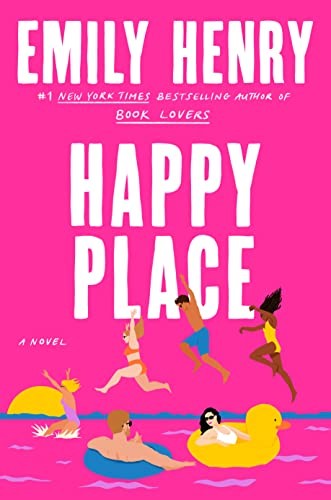
Happy Place by Emily Henry is a 2023 romance book about grief and loss, identity and self-reinvention, relationships and communication. The novel argues that performing wellness for others — friends, partners, parents — is its own kind of self-abandonment, and eventually the performance collapses.
Summary
Harriet and Wyn were the couple everyone else wanted to be. But they broke off their engagement months ago, and neither of them has told their closest friends. Now those friends have gathered one last time at the Maine cottage they've returned to every summer for a decade — a cottage that's about to be sold — and Harriet and Wyn are expected to show up as the couple they no longer are. They agree to pretend. Five days. One bedroom. No one finds out.
The setup sounds like a familiar romantic comedy, but what Emily Henry is actually writing about is more uncomfortable: what happens when you outgrow the life you were supposed to want. Harriet has been performing competence and calm for so long — the brilliant surgical resident, the steady girlfriend, the friend who holds everything together — that she's not entirely sure who she is outside the role. Wyn's arc runs parallel: a man who has learned to make himself smaller, quieter, easier to be around, rather than admit what he actually needs. The pretense they maintain for their friends is also the pretense they've been maintaining with each other.
Henry writes in close third person with a lot of interiority, which suits the material. The Maine cottage is vividly rendered as a place where time slows, where past and present selves coexist uncomfortably, and where the annual ritual of this friend group has become its own kind of pressure. The novel alternates between the present and flashbacks that fill in how the relationship developed and where it cracked. The pacing is deliberate — this is not a breezy beach read despite the setting — and the emotional payoffs feel earned rather than manufactured.
Readers who loved Beach Read or People We Meet on Vacation will find the same wit and emotional intelligence, with perhaps a sharper focus on mental health, identity drift, and what we owe ourselves after spending years being what others need. Those who want plot-driven romance with lighter stakes may find the interior monologue heavy. But for anyone who has ever performed fineness they didn't feel, or stayed somewhere past its expiration date, Happy Place lands with real precision.
Talk to Happy Place like its author wrote you back.
Get the ideas that fit your life — not generic summaries.
- Chat with the book
- Audiobook-style main ideas
- Adapts to your life and goals
- Helps you take action
Key takeaways
- 1.
The novel argues that performing wellness for others — friends, partners, parents — is its own kind of self-abandonment, and eventually the performance collapses.
- 2.
Harriet's arc is about the cost of competence: when you are always the one who holds it together, no one thinks to hold you.
- 3.
The book is interested in what couples owe each other when they've quietly become different people, and whether honesty or kindness is the more loving default.
- 4.
Henry uses the cottage — a place of annual ritual and accumulated memory — to show how the stories we tell about ourselves in groups are often out of date long before we retire them.
- 5.
The flashback structure quietly reframes what looks like a love story into something more like a postmortem: the reader sees what worked and what the couple failed to say.
- 6.
Wyn's learned smallness — the habit of making himself easier, less demanding, less present — is treated as its own kind of wound, not a virtue.
- 7.
The friend group dynamic captures something true about long friendships: they can become a collective fiction that none of the participants feels authorized to revise.
- 8.
Happy Place ultimately argues that grief is not only for the dead — you can grieve a relationship, a version of yourself, a future you believed in.
Discussion questions
Use these on your own, with a book club, or as chat starters in Superbook. Book club version, ready to copy or print →
- 1.
Harriet spends most of the novel performing fine-ness she doesn't feel. At what point, if any, does that performance cross from social grace into self-betrayal?
- 2.
Wyn has learned to make himself easier and smaller to avoid burdening the people he loves. Is that a form of love, or a form of dishonesty? The novel seems to have a view — do you agree with it?
- 3.
The friends at the cottage are all performing something for each other. Which character's performance felt most familiar to you, and why?
- 4.
The Maine cottage has become a kind of annual obligation — beloved but also constraining. Have you ever had a tradition or ritual that you stayed in longer than it served you?
- 5.
Harriet's panic attacks are treated matter-of-factly rather than as a dramatic revelation. How does that handling shape your reading of her character?
- 6.
The novel uses flashbacks to show the relationship developing. By the end, do you think the breakup was the couple's fault, the circumstances' fault, or neither?
- 7.
Henry's romances often feature characters who are very good at articulating everyone's feelings except their own. How does that dynamic play out here compared to her earlier books?
- 8.
The cottage is sold by the end. What does that loss mean for the friend group beyond the literal property?
- 9.
Harriet chose surgery partly because of its identity — the competent, decisive person she wanted to be. How much of your own choices are really about who you want to be seen as?
- 10.
The book's central conflict is less about will-they-won't-they and more about whether both people can become more honest versions of themselves. Is that a satisfying romance engine, or does it undercut the tension?
- 11.
Which character felt most truthfully drawn to you, and which felt most convenient for the plot?
- 12.
By the final pages, have Harriet and Wyn actually solved the problems that broke them up, or have they just decided to try again with better communication? Does the distinction matter?
Themes
Frequently asked questions
-
Is Happy Place worth reading if I've read Emily Henry's other books?
Yes, and in some ways it's her most ambitious. The emotional stakes are higher than Beach Read, the interiority is denser, and the romance is less straightforwardly fun. If you liked Henry for wit and feeling, it delivers both with more weight.
-
Is Happy Place a light beach read?
Less than it looks. The Maine cottage setting is idyllic, but the novel spends a lot of time inside Harriet's head processing anxiety, identity, and grief. Readers expecting something breezy may find the pacing slow. Readers who like emotional depth will find it rewarding.
-
What is Happy Place actually about, without spoilers?
Two people who have secretly broken up must pretend to still be together during a week with their closest friends. The real subject is what each of them has been hiding from themselves, and whether they're capable of the honesty it would take to have a real relationship.
-
Who shouldn't read Happy Place?
If you want a romance with fast plot momentum and low interior-monologue content, this will frustrate you. The novel is long, reflective, and more interested in psychological truth than narrative surprise.
-
Is there an adaptation of Happy Place?
As of publication no film or TV adaptation had been announced, though Henry's novels have attracted significant Hollywood interest as a group.