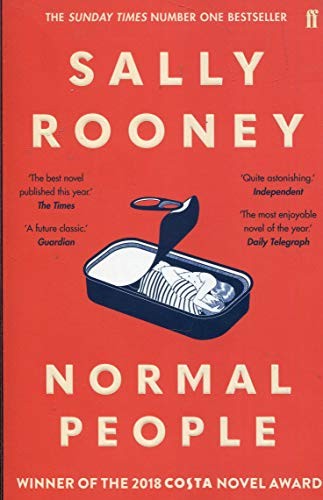
Normal People by Sally Rooney is a 2018 literary fiction book about class and social mobility, intimacy and vulnerability, power dynamics in relationships. Most of the novel's suffering is caused by things not said — Rooney is meticulous about showing how silence is often a strategy for maintaining plausible deniability rather than protection.
Summary
Normal People follows Connell and Marianne from their small-town Irish secondary school through their years at Trinity College Dublin. Connell is popular, athletic, privately insecure. Marianne is abrasive, isolated, secretly craving connection. They begin a relationship they both struggle to name, and the novel traces the decade-long push and pull between them — breaking apart, reconnecting, circling each other through different configurations of power and vulnerability.
The book is centrally about what people fail to say. Nearly every crisis in the novel stems from a sentence left unspoken: Connell doesn't tell Marianne they're together, Marianne doesn't tell Connell what she needs, both of them retreat behind silence when plain speech would change everything. Rooney is interested in how class shapes these silences — Connell's anxiety about his working-class background among Trinity students, Marianne's wealthy family and their particular brand of cruelty, the way money and education confer or withdraw social permission to speak.
Structurally the novel is lean and deliberately stripped of quotation marks, which gives dialogue an unnerving directness. Rooney writes emotional interiority with unusual precision — she can render the exact texture of a social anxiety, the specific arithmetic of desire and self-worth. The chapters alternate perspectives and jump weeks or months between them, forcing the reader to infer what happened in the gaps. It works. The compression is part of what makes the emotional hits land so hard.
Who will love this: readers drawn to close psychological observation, anyone who has navigated a relationship where social context made honesty feel impossible, fans of Toni Morrison's structural compression or Ian McEwan's interiority. Who will bounce: readers wanting more plot, or who find the characters' refusal to simply talk to each other more frustrating than poignant. The Hulu adaptation is good but loses the interior voice that makes the novel click.
Talk to Normal People like its author wrote you back.
Get the ideas that fit your life — not generic summaries.
- Chat with the book
- Audiobook-style main ideas
- Adapts to your life and goals
- Helps you take action
Key takeaways
- 1.
Most of the novel's suffering is caused by things not said — Rooney is meticulous about showing how silence is often a strategy for maintaining plausible deniability rather than protection.
- 2.
Class anxiety is depicted as a bodily experience, not an abstract category: Connell physically contracts in certain rooms, at certain parties, in ways he can barely articulate.
- 3.
The relationship's power dynamic reverses between school and university — who holds social capital in a given setting determines who has permission to want things openly.
- 4.
Marianne's relationship to being desired runs through the novel as a counterweight to Connell's relationship to being liked — two different forms of social hunger, neither healthy.
- 5.
Rooney refuses to resolve the novel cleanly. The ending is not a happy ending or a tragic one; it is an honest accounting of what two people can and can't be for each other.
- 6.
The novel trusts the reader to understand that two people can love each other and still consistently fail each other, without either of them being the villain.
- 7.
Therapy appears late in the novel as something that actually helps — rare for literary fiction, which usually treats mental health intervention as a narrative shortcut or cop-out.
- 8.
The absence of quotation marks is not an affectation: it erodes the boundary between speech and thought in a way that mirrors how Connell and Marianne constantly misread each other.
Discussion questions
Use these on your own, with a book club, or as chat starters in Superbook. Book club version, ready to copy or print →
- 1.
At the novel's pivotal crisis — Connell not inviting Marianne to the debs — he tells himself he was protecting her. Do you believe that? Does the novel?
- 2.
Marianne's family home is a site of real violence, but the novel is restrained about it. How much does her home life explain her relationship to being hurt, and how much does that explanation risk becoming an excuse?
- 3.
Connell's class anxiety is a through-line: he feels fraudulent at Trinity, edits himself at parties. Is this depicted as something he needs to overcome, or does the novel suggest it's a reasonable response to his actual situation?
- 4.
The power in the relationship shifts repeatedly — at school Connell has it, at Trinity Marianne does. Does the novel suggest power in a relationship is inherently zero-sum, or is there a version where neither person holds it over the other?
- 5.
Rooney is often criticized for romanticizing unhealthy relationship patterns. Is that a fair reading, or does the novel actually critique what it depicts?
- 6.
By the end, Connell is going to New York and Marianne is staying. Is this a hopeful ending, a tragic one, or something harder to categorize? What does the novel seem to think?
- 7.
Both Connell and Marianne are extremely smart people who consistently fail to communicate the most important things. Is their silence a character flaw, a product of their circumstances, or something the novel treats as universal?
- 8.
The novel is often described as a love story, but it might more accurately be described as a novel about self-formation. Which reading feels more accurate to you?
- 9.
Compared to Normal People, how does the relationship dynamic in Conversations with Friends (if you've read it) differ? Does Rooney's interest in the same territory feel repetitive or deepened?
- 10.
Helen, Connell's university girlfriend, is a minor character but an important one. What work does she do in the novel, and is she treated fairly by the narrative?
- 11.
Marianne's sadomasochistic relationships at university are introduced and then dropped. What do you think Rooney was trying to do with them, and did it work?
- 12.
The novel generated enormous cultural conversation about whether Marianne and Connell are sympathetic or infuriating. Which camp are you in, and why?
Themes
Frequently asked questions
-
Is Normal People worth reading?
Yes, if you have patience for novels where emotional precision is the main event rather than plot. Rooney's ability to render the interior texture of anxiety and desire is genuinely unusual. If you need things to happen, or find characters who won't just say what they mean deeply frustrating, this will test you.
-
Is Normal People hard to read?
Not technically difficult, but the absent quotation marks take twenty pages to stop noticing. The emotional difficulty is higher than the prose difficulty — Rooney writes about shame and longing with very little buffer between the reader and the feeling.
-
What is Normal People actually about, without spoilers?
Two people from the same Irish town who are clearly made for each other and spend years failing to quite be together, mostly because neither of them will say what they need out loud. It's less about whether they end up together and more about why honesty is so hard even when the stakes are this high.
-
Is the TV show as good as the book?
The adaptation is unusually faithful and the performances are excellent, but it loses the interiority that makes the novel work. The book lives in Connell's and Marianne's heads in ways the camera can only approximate. Worth watching, but read the novel first.
-
Who shouldn't read Normal People?
Readers who need characters to make sensible decisions, or who find novels about young people's romantic lives trivial. Also readers who want explicit answers — Rooney is deliberately ambiguous about how much the characters are damaged vs. just human.