Politics · Book club
Hate, Inc. book club questions
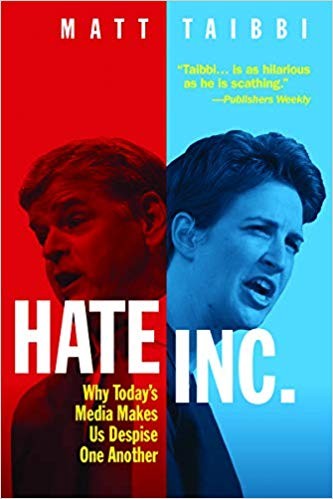
Here are 12 book club questions for Hate, Inc. by Matt Taibbi, ordered to open easily and end somewhere worth arguing about. Copy them, print them, or bring them up one at a time.
The 12 questions
- 1.
Taibbi argues there is no meaningful difference between Fox News and MSNBC in terms of business model, only in the audience they're targeting. Is that a fair comparison?
- 2.
The book claims that political outrage is more addictive than information. Reflect on your own media consumption — what emotions does it most reliably produce in you?
- 3.
Taibbi draws heavily on Chomsky's Manufacturing Consent. How does 'manufacturing dissent' differ from 'manufacturing consent,' and which is a more accurate description of current media?
- 4.
The book argues that media's obsession with partisan conflict crowds out coverage of corporate power and foreign policy. What important stories do you think are systematically underreported?
- 5.
Taibbi is equally critical of left-leaning and right-leaning media. Is that symmetry intellectually honest, or does it understate real differences in accuracy and accountability?
- 6.
If media companies profit from outrage, and outrage is a genuine emotional response to real events, at what point is the anger manufactured versus reported?
- 7.
What would a journalism business model that doesn't rely on outrage look like? What are the real obstacles to building it?
- 8.
Taibbi focuses primarily on television and digital media. How does his argument apply or fail to apply to print journalism, local news, or international media?
- 9.
The book was published in 2019, before the COVID pandemic and the 2020 election. Has the media landscape it describes gotten better or worse since then?
- 10.
How much responsibility do audiences bear for the current state of media? If people consistently chose less emotionally engaging but more informative journalism, would the industry adapt?
- 11.
Taibbi is a polemicist as much as an analyst. Does his rhetorical style strengthen or undermine the argument?
- 12.
What would it take for you personally to change your media diet, and what would you lose?
How to run the discussion
- Pick six to eight, not all of them. An hour of real discussion covers fewer questions than anyone expects, and racing the list is what makes a book club feel like homework.
- Open with what people noticed, not what they concluded. Asking for a verdict first hardens opinions before anyone has heard each other.
- Let the disagreement run. The questions below that split a room are the ones worth the time; the ones everyone answers the same way can be skipped.
- Ask the quiet person a specific question. A direct, narrow question is far easier to answer than an open invitation to contribute.
Themes worth steering toward
If the conversation stalls, these are the threads that usually restart it.
Common questions
What are good book club questions for Hate, Inc.?
Here are 12 book club questions for Hate, Inc. by Matt Taibbi, ordered to open easily and end somewhere worth arguing about. The strongest openers ask what each reader noticed rather than what they concluded, and the discussion usually turns on media criticism, polarization, journalism.
How long should a book club discussion of Hate, Inc. last?
Most groups run 60 to 90 minutes of actual discussion. That is roughly six to eight questions, not all of them, so pick the ones that suit your group rather than working down the list in order.
What are the main themes in Hate, Inc.?
Media criticism, Polarization, Journalism, Outrage economy, Political division. Those are the threads most likely to divide a room, which makes them the useful places to steer a discussion that has gone quiet.
Picking the next one? See books like Hate, Inc. or questions for other book club picks.
