History · Book club
Hitler's Willing Executioners: Ordinary Germans and the Holocaust book club questions
Here are 12 book club questions for Hitler's Willing Executioners: Ordinary Germans and the Holocaust by Daniel Jonah Goldhagen, ordered to open easily and end somewhere worth arguing about. Copy them, print them, or bring them up one at a time.
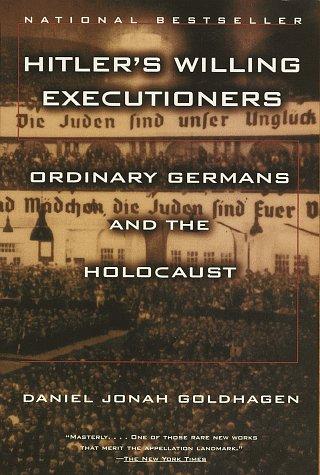
Hitler's Willing Executioners is Daniel Goldhagen's argument that the Holocaust was made possible by a specifically German form of antisemitism — what he calls "eliminationist antisemitism" — that was so deeply embedded in German culture by the twentieth century that ordinary Germans participated in the genocide willingly, not reluctantly, and often with evident enthusiasm.
Daniel Jonah Goldhagen · 1996 · 11h 30m
Full summary and key takeaways →The 12 questions
- 1.
Goldhagen and Browning use similar evidence and reach sharply different conclusions. How is this possible? What does it reveal about how historical evidence is interpreted?
- 2.
Goldhagen argues that German antisemitism was uniquely eliminationist by the twentieth century. What kind of evidence would you need to evaluate this claim? What would count against it?
- 3.
If Goldhagen is right, what are the implications for how we think about the role of culture in enabling atrocity? Does a cultural explanation reduce or increase individual responsibility?
- 4.
If Browning is right and situational factors are primary, does that make the Holocaust more disturbing — because it could happen anywhere — or less, because it requires specific historical conditions?
- 5.
Goldhagen rejects Arendt's 'banality of evil' thesis. What is at stake in this disagreement beyond the historical facts? What are the moral and political implications of each position?
- 6.
The book generated much more popular engagement in Germany than in academic circles. What explains this divergence? What did German readers find in it that professional historians did not?
- 7.
Critics accused Goldhagen of treating Germany as a monolithic culture when in fact antisemitic attitudes varied substantially. How should historians handle variation within a national culture when making cultural-level arguments?
- 8.
The death marches provide Goldhagen's strongest evidence for willing participation in late-war conditions. What are the strongest objections to this interpretation of the evidence?
- 9.
Does the distinction between willing and coerced participation matter morally? Does it change how we think about collective responsibility or national guilt?
- 10.
Some critics argued that Goldhagen's argument, by making the Holocaust uniquely German, implicitly absolved other nations and other perpetrators. Is this a fair reading of the book's implications?
- 11.
Hitler's Willing Executioners is nearly 600 pages. After this length of argument, do you think Goldhagen proves his central claim, or does he accumulate evidence that supports a weaker version of his thesis?
- 12.
How should we read a book that has been substantially criticized by professional historians but that has had significant and arguably positive effects on public historical consciousness?
How to run the discussion
- Pick six to eight, not all of them. An hour of real discussion covers fewer questions than anyone expects, and racing the list is what makes a book club feel like homework.
- Open with what people noticed, not what they concluded. Asking for a verdict first hardens opinions before anyone has heard each other.
- Let the disagreement run. The questions below that split a room are the ones worth the time; the ones everyone answers the same way can be skipped.
- Ask the quiet person a specific question. A direct, narrow question is far easier to answer than an open invitation to contribute.
Themes worth steering toward
If the conversation stalls, these are the threads that usually restart it.
Common questions
What are good book club questions for Hitler's Willing Executioners: Ordinary Germans and the Holocaust?
Here are 12 book club questions for Hitler's Willing Executioners: Ordinary Germans and the Holocaust by Daniel Jonah Goldhagen, ordered to open easily and end somewhere worth arguing about. The strongest openers ask what each reader noticed rather than what they concluded, and the discussion usually turns on the holocaust, antisemitism, perpetrators.
How long should a book club discussion of Hitler's Willing Executioners: Ordinary Germans and the Holocaust last?
Most groups run 60 to 90 minutes of actual discussion. That is roughly six to eight questions, not all of them, so pick the ones that suit your group rather than working down the list in order.
What are the main themes in Hitler's Willing Executioners: Ordinary Germans and the Holocaust?
The Holocaust, Antisemitism, Perpetrators, German history, Ideology. Those are the threads most likely to divide a room, which makes them the useful places to steer a discussion that has gone quiet.
Picking the next one? See books like Hitler's Willing Executioners: Ordinary Germans and the Holocaust or questions for other book club picks.
