History · Book club
Homo Deus: A Brief History of Tomorrow book club questions
Here are 12 book club questions for Homo Deus: A Brief History of Tomorrow by Yuval Noah Harari, ordered to open easily and end somewhere worth arguing about. Copy them, print them, or bring them up one at a time.
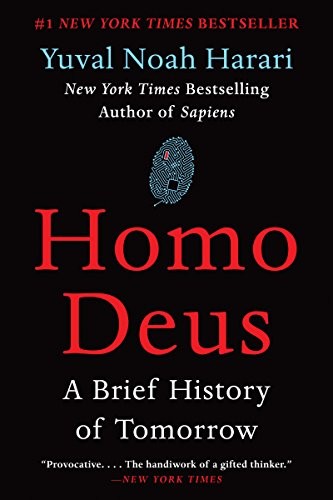
Homo Deus picks up where Sapiens left off, but turns to face the other direction.
Yuval Noah Harari · 2016 · 7h 0m
Full summary and key takeaways →The 12 questions
- 1.
Harari argues that famine, plague, and war have been reduced to manageable problems. Does that framing feel accurate from where you sit, or does it require a kind of global perspective that obscures what's still urgent locally?
- 2.
The book claims humanism is a religion — a set of beliefs rather than self-evident truths. What assumptions about human uniqueness do you hold that you've never examined as assumptions?
- 3.
If an algorithm could reliably predict your political preferences, career satisfaction, and romantic compatibility better than your own introspection, would you use it? Where does that decision lead over time?
- 4.
Harari separates intelligence from consciousness. Should a system that is vastly more intelligent but not conscious have rights? Does the answer depend on how it behaves, or on what it experiences?
- 5.
The book suggests that free will is likely an illusion constructed after the fact by the conscious mind. If that's true, how does it change how you think about accountability — your own or others'?
- 6.
Who currently owns the data generated by your body, your behavior, and your relationships? Who should own it, and what kind of power does ownership actually confer?
- 7.
Dataism values organisms by how much data they process and transmit. Name a human activity you value that produces no useful data. How would it fare under a Dataist system?
- 8.
Harari describes a potential split between a small class of upgraded humans and the rest. Is there a point at which enhancement crosses from individual choice into a collective problem requiring regulation?
- 9.
The book is more interested in posing questions than answering them. Is that a strength — intellectual honesty about genuine uncertainty — or an evasion of responsibility for a public intellectual with this kind of reach?
- 10.
Sapiens argued that shared fictions hold societies together. Homo Deus suggests those fictions are beginning to dissolve under algorithmic pressure. What shared fictions are you aware of depending on right now?
- 11.
Harari ends without a clear program. If you had to draft one concrete policy that responds to the risks he identifies, what would it be?
- 12.
Compare Homo Deus to Sapiens. Which book changed how you think more, and why? If you've only read one, what drew you to it over the other?
How to run the discussion
- Pick six to eight, not all of them. An hour of real discussion covers fewer questions than anyone expects, and racing the list is what makes a book club feel like homework.
- Open with what people noticed, not what they concluded. Asking for a verdict first hardens opinions before anyone has heard each other.
- Let the disagreement run. The questions below that split a room are the ones worth the time; the ones everyone answers the same way can be skipped.
- Ask the quiet person a specific question. A direct, narrow question is far easier to answer than an open invitation to contribute.
Themes worth steering toward
If the conversation stalls, these are the threads that usually restart it.
Common questions
What are good book club questions for Homo Deus: A Brief History of Tomorrow?
Here are 12 book club questions for Homo Deus: A Brief History of Tomorrow by Yuval Noah Harari, ordered to open easily and end somewhere worth arguing about. The strongest openers ask what each reader noticed rather than what they concluded, and the discussion usually turns on futurism, technology and humanity, artificial intelligence.
How long should a book club discussion of Homo Deus: A Brief History of Tomorrow last?
Most groups run 60 to 90 minutes of actual discussion. That is roughly six to eight questions, not all of them, so pick the ones that suit your group rather than working down the list in order.
What are the main themes in Homo Deus: A Brief History of Tomorrow?
Futurism, Technology and humanity, Artificial intelligence, Dataism, Free will. Those are the threads most likely to divide a room, which makes them the useful places to steer a discussion that has gone quiet.
Picking the next one? See books like Homo Deus: A Brief History of Tomorrow or questions for other book club picks.
