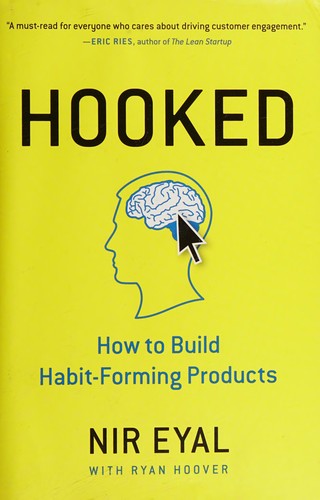
Talk to Hooked: How to Build Habit-Forming Products like its author wrote you back.
Get the ideas that fit your life — not generic summaries.
- Chat with the book
- Audiobook-style main ideas
- Adapts to your life and goals
- Helps you take action
What it argues
Hooked is Nir Eyal's framework for designing products that people return to without external prompting. The core model has four phases: trigger, action, variable reward, and investment. Each cycle through the loop increases the likelihood that a user will return unprompted. Eyal draws on behavioral economics and psychology research to explain why some products colonize daily routines while technically superior alternatives never gain traction.
The trigger phase distinguishes between external triggers — notifications, emails, ads — and internal triggers, which are emotional states like boredom, loneliness, or anxiety. External triggers are what get users in the door the first time. Internal triggers are what keep them coming back. The most durable habit-forming products attach themselves to existing negative emotions and offer relief or stimulation as a substitute. Eyal's observation here is worth slowing down on: the most powerful hook isn't novelty, it's the reliable scratch of an itch the user already has.
What it gets right
- 1.
The Hook Model has four phases: trigger, action, variable reward, and investment. Each loop cycle strengthens the habit and reduces the need for external prompting.
- 2.
External triggers (notifications, links) bring users in initially. Internal triggers — emotional states like boredom or anxiety — are what sustain long-term engagement.
- 3.
Variable rewards drive more compulsive behavior than predictable ones. The uncertainty of the payoff is the mechanism, not the payoff itself.
What it covers
Who wrote it
Nir Eyal is an American author and behavioral designer who has taught at the Stanford Graduate School of Business and the Hasso Plattner Institute of Design. He has worked in the video gaming and advertising industries and writes about the intersection of psychology, technology, and business. Hooked, published in 2014, grew out of research he conducted while advising technology startups. His follow-up book, Indistractable (2019), takes a different angle on the same territory, arguing for techniques to resist the very hooks his earlier work described.
