Hooked: How to Build Habit-Forming Products by Nir Eyal is a 2014 business book about habit formation, product design, behavioral psychology. The Hook Model has four phases: trigger, action, variable reward, and investment. Each loop cycle strengthens the habit and reduces the need for external prompting.
Summary
Hooked is Nir Eyal's framework for designing products that people return to without external prompting. The core model has four phases: trigger, action, variable reward, and investment. Each cycle through the loop increases the likelihood that a user will return unprompted. Eyal draws on behavioral economics and psychology research to explain why some products colonize daily routines while technically superior alternatives never gain traction.
The trigger phase distinguishes between external triggers — notifications, emails, ads — and internal triggers, which are emotional states like boredom, loneliness, or anxiety. External triggers are what get users in the door the first time. Internal triggers are what keep them coming back. The most durable habit-forming products attach themselves to existing negative emotions and offer relief or stimulation as a substitute. Eyal's observation here is worth slowing down on: the most powerful hook isn't novelty, it's the reliable scratch of an itch the user already has.
Variable reward is where the model borrows heavily from B.F. Skinner's slot-machine research. Unpredictable payoffs — will this tweet get likes? what's in the feed? — drive more compulsive checking behavior than predictable ones. Eyal distinguishes rewards of the tribe (social validation), rewards of the hunt (information or resources), and rewards of the self (completion, mastery). The investment phase is subtler: every bit of data a user adds to a product — followers, playlists, transaction history — raises the switching cost and primes the next trigger cycle.
The book ends with a chapter on ethics that feels more like a disclaimer than a reckoning. Eyal introduces a "manipulation matrix" that divides products into facilitators, peddlers, entertainers, and dealers based on whether the product genuinely helps the user. It's a useful frame but thin. Hooked is most valuable as a descriptive tool: it explains why engagement loops work before it asks whether any given loop should exist. Designers and founders who understand the model will build better products; whether those products are good for users is a question the book raises but mostly leaves open.
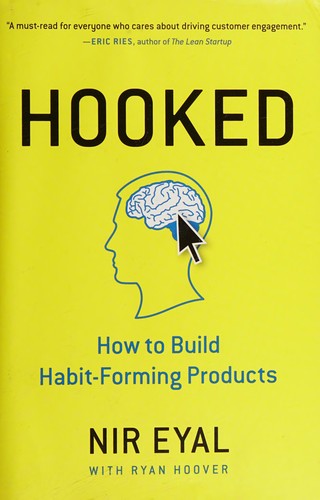
Talk to Hooked: How to Build Habit-Forming Products like its author wrote you back.
Get the ideas that fit your life — not generic summaries.
- Chat with the book
- Audiobook-style main ideas
- Adapts to your life and goals
- Helps you take action
Key takeaways
- 1.
The Hook Model has four phases: trigger, action, variable reward, and investment. Each loop cycle strengthens the habit and reduces the need for external prompting.
- 2.
External triggers (notifications, links) bring users in initially. Internal triggers — emotional states like boredom or anxiety — are what sustain long-term engagement.
- 3.
Variable rewards drive more compulsive behavior than predictable ones. The uncertainty of the payoff is the mechanism, not the payoff itself.
- 4.
Investment deepens the hook. Every piece of data, content, or social graph a user adds increases switching costs and primes the next trigger.
- 5.
The simplest action a user can take in the moment of a trigger determines whether the hook closes. Reducing friction at the action step is as important as designing the reward.
- 6.
Fogg's behavior model underlies much of the framework: behavior happens when motivation, ability, and a trigger converge at the same moment.
- 7.
Products that attach to existing internal triggers — negative emotions users already experience — are stickier than those trying to create new emotions from scratch.
- 8.
Eyal's manipulation matrix asks designers to consider whether the product genuinely improves users' lives. Most successful habit-forming products exist in the ambiguous middle of that question.
Discussion questions
Use these on your own, with a book club, or as chat starters in Superbook. Book club version, ready to copy or print →
- 1.
Eyal argues that internal triggers are more powerful than external ones. What internal state does your most-used app exploit, and is that a problem?
- 2.
The variable reward mechanism is borrowed from slot machine research. Does knowing that make you more or less likely to change how you use social media?
- 3.
Think of a product you've quit using. Did it fail on trigger, action, reward, or investment — or somewhere else in the loop?
- 4.
The investment phase argues that adding data to a product increases switching costs. Where in your own digital life are you locked in because of accumulated investment?
- 5.
Eyal draws a line between facilitators (products that genuinely help users) and dealers (products that exploit them). Where would you place the apps you use most?
- 6.
If you were designing a habit-forming product for something genuinely beneficial — exercise, language learning, a health behavior — which phase of the Hook Model would be hardest to execute honestly?
- 7.
The book was written for product designers and founders. Does reading it from a user's perspective change anything about how you interact with technology?
- 8.
Eyal says the most powerful internal trigger is anxiety. Can you identify a specific moment in your day when an app reliably captures you at an anxious moment?
- 9.
The ethics chapter is brief. Does the manipulation matrix Eyal proposes feel like an adequate framework for deciding whether to build a particular product?
- 10.
Variable rewards of the tribe depend on social validation. How much of your own engagement with social platforms is driven by checking whether your posts performed?
- 11.
The book assumes that habit formation in products is inherently a tool — neutral until pointed at something. Do you agree with that framing?
- 12.
Which products in your life have successfully attached to an existing routine rather than trying to create a new one? Was the attachment deliberate or accidental?
Themes
Frequently asked questions
-
What is the main idea of Hooked?
The Hook Model is a four-phase cycle — trigger, action, variable reward, investment — that explains how some products form habitual use without relying on expensive advertising. Each loop makes the next use more likely by attaching behavior to internal emotional states.
-
Who should read Hooked?
Product managers, designers, and founders building consumer software will get the most from it. It's also worth reading as a user who wants to understand why certain apps are so hard to put down. Readers primarily interested in personal productivity or habit formation may prefer Atomic Habits or Tiny Habits.
-
Is Hooked worth reading in 2026?
Yes, with caveats. The framework is clear and has aged well as a descriptive model. The ethics section is thin given how much the conversation around attention and technology has developed since 2014. Readers looking for a serious treatment of digital wellbeing will need to supplement it.
-
How long does it take to read Hooked?
Around three to four hours. At roughly 240 pages it's a short book, and Eyal writes efficiently. The chapters map directly onto the four phases of the model, so it's easy to read in discrete sittings.
-
What's the most actionable idea in Hooked?
The internal trigger audit. Eyal suggests tracing back from a behavior — why did I open this app? — five times until you reach the underlying emotion. Doing that once for your three most-used apps reveals more about your relationship with technology than most digital-wellness programs do.