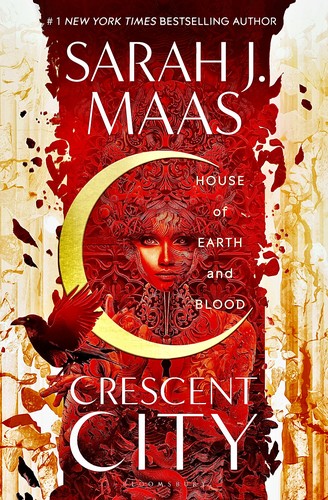
Talk to House of Earth and Blood like its author wrote you back.
Get the ideas that fit your life — not generic summaries.
- Chat with the book
- Audiobook-style main ideas
- Adapts to your life and goals
- Helps you take action
What it argues
Bryce Quinlan is half-fae, half-human, and fully invested in the nightlife of Crescent City — a contemporary urban fantasy setting where humans and magical creatures coexist under the governance of the Asteri, god-like beings of enormous and opaque power. When Bryce's best friend is murdered in an attack that slaughters her whole friend group, the case goes cold. Two years later, when the killings resume, Bryce is pulled back in with Hunt Athalar — a fallen angel conscripted into service as an assassin — as her unlikely partner.
House of Earth and Blood is Maas's most ambitious world-building project. Crescent City is a genuinely different kind of setting from Prythian or Adarlan: urban, contemporary, populated with fae, shifters, angels, demons, and humans navigating a stratified society with explicit racial and class dimensions. The world has technology, media, social hierarchies recognizable from our own. The murder mystery structure gives the novel a procedural skeleton that the ACOTAR books lacked. The romance between Bryce and Hunt develops against genuine grief and genuine danger rather than just atmospheric threat.
What it gets right
- 1.
Bryce's grief for Danika is the novel's emotional spine: not a backstory motivation but an ongoing, unresolved presence that structures every choice she makes.
- 2.
Crescent City is built around stratification — of species, of power, of access to autonomy — that maps onto contemporary anxieties more directly than Maas's previous settings.
- 3.
Hunt Athalar's servitude — the bargain that makes him a weapon of the Asteri — is the framework the novel uses to explore what freedom means when it's been systematically taken rather than just threatened.
What it covers
Who wrote it
Sarah J. Maas is an American fantasy author whose ACOTAR, Throne of Glass, and Crescent City series have collectively sold tens of millions of copies. House of Earth and Blood, published in 2020, launched her Crescent City series and marked a significant expansion of her world-building ambition and page count. It debuted at number one on the New York Times bestseller list despite releasing during the early months of the COVID-19 pandemic. Maas lives in Pennsylvania; she has credited Brandon Sanderson and Tamora Pierce as formative influences.
