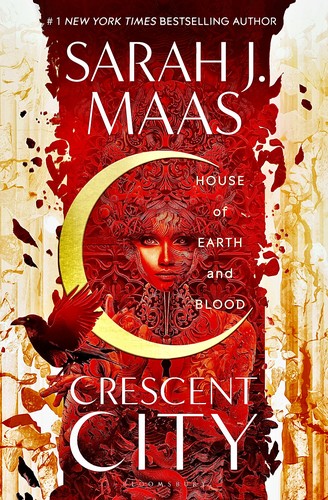
Talk to House of Earth and Blood like its author wrote you back.
Get the ideas that fit your life — not generic summaries.
- Chat with the book
- Audiobook-style main ideas
- Adapts to your life and goals
- Helps you take action
House of Earth and Blood, in detail
Bryce Quinlan is half-fae, half-human, and fully invested in the nightlife of Crescent City — a contemporary urban fantasy setting where humans and magical creatures coexist under the governance of the Asteri, god-like beings of enormous and opaque power. When Bryce's best friend is murdered in an attack that slaughters her whole friend group, the case goes cold. Two years later, when the killings resume, Bryce is pulled back in with Hunt Athalar — a fallen angel conscripted into service as an assassin — as her unlikely partner.
House of Earth and Blood is Maas's most ambitious world-building project. Crescent City is a genuinely different kind of setting from Prythian or Adarlan: urban, contemporary, populated with fae, shifters, angels, demons, and humans navigating a stratified society with explicit racial and class dimensions. The world has technology, media, social hierarchies recognizable from our own. The murder mystery structure gives the novel a procedural skeleton that the ACOTAR books lacked. The romance between Bryce and Hunt develops against genuine grief and genuine danger rather than just atmospheric threat.
The novel is very long — nearly 800 pages — and earns some but not all of that length. The first hundred pages are dense with world-building and character introduction, and Maas is asking readers to invest in a new system without the familiar Prythian infrastructure. The payoff comes in the back third, where the mystery's resolution and the emotional arc of Bryce's grief converge with real force. The ending includes a reveal that connects the Crescent City series to the ACOTAR universe in a way that pleased existing fans and surprised readers new to Maas.
This is a book that rewards patience and punishes skimming. It is not a light fantasy; the grief at its center is written without sentimentality, and the corruption the characters discover is genuinely unsettling. Readers who find urban fantasy settings less compelling than high fantasy may struggle. Readers who want a larger world, more morally complex politics, and a heroine whose damage is the point rather than backstory will find it among Maas's most complete novels.
The big ideas
- 1.
Bryce's grief for Danika is the novel's emotional spine: not a backstory motivation but an ongoing, unresolved presence that structures every choice she makes.
- 2.
Crescent City is built around stratification — of species, of power, of access to autonomy — that maps onto contemporary anxieties more directly than Maas's previous settings.
- 3.
Hunt Athalar's servitude — the bargain that makes him a weapon of the Asteri — is the framework the novel uses to explore what freedom means when it's been systematically taken rather than just threatened.
