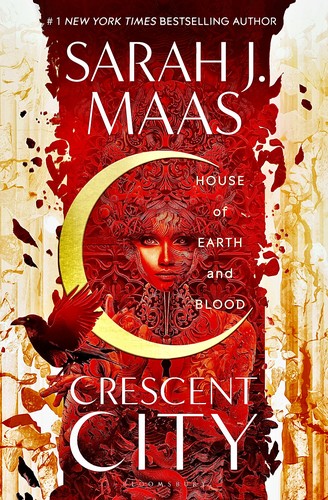
House of Earth and Blood by Sarah J. Maas is a 2020 fantasy book about grief and survival, justice and corruption, belonging and found family. Bryce's grief for Danika is the novel's emotional spine: not a backstory motivation but an ongoing, unresolved presence that structures every choice she makes.
Summary
Bryce Quinlan is half-fae, half-human, and fully invested in the nightlife of Crescent City — a contemporary urban fantasy setting where humans and magical creatures coexist under the governance of the Asteri, god-like beings of enormous and opaque power. When Bryce's best friend is murdered in an attack that slaughters her whole friend group, the case goes cold. Two years later, when the killings resume, Bryce is pulled back in with Hunt Athalar — a fallen angel conscripted into service as an assassin — as her unlikely partner.
House of Earth and Blood is Maas's most ambitious world-building project. Crescent City is a genuinely different kind of setting from Prythian or Adarlan: urban, contemporary, populated with fae, shifters, angels, demons, and humans navigating a stratified society with explicit racial and class dimensions. The world has technology, media, social hierarchies recognizable from our own. The murder mystery structure gives the novel a procedural skeleton that the ACOTAR books lacked. The romance between Bryce and Hunt develops against genuine grief and genuine danger rather than just atmospheric threat.
The novel is very long — nearly 800 pages — and earns some but not all of that length. The first hundred pages are dense with world-building and character introduction, and Maas is asking readers to invest in a new system without the familiar Prythian infrastructure. The payoff comes in the back third, where the mystery's resolution and the emotional arc of Bryce's grief converge with real force. The ending includes a reveal that connects the Crescent City series to the ACOTAR universe in a way that pleased existing fans and surprised readers new to Maas.
This is a book that rewards patience and punishes skimming. It is not a light fantasy; the grief at its center is written without sentimentality, and the corruption the characters discover is genuinely unsettling. Readers who find urban fantasy settings less compelling than high fantasy may struggle. Readers who want a larger world, more morally complex politics, and a heroine whose damage is the point rather than backstory will find it among Maas's most complete novels.
Talk to House of Earth and Blood like its author wrote you back.
Get the ideas that fit your life — not generic summaries.
- Chat with the book
- Audiobook-style main ideas
- Adapts to your life and goals
- Helps you take action
Key takeaways
- 1.
Bryce's grief for Danika is the novel's emotional spine: not a backstory motivation but an ongoing, unresolved presence that structures every choice she makes.
- 2.
Crescent City is built around stratification — of species, of power, of access to autonomy — that maps onto contemporary anxieties more directly than Maas's previous settings.
- 3.
Hunt Athalar's servitude — the bargain that makes him a weapon of the Asteri — is the framework the novel uses to explore what freedom means when it's been systematically taken rather than just threatened.
- 4.
The murder mystery structure requires Maas to play fair with her readers in a way fantasy doesn't always demand: there are clues, and in retrospect they were there.
- 5.
The found family in Crescent City is the most diverse and contemporary of Maas's ensembles, reflecting an urban setting that can't rely on courtly homogeneity.
- 6.
The Asteri are the most explicitly political of Maas's antagonists — a ruling structure that depends on the ignorance and division of the people it governs.
- 7.
Bryce's half-human status is used to explore the experience of being not fully accepted by any community — a theme that runs throughout Maas's heroines but is most explicit here.
- 8.
The novel's final act connects to the ACOTAR universe in a way that recasts the entire setting as part of a larger cosmology — a move that is either thrilling or exhausting depending on your relationship to the series.
Discussion questions
Use these on your own, with a book club, or as chat starters in Superbook. Book club version, ready to copy or print →
- 1.
Bryce's grief for Danika defines her for the first third of the novel. How does Maas write grief here differently from how it typically functions in fantasy — as motivation or backstory?
- 2.
The Crescent City setting is contemporary urban fantasy rather than high fantasy. What does that shift allow the novel to do that Prythian wouldn't?
- 3.
Hunt is enslaved — his freedom contingent on his service. How does the romance between Hunt and Bryce navigate the power imbalance that creates?
- 4.
The Asteri's control over Crescent City is maintained through a particular mechanism revealed late in the novel. Does the reveal feel like a meaningful comment on how power actually works, or is it just plot?
- 5.
The mystery is structured with real clues. Looking back, which clue should you have registered and didn't? Which one did you catch?
- 6.
Danika is a ghost presence for most of the novel but feels like a full character by the end. How does Maas make a dead character that present?
- 7.
The racial hierarchy in Crescent City — fae above humans, angels above shifters — is treated as systemic rather than just as individual prejudice. Is that treatment convincing, or does the novel naturalize what it thinks it's critiquing?
- 8.
The crossover reveal at the end has divided readers. If you've read ACOTAR, did it feel earned? If you haven't, did it feel bewildering?
- 9.
House of Earth and Blood is nearly 800 pages. Which storyline most justified the length, and which felt most like the novel testing your patience?
- 10.
The friends Bryce lost in the opening attack are described but not developed. Does their flatness affect how the loss lands emotionally?
- 11.
Ruhn Danaan and his storyline are largely parallel to the main plot. What would the novel lose if he were removed?
- 12.
By the final pages, has Bryce's grief been resolved or transformed? What's the difference, and which does the novel claim to offer?
Themes
Frequently asked questions
-
Do I need to read ACOTAR before House of Earth and Blood?
No — Crescent City is a separate series with a distinct world, characters, and setting. Readers new to Maas can start here. The crossover elements at the end make more sense with ACOTAR background, but they're not required for the novel to work.
-
Is House of Earth and Blood really 800 pages?
Yes. It is the longest of Maas's novels to date. The first hundred pages are the most demanding; readers who get to the murder mystery's active phase typically report the length becoming invisible.
-
What makes Crescent City different from the ACOTAR world?
Contemporary urban fantasy setting with technology, media, and class dynamics versus high fantasy fae courts. The tone is darker, the politics more explicit, and the heroine's motivation is grief rather than displacement.
-
Who shouldn't read this book?
Readers who bounced off Maas's prose in earlier books — it is the same voice applied to greater complexity. Also readers who find very long page counts without relief prohibitive. The opening is slow by design.
-
Is there a sequel?
Yes — House of Sky and Breath (2022) and House of Flame and Shadow (2024) continue the Crescent City series. The series is ongoing.