Politics · Book club
How Democracies Die book club questions
Here are 12 book club questions for How Democracies Die by Steven Levitsky and Daniel Ziblatt, ordered to open easily and end somewhere worth arguing about. Copy them, print them, or bring them up one at a time.
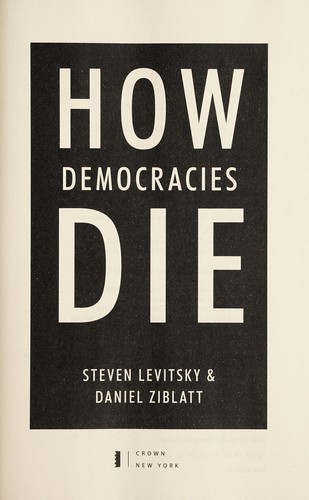
Steven Levitsky and Daniel Ziblatt are Harvard comparative politics scholars who have spent their careers studying how democracies break down in Latin America and Europe.
Steven Levitsky and Daniel Ziblatt · 2018 · 5h 45m
Full summary and key takeaways →The 12 questions
- 1.
Levitsky and Ziblatt argue that party gatekeeping is democracy's first line of defense. By that standard, how have the two major American parties performed over the last decade?
- 2.
The four behavioral indicators of authoritarian tendencies are designed to be observable before an election. How useful are they as a practical checklist for voters?
- 3.
The book distinguishes between hardball politics — aggressive but within norms — and norm-breaking. Where do you draw that line, and is the distinction as clear in practice as it sounds in theory?
- 4.
The authors use Latin American and European examples heavily. Do you find those comparisons persuasive, or do American institutional differences make the analogies break down?
- 5.
Mutual toleration requires accepting that your opponents are legitimate even when you believe their policies are deeply harmful. What are the limits of that norm?
- 6.
The book was written in 2017–2018. Which of its predictions have proved accurate and which have not?
- 7.
Levitsky and Ziblatt argue that polarization is a structural threat to democracy even when it reflects genuine disagreement about important issues. How do you think about that tradeoff?
- 8.
The diagnosis in the book is clearer than the remedy. What would a convincing theory of democratic recovery look like, and does the book gesture toward one?
- 9.
The authors discuss how ruling parties in other countries — Hungary, Turkey — have used legal tools to lock in electoral advantages. Which of those tools are available in the American system?
- 10.
How Democracies Die focuses on executive overreach. What would a version of the argument focused on legislative or judicial dysfunction look like?
- 11.
The book emphasizes elites — party leaders, institutions, prominent politicians — as the main actors who protect or fail to protect democracy. What role does it assign to ordinary voters?
- 12.
Which unwritten norm that the authors describe as important seems most fragile to you today?
How to run the discussion
- Pick six to eight, not all of them. An hour of real discussion covers fewer questions than anyone expects, and racing the list is what makes a book club feel like homework.
- Open with what people noticed, not what they concluded. Asking for a verdict first hardens opinions before anyone has heard each other.
- Let the disagreement run. The questions below that split a room are the ones worth the time; the ones everyone answers the same way can be skipped.
- Ask the quiet person a specific question. A direct, narrow question is far easier to answer than an open invitation to contribute.
Themes worth steering toward
If the conversation stalls, these are the threads that usually restart it.
Common questions
What are good book club questions for How Democracies Die?
Here are 12 book club questions for How Democracies Die by Steven Levitsky and Daniel Ziblatt, ordered to open easily and end somewhere worth arguing about. The strongest openers ask what each reader noticed rather than what they concluded, and the discussion usually turns on democracy, authoritarianism, political norms.
How long should a book club discussion of How Democracies Die last?
Most groups run 60 to 90 minutes of actual discussion. That is roughly six to eight questions, not all of them, so pick the ones that suit your group rather than working down the list in order.
What are the main themes in How Democracies Die?
Democracy, Authoritarianism, Political norms, Institutional decay, Polarization. Those are the threads most likely to divide a room, which makes them the useful places to steer a discussion that has gone quiet.
Picking the next one? See books like How Democracies Die or questions for other book club picks.
