History · Book club
How the Internet Happened book club questions
Here are 12 book club questions for How the Internet Happened by Brian McCullough, ordered to open easily and end somewhere worth arguing about. Copy them, print them, or bring them up one at a time.
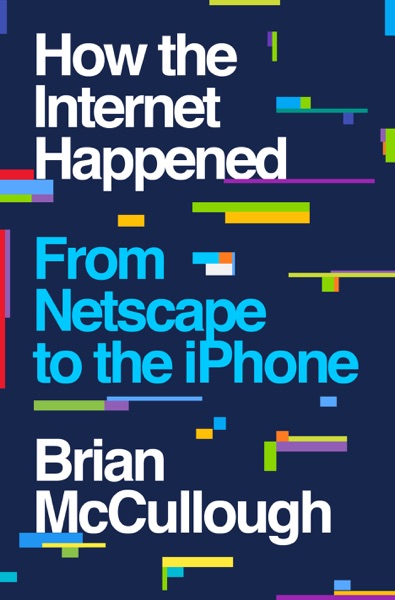
How the Internet Happened covers the commercial history of the internet from the release of Mosaic in 1993 to the launch of the iPhone in 2007 — the window in which the web went from academic experiment to the defining infrastructure of modern life.
Brian McCullough · 2018 · 6h 15m
Full summary and key takeaways →The 12 questions
- 1.
McCullough argues the period from 1993 to 2007 was the most consequential in modern economic history. Do you agree with that framing? What would you put in competition with it?
- 2.
The dot-com crash destroyed enormous paper wealth but much of the infrastructure — fiber, data centers, servers — was bought out of bankruptcy and became the cheap foundation for the next wave. What does that suggest about how to think about booms and busts?
- 3.
Netscape had first-mover advantage and a dominant market position and still lost. What does that imply about the value of being first in technology markets?
- 4.
AOL's subscriber base looked like an asset but turned into a liability as technology shifted. Can you think of current companies whose apparent moats might be the same kind of trap?
- 5.
Google's founders were initially reluctant to build an advertising business. How did the AdWords model change the economics of the internet, and was that change net positive or net negative?
- 6.
The book describes a culture of extreme optimism during the late 1990s that was contagious even to people who privately had doubts. How do social dynamics shape financial behavior in ways that individual analysis doesn't account for?
- 7.
Amazon survived the dot-com crash partly because Bezos kept investing in infrastructure when others were cutting. What does that suggest about the relationship between crisis and long-term position?
- 8.
The transition from desktop to mobile rewrote the competitive landscape almost completely. Which industries today feel stable but might face a similar platform shift?
- 9.
McCullough covers a period before social media dominated. What does his account suggest about what was lost, as well as gained, when the social layer was added on top of the early web?
- 10.
The early internet was genuinely decentralized — competing browsers, search engines, portals, email providers. The web that emerged from 2007 onward is far more concentrated. Was that inevitable?
- 11.
Several founders in the book failed spectacularly and then succeeded in later ventures. What patterns do you notice in how they used failure, if they did?
- 12.
McCullough stops at 2007 and the iPhone. If you were writing the next chapter, what would be the defining story of the 2007–2020 period?
How to run the discussion
- Pick six to eight, not all of them. An hour of real discussion covers fewer questions than anyone expects, and racing the list is what makes a book club feel like homework.
- Open with what people noticed, not what they concluded. Asking for a verdict first hardens opinions before anyone has heard each other.
- Let the disagreement run. The questions below that split a room are the ones worth the time; the ones everyone answers the same way can be skipped.
- Ask the quiet person a specific question. A direct, narrow question is far easier to answer than an open invitation to contribute.
Themes worth steering toward
If the conversation stalls, these are the threads that usually restart it.
Common questions
What are good book club questions for How the Internet Happened?
Here are 12 book club questions for How the Internet Happened by Brian McCullough, ordered to open easily and end somewhere worth arguing about. The strongest openers ask what each reader noticed rather than what they concluded, and the discussion usually turns on technology history, innovation, entrepreneurship.
How long should a book club discussion of How the Internet Happened last?
Most groups run 60 to 90 minutes of actual discussion. That is roughly six to eight questions, not all of them, so pick the ones that suit your group rather than working down the list in order.
What are the main themes in How the Internet Happened?
Technology history, Innovation, Entrepreneurship, Media, Silicon Valley. Those are the threads most likely to divide a room, which makes them the useful places to steer a discussion that has gone quiet.
Picking the next one? See books like How the Internet Happened or questions for other book club picks.
