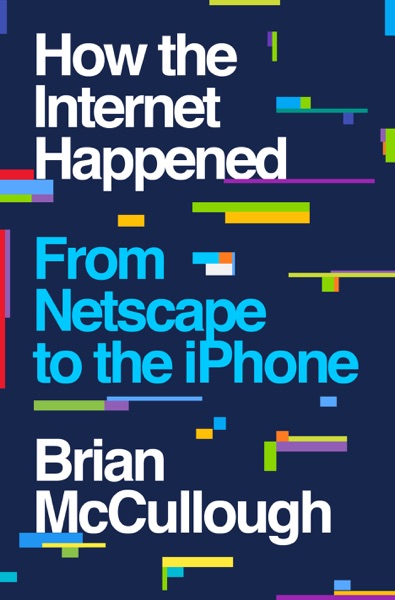
Talk to How the Internet Happened like its author wrote you back.
Get the ideas that fit your life — not generic summaries.
- Chat with the book
- Audiobook-style main ideas
- Adapts to your life and goals
- Helps you take action
What it argues
How the Internet Happened covers the commercial history of the internet from the release of Mosaic in 1993 to the launch of the iPhone in 2007 — the window in which the web went from academic experiment to the defining infrastructure of modern life. Brian McCullough, who also hosts the Techmeme Ride Home podcast, writes from the perspective of a journalist who was paying attention during this period, and the book benefits from contemporaneous texture as well as retrospective analysis.
The narrative moves chronologically through the major episodes: the browser wars between Netscape and Microsoft, the dot-com boom and its extraordinary valuations, the implosion of 2000 to 2001, and the second wave of companies — Google, Amazon, Apple, Facebook, YouTube — that emerged from the wreckage and came to dominate the era that followed. McCullough is particularly good on the first wave, capturing the genuine excitement and genuine delusion that coexisted in equal measure during the late 1990s.
What it gets right
- 1.
The commercial internet was shaped by a handful of specific product decisions — most notably Mosaic and Netscape — that brought the web to non-technical users and created the consumer internet we know.
- 2.
The dot-com bubble was not simply irrational exuberance. Many participants understood the fundamentals were stretched but believed they could exit before the crash. Some were right; most were not.
- 3.
AOL's dominance in the late 1990s looked like a permanent moat but was actually a symptom of a transition period. As broadband replaced dial-up, the moat evaporated almost completely.
What it covers
Who wrote it
Brian McCullough is an American technology journalist, podcast host, and author based in New York. He hosts the Techmeme Ride Home, a daily technology news podcast, and previously ran the Internet History Podcast, which was the primary research vehicle for this book. How the Internet Happened draws on hundreds of interviews and contemporaneous coverage from the era it documents. McCullough has covered technology as a journalist and commentator for over two decades.
