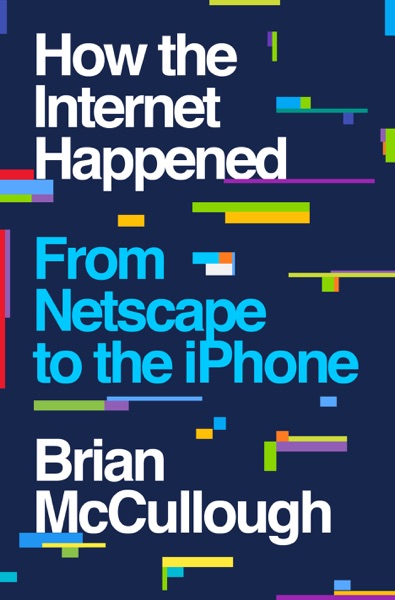
Talk to How the Internet Happened like its author wrote you back.
Get the ideas that fit your life — not generic summaries.
- Chat with the book
- Audiobook-style main ideas
- Adapts to your life and goals
- Helps you take action
How the Internet Happened, in detail
How the Internet Happened covers the commercial history of the internet from the release of Mosaic in 1993 to the launch of the iPhone in 2007 — the window in which the web went from academic experiment to the defining infrastructure of modern life. Brian McCullough, who also hosts the Techmeme Ride Home podcast, writes from the perspective of a journalist who was paying attention during this period, and the book benefits from contemporaneous texture as well as retrospective analysis.
The narrative moves chronologically through the major episodes: the browser wars between Netscape and Microsoft, the dot-com boom and its extraordinary valuations, the implosion of 2000 to 2001, and the second wave of companies — Google, Amazon, Apple, Facebook, YouTube — that emerged from the wreckage and came to dominate the era that followed. McCullough is particularly good on the first wave, capturing the genuine excitement and genuine delusion that coexisted in equal measure during the late 1990s.
What the book does well is explain the decisions that shaped outcomes — why Netscape fumbled its advantage, why AOL's subscriber base proved to be a trap rather than a moat, why Google's late entry into search actually helped it. The case studies are accessible without being oversimplified, and McCullough is willing to attribute outcomes to both structural forces and individual decisions rather than settling for a single explanation.
The book covers a lot of ground in a relatively small space, which means individual episodes receive less depth than dedicated accounts like Hatching Twitter or No Filter. Readers already steeped in internet history will find the overview valuable for synthesis but may want more granular detail on specific companies. For readers who lived through this period without fully understanding it, or who came of age after it, How the Internet Happened is an efficient and honest entry point to one of the most consequential periods in modern economic history.
The big ideas
- 1.
The commercial internet was shaped by a handful of specific product decisions — most notably Mosaic and Netscape — that brought the web to non-technical users and created the consumer internet we know.
- 2.
The dot-com bubble was not simply irrational exuberance. Many participants understood the fundamentals were stretched but believed they could exit before the crash. Some were right; most were not.
- 3.
AOL's dominance in the late 1990s looked like a permanent moat but was actually a symptom of a transition period. As broadband replaced dial-up, the moat evaporated almost completely.
