Business · Book club
How to Make Money in Stocks book club questions
Here are 12 book club questions for How to Make Money in Stocks by William J. O'Neil, ordered to open easily and end somewhere worth arguing about. Copy them, print them, or bring them up one at a time.
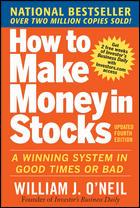
William O'Neil's How to Make Money in Stocks is the manual behind CAN SLIM, a growth-stock selection and timing system O'Neil developed by studying every major market winner in the United States from 1880 onward.
William J. O'Neil · 1988 · 5h 40m
Full summary and key takeaways →The 12 questions
- 1.
O'Neil argues that studying historical winners reveals universal patterns. Do you find that argument convincing, or could those patterns be artifacts of data-mining?
- 2.
The 7–8% stop loss rule requires selling stocks regardless of your opinion about the underlying business. How would you feel selling a stock you still believed in because it hit the rule?
- 3.
CAN SLIM requires significant active management and chart reading. At what point does that time commitment exceed the value it generates for a particular investor?
- 4.
O'Neil says leaders, not laggards, produce the best returns. In your experience, is it easy to identify which stocks are leading their sectors in real time?
- 5.
The system produces buy and sell signals that require action. How would transaction costs and taxes affect the net returns of a strict CAN SLIM investor?
- 6.
O'Neil's research covers over a century of market data. How much of what worked from 1880 to 1988 do you think still applies in a world of algorithmic trading and instant information?
- 7.
What's the difference between a growth investor using CAN SLIM and a momentum trader? Is there a meaningful distinction?
- 8.
The book uses hundreds of annotated charts. How much does pattern recognition in stock charts resemble and differ from the kind of pattern recognition experts develop in other fields?
- 9.
O'Neil founded Investor's Business Daily. Does the fact that his newspaper reinforces his methodology represent a conflict of interest, or is it simply vertical integration around a belief?
- 10.
If you had used strict CAN SLIM rules during the 2020–2021 bull market, when would you have been pushed out? Was that a feature or a bug?
- 11.
O'Neil is a quantitative researcher and a momentum trader in the same person. Which of those two identities produces more tension in the methodology?
- 12.
Which single CAN SLIM criterion do you think is most predictive of future stock performance, and which do you think is least reliable?
How to run the discussion
- Pick six to eight, not all of them. An hour of real discussion covers fewer questions than anyone expects, and racing the list is what makes a book club feel like homework.
- Open with what people noticed, not what they concluded. Asking for a verdict first hardens opinions before anyone has heard each other.
- Let the disagreement run. The questions below that split a room are the ones worth the time; the ones everyone answers the same way can be skipped.
- Ask the quiet person a specific question. A direct, narrow question is far easier to answer than an open invitation to contribute.
Themes worth steering toward
If the conversation stalls, these are the threads that usually restart it.
Common questions
What are good book club questions for How to Make Money in Stocks?
Here are 12 book club questions for How to Make Money in Stocks by William J. O'Neil, ordered to open easily and end somewhere worth arguing about. The strongest openers ask what each reader noticed rather than what they concluded, and the discussion usually turns on stock market investing, growth investing, technical analysis.
How long should a book club discussion of How to Make Money in Stocks last?
Most groups run 60 to 90 minutes of actual discussion. That is roughly six to eight questions, not all of them, so pick the ones that suit your group rather than working down the list in order.
What are the main themes in How to Make Money in Stocks?
Stock market investing, Growth investing, Technical analysis, Trading systems, Wealth building. Those are the threads most likely to divide a room, which makes them the useful places to steer a discussion that has gone quiet.
Picking the next one? See books like How to Make Money in Stocks or questions for other book club picks.
