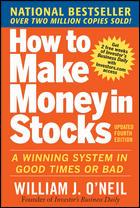
How to Make Money in Stocks by William J. O'Neil is a 1988 business book about stock market investing, growth investing, technical analysis. CAN SLIM identifies seven shared characteristics among the biggest stock market winners before their largest price moves. History consistently validates the pattern.
Summary
William O'Neil's How to Make Money in Stocks is the manual behind CAN SLIM, a growth-stock selection and timing system O'Neil developed by studying every major market winner in the United States from 1880 onward. O'Neil founded Investor's Business Daily as a newspaper to support investors using this approach, and this book is his most comprehensive explanation of how it works. Now in its fourth edition, it remains one of the most widely read books on growth investing and stock market timing.
CAN SLIM is an acronym for seven criteria: Current quarterly earnings, Annual earnings growth, New products or management, Supply and demand for shares, Leader or laggard among peers, Institutional sponsorship, and Market direction. Each letter gets a chapter. The thesis is that stocks with the highest probability of major price moves share identifiable characteristics at the time of their breakout. O'Neil backs this with exhaustive research showing that most of history's best-performing stocks — from early Apple to Cisco to Google — showed the CAN SLIM pattern before their biggest runs.
The system combines fundamental screening (earnings growth rate, return on equity, profit margins) with technical timing (chart patterns, volume signals, base formations). O'Neil's great insistence is that both matter: fundamentals identify what to buy and technicals identify when. He is equally insistent about cutting losses: the rule of selling any stock that falls 7–8% below your purchase price, without exception, is central to the system. Most amateurs hold losers too long; CAN SLIM builds loss discipline into the methodology explicitly.
The book is long and detailed, and honest readers will acknowledge that executing CAN SLIM consistently is harder than describing it. The chart reading requires practice, and the methodology gives frequent signals to buy and sell, producing real transaction costs and emotional friction. Critics note that the system requires significant time and active management, making it unsuitable for investors who prefer a passive approach. Still, for growth investors, the research behind the system is genuinely compelling, and O'Neil's insistence on data over opinion sets the book apart from most stock-picking guides.
Talk to How to Make Money in Stocks like its author wrote you back.
Get the ideas that fit your life — not generic summaries.
- Chat with the book
- Audiobook-style main ideas
- Adapts to your life and goals
- Helps you take action
Key takeaways
- 1.
CAN SLIM identifies seven shared characteristics among the biggest stock market winners before their largest price moves. History consistently validates the pattern.
- 2.
Selling any stock that falls 7–8% from your buy point, without exception, is the single most important rule in the system. Small losses are manageable; large losses are not.
- 3.
Volume confirms price. A stock breaking out on high volume is signaling institutional buying. A breakout on low volume is suspect.
- 4.
Most great stock runs begin from base patterns — periods of price consolidation after which demand overwhelms supply. Learning to read bases correctly is the core technical skill.
- 5.
Leaders outperform laggards in every market cycle. Buying the third-strongest stock in an industry instead of the strongest costs you returns without reducing risk.
- 6.
Institutional sponsorship (mutual funds, pension funds, endowments) drives sustainable price moves. Stocks without it can run briefly but won't sustain a major trend.
- 7.
Market direction determines when to be invested at all. O'Neil recommends reducing exposure when the broad market shows distribution days and increasing it when follow-through days confirm a new uptrend.
- 8.
The historical research behind the system covers over 130 years and thousands of stocks. The criteria weren't invented — they were observed from what actually worked.
Discussion questions
Use these on your own, with a book club, or as chat starters in Superbook. Book club version, ready to copy or print →
- 1.
O'Neil argues that studying historical winners reveals universal patterns. Do you find that argument convincing, or could those patterns be artifacts of data-mining?
- 2.
The 7–8% stop loss rule requires selling stocks regardless of your opinion about the underlying business. How would you feel selling a stock you still believed in because it hit the rule?
- 3.
CAN SLIM requires significant active management and chart reading. At what point does that time commitment exceed the value it generates for a particular investor?
- 4.
O'Neil says leaders, not laggards, produce the best returns. In your experience, is it easy to identify which stocks are leading their sectors in real time?
- 5.
The system produces buy and sell signals that require action. How would transaction costs and taxes affect the net returns of a strict CAN SLIM investor?
- 6.
O'Neil's research covers over a century of market data. How much of what worked from 1880 to 1988 do you think still applies in a world of algorithmic trading and instant information?
- 7.
What's the difference between a growth investor using CAN SLIM and a momentum trader? Is there a meaningful distinction?
- 8.
The book uses hundreds of annotated charts. How much does pattern recognition in stock charts resemble and differ from the kind of pattern recognition experts develop in other fields?
- 9.
O'Neil founded Investor's Business Daily. Does the fact that his newspaper reinforces his methodology represent a conflict of interest, or is it simply vertical integration around a belief?
- 10.
If you had used strict CAN SLIM rules during the 2020–2021 bull market, when would you have been pushed out? Was that a feature or a bug?
- 11.
O'Neil is a quantitative researcher and a momentum trader in the same person. Which of those two identities produces more tension in the methodology?
- 12.
Which single CAN SLIM criterion do you think is most predictive of future stock performance, and which do you think is least reliable?
Themes
Frequently asked questions
-
Is How to Make Money in Stocks suitable for beginning investors?
It's accessible to beginners but requires significant effort to apply. The concepts are explained clearly, but executing the system requires learning to read charts, track earnings data, and monitor market signals consistently. Passive investors or those who prefer index funds will find it unnecessary.
-
What is CAN SLIM?
An acronym for seven criteria O'Neil found in every major stock market winner before its biggest price move: Current earnings, Annual earnings, New products or management, Supply and demand, Leader vs. laggard, Institutional sponsorship, and Market direction. The system uses both fundamental screening and technical timing.
-
How does this book differ from a value investing approach?
Value investing buys stocks trading below intrinsic value and waits for the discount to close. CAN SLIM buys stocks with strong growth momentum at or near new highs and uses technical patterns to time entries. O'Neil explicitly argues that most great stocks look expensive by traditional valuation metrics just before their biggest moves.
-
How long does it take to read?
Five to six hours for the text, though the chart chapters reward slower reading alongside actual stock charts. Many readers read it once for the framework and return to specific chapters when they need to review a concept during active analysis.
-
Is the 7–8% stop loss rule really non-negotiable?
O'Neil treats it as non-negotiable, and the logic is compelling: a 7% loss requires a 7.5% gain to break even; a 50% loss requires a 100% gain. The bigger the loss you allow, the harder it becomes to recover. Most investors who object to the rule have, at some point, experienced what happens when they ignore it.
Similar books
The Intelligent Investor
Benjamin Graham
A Random Walk Down Wall Street
Burton G. Malkiel
Common Stocks and Uncommon Profits
Philip A. Fisher
Thinking in Bets: Making Smarter Decisions When You Don't Have All the Facts
Annie Duke
