Memoir · Book club
I Am Malala book club questions
Here are 12 book club questions for I Am Malala by Malala Yousafzai, ordered to open easily and end somewhere worth arguing about. Copy them, print them, or bring them up one at a time.
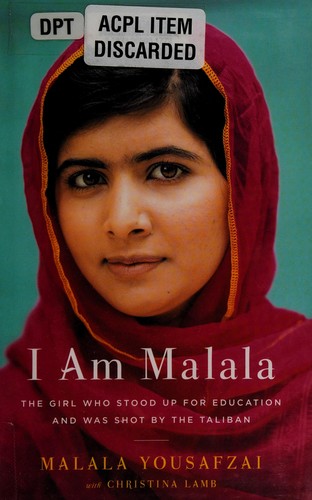
I Am Malala is the memoir of Malala Yousafzai, the Pakistani activist who was shot by the Taliban on her school bus in October 2012 at age fifteen, and who survived to become the youngest recipient of the Nobel Peace Prize.
Malala Yousafzai · 2013 · 6h 0m
Full summary and key takeaways →The 12 questions
- 1.
Malala frames education as a right she was willing to die for. Do you think that framing is universal, culturally specific, or something in between?
- 2.
Her father, Ziauddin, is in many ways the central adult figure in the book. How did his choices — including the decision to keep speaking publicly — shape both Malala's activism and the family's risk?
- 3.
The Taliban's control of Swat was built on fear and incremental compliance. At what point do you think resistance becomes possible in such an environment, and what makes it so difficult before then?
- 4.
Malala acknowledges that her anonymity as the BBC blogger was an open secret. What does that tell us about how public figures navigate between visibility and protection?
- 5.
The book is co-authored by a journalist. How does that affect how you read it as a memoir? Does it matter whether every sentence came directly from Malala?
- 6.
Malala says her Islam is incompatible with the Taliban's. How does the book handle the distinction between the religion and its ideological weaponization, and does it do so convincingly?
- 7.
After the shooting, Malala became a global symbol. What does it cost a person to become a symbol, and does the book reckon honestly with that cost?
- 8.
The Yousafzai family's attachment to the Swat Valley is a recurring theme. What does it mean to love a place that has been made dangerous by the people who also claim to love it?
- 9.
Pakistan's internal politics around the Taliban — complicity, denial, selective enforcement — are documented in the book. How do these complicate the simple narrative of brave girl versus violent extremism?
- 10.
Malala received the Nobel Peace Prize at seventeen. Is there something troubling about the way the world elevates individual survivors as symbols, rather than addressing the structural conditions that create them?
- 11.
Have you changed any behavior or assumption as a result of reading this book? If yes, what? If not, why not?
- 12.
Malala's story is widely used in schools. What are the risks of turning a living person's memoir into a pedagogical symbol?
How to run the discussion
- Pick six to eight, not all of them. An hour of real discussion covers fewer questions than anyone expects, and racing the list is what makes a book club feel like homework.
- Open with what people noticed, not what they concluded. Asking for a verdict first hardens opinions before anyone has heard each other.
- Let the disagreement run. The questions below that split a room are the ones worth the time; the ones everyone answers the same way can be skipped.
- Ask the quiet person a specific question. A direct, narrow question is far easier to answer than an open invitation to contribute.
Themes worth steering toward
If the conversation stalls, these are the threads that usually restart it.
Common questions
What are good book club questions for I Am Malala?
Here are 12 book club questions for I Am Malala by Malala Yousafzai, ordered to open easily and end somewhere worth arguing about. The strongest openers ask what each reader noticed rather than what they concluded, and the discussion usually turns on education, courage, women's rights.
How long should a book club discussion of I Am Malala last?
Most groups run 60 to 90 minutes of actual discussion. That is roughly six to eight questions, not all of them, so pick the ones that suit your group rather than working down the list in order.
What are the main themes in I Am Malala?
Education, Courage, Women's rights, Conflict, Identity. Those are the threads most likely to divide a room, which makes them the useful places to steer a discussion that has gone quiet.
Picking the next one? See books like I Am Malala or questions for other book club picks.
