Psychology · Book club
Immunity to Change book club questions
Here are 12 book club questions for Immunity to Change by Robert Kegan and Lisa Laskow Lahey, ordered to open easily and end somewhere worth arguing about. Copy them, print them, or bring them up one at a time.
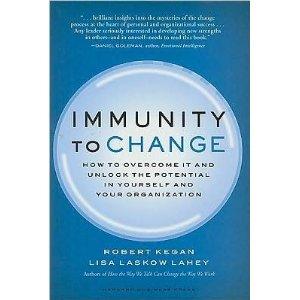
Immunity to Change is Robert Kegan and Lisa Laskow Lahey's attempt to explain why intelligent, motivated people fail to change behavior they genuinely want to change.
Robert Kegan and Lisa Laskow Lahey · 2009 · 6h 0m
Full summary and key takeaways →The 12 questions
- 1.
Pick an improvement goal you've been pursuing for more than a year without progress. What are the behaviors you keep doing that work against it?
- 2.
Kegan and Lahey argue that competing commitments are not irrational — they're protecting something real. What might your own competing commitment be protecting you from?
- 3.
What is a big assumption in your professional life that you've never seriously tested? What would it mean for your identity if it turned out to be wrong?
- 4.
The book distinguishes between technical problems and adaptive challenges. Which problems at your organization are being treated as technical when they're actually adaptive?
- 5.
Where in your leadership has fear — of conflict, disapproval, failure — been driving behavior you attributed to other reasons?
- 6.
Have you ever completed the four-column exercise? If so, what did you discover in the third column that surprised you?
- 7.
The developmental model suggests most adults are operating from a socialized mind. Where do you see that operating in yourself or others you know well?
- 8.
What would a small, safe experiment look like for testing a big assumption you hold about yourself at work?
- 9.
Kegan argues that organizations can have collective immunities. Where do you see your organization consistently failing to change something everyone agrees should change?
- 10.
The book is demanding to read and to apply. What would need to be true about your circumstances for you to actually work through the four-column map seriously?
- 11.
What would you need to see to believe this framework works in practice, and where might you find that evidence?
- 12.
The authors distinguish between learning that adds new skills and learning that changes how you make meaning. Which kind of development have you experienced, and what triggered it?
How to run the discussion
- Pick six to eight, not all of them. An hour of real discussion covers fewer questions than anyone expects, and racing the list is what makes a book club feel like homework.
- Open with what people noticed, not what they concluded. Asking for a verdict first hardens opinions before anyone has heard each other.
- Let the disagreement run. The questions below that split a room are the ones worth the time; the ones everyone answers the same way can be skipped.
- Ask the quiet person a specific question. A direct, narrow question is far easier to answer than an open invitation to contribute.
Themes worth steering toward
If the conversation stalls, these are the threads that usually restart it.
Common questions
What are good book club questions for Immunity to Change?
Here are 12 book club questions for Immunity to Change by Robert Kegan and Lisa Laskow Lahey, ordered to open easily and end somewhere worth arguing about. The strongest openers ask what each reader noticed rather than what they concluded, and the discussion usually turns on change, leadership development, self-awareness.
How long should a book club discussion of Immunity to Change last?
Most groups run 60 to 90 minutes of actual discussion. That is roughly six to eight questions, not all of them, so pick the ones that suit your group rather than working down the list in order.
What are the main themes in Immunity to Change?
Change, Leadership development, Self-awareness, Adult development, Organizational behavior. Those are the threads most likely to divide a room, which makes them the useful places to steer a discussion that has gone quiet.
Picking the next one? See books like Immunity to Change or questions for other book club picks.
