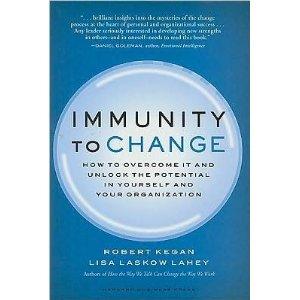
Immunity to Change by Robert Kegan and Lisa Laskow Lahey is a 2009 psychology book about change, leadership development, self-awareness. Most failed personal change is not a willpower problem but an immunity problem: hidden competing commitments quietly undermine the stated goal.
Summary
Immunity to Change is Robert Kegan and Lisa Laskow Lahey's attempt to explain why intelligent, motivated people fail to change behavior they genuinely want to change. The answer they develop over the book is that most failed personal and organizational change is not a deficit of will or information — it's the product of a hidden competing commitment that quietly sabotages the stated goal. They call this system an "immunity to change," and the book is essentially a guided method for surfacing and dismantling it.
The diagnostic tool at the book's center is a four-column map. The first column lists the improvement goal — what you say you want to change. The second column lists what you're actually doing that works against that goal, the behaviors you can observe in yourself. The third column uncovers the competing commitment: the hidden goal your behaviors are actually serving. The fourth column names the big assumption holding the whole system in place — the deep belief that makes the competing commitment feel necessary. The map is deceptively simple to describe and genuinely difficult to complete honestly. Kegan and Lahey walk through dozens of examples at both individual and organizational levels.
The book draws heavily on Kegan's earlier developmental theory, particularly his distinction between "socialized mind," "self-authoring mind," and "self-transforming mind." Most adults operate from a socialized mind — meaning their sense of identity is still largely defined by the expectations of others — and this limits both their capacity for self-directed change and their ability to lead others through transformation. Developing a self-authoring mind, the book argues, requires exactly the kind of assumption-questioning that the immunity-to-change map makes possible.
The second half applies the framework at organizational scale, including case studies from schools and corporations. This section is less tight than the individual application and requires more tolerance for academic prose. The individual diagnostic tool, however, is one of the more genuinely useful self-reflection exercises in the leadership literature — specific enough to be actionable, deep enough to reveal something that simpler frameworks miss.
Talk to Immunity to Change like its author wrote you back.
Get the ideas that fit your life — not generic summaries.
- Chat with the book
- Audiobook-style main ideas
- Adapts to your life and goals
- Helps you take action
Key takeaways
- 1.
Most failed personal change is not a willpower problem but an immunity problem: hidden competing commitments quietly undermine the stated goal.
- 2.
The four-column map surfaces the hidden commitment and the big assumption holding it in place. Without that diagnosis, change efforts treat symptoms rather than causes.
- 3.
Big assumptions feel like facts. They operate outside conscious scrutiny until deliberately examined, at which point their hold often weakens.
- 4.
Kegan distinguishes socialized, self-authoring, and self-transforming minds. Most adult development work aims at moving from the first to the second: from being defined by others' expectations to self-directed goals.
- 5.
Organizational immunity is a collective version of individual immunity. Teams and companies can share hidden competing commitments that block change at scale.
- 6.
Testing a big assumption doesn't mean abandoning it. It means designing small experiments to check whether the feared consequence actually materializes.
- 7.
Leaders who haven't examined their own immunities are limited in their ability to help others examine theirs. Self-awareness is not optional for development-focused leadership.
- 8.
Change that sticks requires changing the underlying meaning-making system, not just the behavior. Surface fixes rarely hold because the deeper structure reasserts itself.
Discussion questions
Use these on your own, with a book club, or as chat starters in Superbook. Book club version, ready to copy or print →
- 1.
Pick an improvement goal you've been pursuing for more than a year without progress. What are the behaviors you keep doing that work against it?
- 2.
Kegan and Lahey argue that competing commitments are not irrational — they're protecting something real. What might your own competing commitment be protecting you from?
- 3.
What is a big assumption in your professional life that you've never seriously tested? What would it mean for your identity if it turned out to be wrong?
- 4.
The book distinguishes between technical problems and adaptive challenges. Which problems at your organization are being treated as technical when they're actually adaptive?
- 5.
Where in your leadership has fear — of conflict, disapproval, failure — been driving behavior you attributed to other reasons?
- 6.
Have you ever completed the four-column exercise? If so, what did you discover in the third column that surprised you?
- 7.
The developmental model suggests most adults are operating from a socialized mind. Where do you see that operating in yourself or others you know well?
- 8.
What would a small, safe experiment look like for testing a big assumption you hold about yourself at work?
- 9.
Kegan argues that organizations can have collective immunities. Where do you see your organization consistently failing to change something everyone agrees should change?
- 10.
The book is demanding to read and to apply. What would need to be true about your circumstances for you to actually work through the four-column map seriously?
- 11.
What would you need to see to believe this framework works in practice, and where might you find that evidence?
- 12.
The authors distinguish between learning that adds new skills and learning that changes how you make meaning. Which kind of development have you experienced, and what triggered it?
Themes
Frequently asked questions
-
Is Immunity to Change worth reading if I've already read a lot of leadership books?
Yes, because the diagnostic framework is unlike most leadership books. Where many books offer principles or habits, this one gives you a structured method for identifying why your own behavior doesn't match your intentions. That specificity is rare and genuinely useful.
-
How long does it take to read Immunity to Change?
Around five to six hours. The first half is more accessible; the second half is more academic. Many readers find value in reading the first half carefully and skimming the organizational case studies unless those are directly relevant to their work.
-
What is the four-column exercise?
A self-diagnostic tool. Column one: your improvement goal. Column two: the behaviors you do that undermine it. Column three: the hidden competing commitment those behaviors serve. Column four: the big assumption that makes the competing commitment feel necessary. Working through it honestly typically takes an hour and produces uncomfortable but clarifying insights.
-
Who should read Immunity to Change?
Leaders and coaches who work with people trying to change deeply ingrained behaviors, and anyone who has repeatedly failed to sustain a change they genuinely wanted to make. The organizational sections are most relevant to HR leaders and executive coaches.
-
Is this book too theoretical to be practical?
The theory is present and unavoidable, but the four-column map is concrete and actionable. Readers who engage with the exercises rather than just reading the framework descriptions tend to find it the most practically useful book they've read on personal development.