Memoir · Book club
In Search of Memory book club questions
Here are 12 book club questions for In Search of Memory by Eric R. Kandel, ordered to open easily and end somewhere worth arguing about. Copy them, print them, or bring them up one at a time.
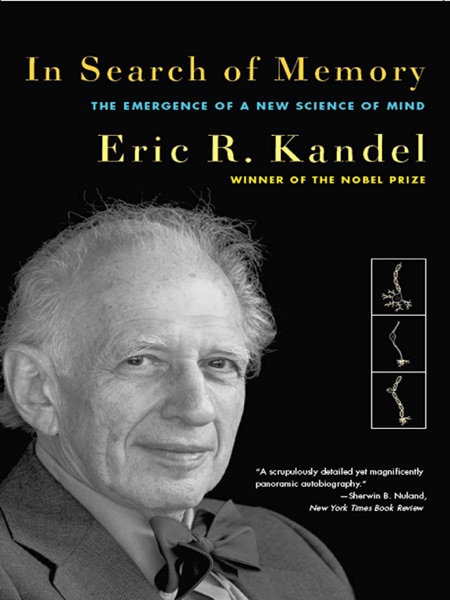
In Search of Memory is Eric Kandel's autobiography interleaved with the history of neuroscience, organized around his own central scientific achievement: the cellular and molecular mechanisms of memory storage in the sea slug Aplysia.
Eric R. Kandel · 2006 · 10h 0m
Full summary and key takeaways →The 12 questions
- 1.
Kandel connects his scientific interest in memory to the traumatic experience of Kristallnacht. How much of any scientific career do you think is traceable to specific biographical questions?
- 2.
The choice to work on Aplysia rather than mammals was a strategic bet. What bets in your own field — or life — have you made based on tractability rather than direct relevance?
- 3.
Kandel argues that psychotherapy and drug therapy both work by changing the brain, and that the distinction between psychological and biological treatment is therefore partly artificial. Does that argument hold for you?
- 4.
What does it mean for identity that long-term memory requires physical changes — new synaptic connections — each time it is formed or retrieved?
- 5.
Memory is reconstructive rather than archival. Does that change how you think about the reliability of your own memories, or about the reliability of witness testimony?
- 6.
Kandel worked on the same organism for most of his career. What is gained by that kind of sustained focus, and what is lost?
- 7.
The Vienna chapters raise questions about how ordinary people become perpetrators. Kandel never fully answers the question. Does the neuroscience he developed elsewhere illuminate it?
- 8.
The Nobel comes late — Kandel was seventy when he received it in 2000. What does the timeline of scientific recognition suggest about how science values different kinds of work?
- 9.
Kandel describes the reductionist program in neuroscience. What questions about memory and mind does that program seem structurally unable to answer?
- 10.
The book is both autobiography and scientific exposition. Does the personal narrative make the science more accessible, or does it sometimes feel like separate books in the same cover?
- 11.
If memory is the biological substrate of identity, what does Alzheimer's disease represent at the level of personhood, not just cognition?
- 12.
Kandel ended up at a major American research university after fleeing Europe as a refugee. What does his story suggest about the role of geographic and institutional luck in scientific achievement?
How to run the discussion
- Pick six to eight, not all of them. An hour of real discussion covers fewer questions than anyone expects, and racing the list is what makes a book club feel like homework.
- Open with what people noticed, not what they concluded. Asking for a verdict first hardens opinions before anyone has heard each other.
- Let the disagreement run. The questions below that split a room are the ones worth the time; the ones everyone answers the same way can be skipped.
- Ask the quiet person a specific question. A direct, narrow question is far easier to answer than an open invitation to contribute.
Themes worth steering toward
If the conversation stalls, these are the threads that usually restart it.
Common questions
What are good book club questions for In Search of Memory?
Here are 12 book club questions for In Search of Memory by Eric R. Kandel, ordered to open easily and end somewhere worth arguing about. The strongest openers ask what each reader noticed rather than what they concluded, and the discussion usually turns on memory and neuroscience, scientific discovery, identity and history.
How long should a book club discussion of In Search of Memory last?
Most groups run 60 to 90 minutes of actual discussion. That is roughly six to eight questions, not all of them, so pick the ones that suit your group rather than working down the list in order.
What are the main themes in In Search of Memory?
Memory and neuroscience, Scientific discovery, Identity and history, The brain and behavior, Vienna and refugee experience. Those are the threads most likely to divide a room, which makes them the useful places to steer a discussion that has gone quiet.
Picking the next one? See books like In Search of Memory or questions for other book club picks.
