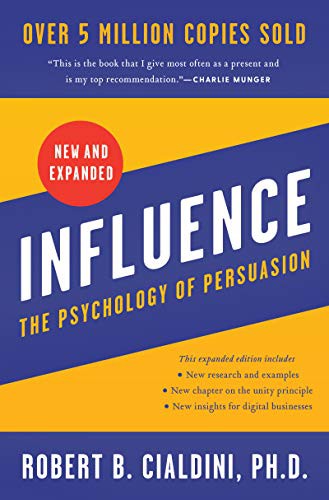
Talk to Influence, New and Expanded: The Psychology of Persuasion like its author wrote you back.
Get the ideas that fit your life — not generic summaries.
- Chat with the book
- Audiobook-style main ideas
- Adapts to your life and goals
- Helps you take action
What it argues
Influence, New and Expanded is the 2021 revision of Robert Cialdini's foundational 1984 work on the psychology of persuasion. The original book identified six principles — reciprocity, commitment and consistency, social proof, authority, liking, and scarcity — that reliably move people to say yes. The new edition adds a seventh: unity, the sense of shared identity between the influencer and the influenced. Cialdini spent three years undercover as a sales trainee, phone solicitor, and fundraiser to identify these principles, then spent decades documenting their psychological mechanisms.
Each principle exploits a different feature of human decision-making. Reciprocity works because we are wired to repay what we receive and feel uncomfortable with unresolved debts. Commitment and consistency work because we want to behave in line with what we've already said and done — a small yes creates a path toward a larger yes. Social proof works because in uncertain situations we look to what others are doing as a signal of correct behavior. Authority signals expertise and we are inclined to defer to experts. Liking makes us more likely to say yes to people we know, like, and who seem similar to us. Scarcity creates perceived value through restriction. Unity argues that shared group membership — family, ethnicity, political tribe, team — creates a bond that makes compliance almost automatic within the group.
What it gets right
- 1.
The seven principles of influence — reciprocity, commitment and consistency, social proof, authority, liking, scarcity, and unity — exploit reliable features of human decision-making, not irrationality.
- 2.
Reciprocity is one of the most powerful of the seven. A small, uninvited gift creates a felt obligation to return the favor, often at greater cost than the original gift.
- 3.
Commitment and consistency: once people take a small step in a direction, they rearrange their self-image to justify it and find it easier to take the next step.
What it covers
Who wrote it
Robert B. Cialdini is Regents' Professor Emeritus of Psychology and Marketing at Arizona State University and one of the most cited social psychologists in the world. He is the author of Influence (1984), Pre-Suasion (2016), and the expanded edition of Influence (2021). Cialdini spent years embedded in compliance industries — sales, advertising, fundraising — to identify the principles documented in his work. He founded the consulting firm Influence at Work and has advised organizations including Google, Microsoft, and the United Nations on ethical persuasion.
