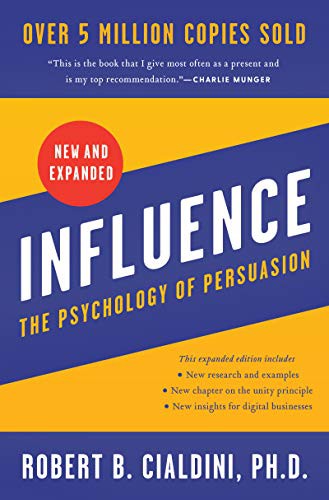
Talk to Influence, New and Expanded: The Psychology of Persuasion like its author wrote you back.
Get the ideas that fit your life — not generic summaries.
- Chat with the book
- Audiobook-style main ideas
- Adapts to your life and goals
- Helps you take action
Influence, New and Expanded: The Psychology of Persuasion, in detail
Influence, New and Expanded is the 2021 revision of Robert Cialdini's foundational 1984 work on the psychology of persuasion. The original book identified six principles — reciprocity, commitment and consistency, social proof, authority, liking, and scarcity — that reliably move people to say yes. The new edition adds a seventh: unity, the sense of shared identity between the influencer and the influenced. Cialdini spent three years undercover as a sales trainee, phone solicitor, and fundraiser to identify these principles, then spent decades documenting their psychological mechanisms.
Each principle exploits a different feature of human decision-making. Reciprocity works because we are wired to repay what we receive and feel uncomfortable with unresolved debts. Commitment and consistency work because we want to behave in line with what we've already said and done — a small yes creates a path toward a larger yes. Social proof works because in uncertain situations we look to what others are doing as a signal of correct behavior. Authority signals expertise and we are inclined to defer to experts. Liking makes us more likely to say yes to people we know, like, and who seem similar to us. Scarcity creates perceived value through restriction. Unity argues that shared group membership — family, ethnicity, political tribe, team — creates a bond that makes compliance almost automatic within the group.
The new edition adds contemporary examples and research that weren't available in 1984, including digital-age applications: review manipulation, fake authority signals, and the use of social proof in online commerce. Cialdini also strengthens the ethical dimension that was present but underdeveloped in the original. He is explicit that these principles can be used to defend against manipulation as well as to practice it, and he discusses which applications he considers ethical and which he considers predatory.
The book is a classic for good reason. The writing is accessible, the research is cited without being academic, and the principles have held up across forty years of replication. The new material doesn't transform the book but it does make it significantly more current. The main limitation is the same as the original: Cialdini writes almost entirely from the perspective of a researcher observing compliance professionals, which gives the book a slightly detached quality when it comes to the ethics of using these techniques yourself.
The big ideas
- 1.
The seven principles of influence — reciprocity, commitment and consistency, social proof, authority, liking, scarcity, and unity — exploit reliable features of human decision-making, not irrationality.
- 2.
Reciprocity is one of the most powerful of the seven. A small, uninvited gift creates a felt obligation to return the favor, often at greater cost than the original gift.
- 3.
Commitment and consistency: once people take a small step in a direction, they rearrange their self-image to justify it and find it easier to take the next step.
