Inspired: How to Create Tech Products Customers Love by Marty Cagan is a 2008 business book about product management, startups, innovation. The feature factory model — building features customers or salespeople request without validating whether they solve the real problem — is the most common cause of wasted product development effort.
Summary
Inspired is Marty Cagan's guide to how the best technology companies build products that customers actually want. Cagan spent time at Hewlett-Packard, Netscape, and eBay before founding the Silicon Valley Product Group, and the book is a distillation of what he observed distinguishes companies that consistently ship great products from those that build the right things wrong and the wrong things right.
The central argument is about process. Most companies treat product development as a feature factory: customers or salespeople request features, PMs write specifications, engineers build the specifications, and the result ships whether or not it solves the real problem. Cagan's alternative is continuous discovery: the product team talks directly to customers constantly, runs rapid experiments to test assumptions before committing to build, and uses prototypes to validate ideas in days rather than months.
The core of Inspired is the product team model. A strong product team consists of a product manager who owns the "why" — the business and customer problem — and engineers who own the "how." Design is a first-class partner, not a service function. The PM's job is not to write requirements for engineers to implement; it is to define the problem clearly enough that the team can discover the best solution together. Cagan is direct about what this requires: PMs must be deeply knowledgeable about their users, their business, their technology, and their market. Most of what passes for product management is really project management.
The second edition, published in 2017, updates the first with more emphasis on continuous discovery, product discovery techniques, and the role of product leadership. Inspired is widely considered required reading for aspiring product managers, though it skews toward consumer and enterprise technology companies. The frameworks apply less cleanly to hardware, regulated industries, or businesses where the product is not primarily software.
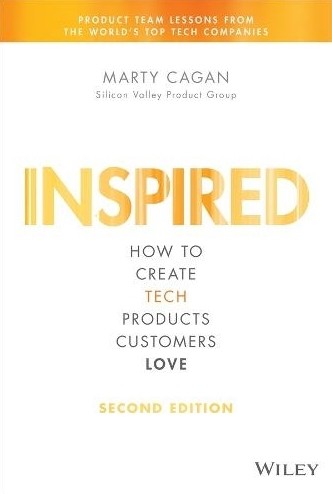
Talk to Inspired: How to Create Tech Products Customers Love like its author wrote you back.
Get the ideas that fit your life — not generic summaries.
- Chat with the book
- Audiobook-style main ideas
- Adapts to your life and goals
- Helps you take action
Key takeaways
- 1.
The feature factory model — building features customers or salespeople request without validating whether they solve the real problem — is the most common cause of wasted product development effort.
- 2.
Product discovery and product delivery are distinct activities. Discovery answers whether something is worth building; delivery answers whether it was built correctly.
- 3.
Strong product teams consist of a PM who owns the problem, engineers who own the solution, and designers as first-class partners — not a waterfall pipeline.
- 4.
The PM's job is not to write requirements — it is to deeply understand customers, business context, and technology well enough to define the right problem for the team to solve.
- 5.
Prototypes are the fundamental tool of product discovery: they let you test your most critical assumptions in days rather than the months it takes to build and ship a full feature.
- 6.
Outcome over output: teams should be measured by whether they solved the business and customer problem, not by whether they shipped the features they planned.
- 7.
Continuous customer engagement is not optional. PMs who talk to customers monthly instead of weekly are flying blind. The best teams have direct, ongoing relationships with users.
- 8.
Product-market fit is not a single moment — it is a signal that shows up in retention, organic growth, and customer behavior. Until you have it, optimizing delivery is premature.
Discussion questions
Use these on your own, with a book club, or as chat starters in Superbook. Book club version, ready to copy or print →
- 1.
Cagan describes the feature factory as the most common failure mode in product organizations. What does it look like in practice, and what are the conditions that create it?
- 2.
What is the difference between product discovery and product delivery? How should a team allocate time between the two?
- 3.
Cagan says PMs must be deeply knowledgeable about customers, business, technology, and market. How do you build that knowledge, and what happens when any one of the four is missing?
- 4.
The book argues that design should be a first-class partner, not a service. What does it look like when design is treated as a service, and what does the product experience feel like as a result?
- 5.
Have you seen a product team that was genuinely empowered to discover and deliver — not just execute on a roadmap? What made that possible?
- 6.
Cagan says the roadmap is often the enemy of good product work. What's the right relationship between a long-term product vision and a short-term execution plan?
- 7.
How do you run a prototype test that is genuinely informative rather than just confirmatory? What makes customers tell you what you want to hear instead of what is true?
- 8.
What is outcome over output, and how do you measure outcomes for products where the metrics are lagging rather than leading indicators?
- 9.
Inspired is primarily about consumer and enterprise software. How much of the framework applies to products that are not primarily software?
- 10.
Cagan describes a strong PM as someone who understands the customer better than anyone and the business constraints well enough to make hard tradeoffs. How do you develop that kind of judgment?
- 11.
What's the difference between a product manager and a project manager? Have you seen organizations that confuse the two roles, and what was the effect?
- 12.
If you were redesigning how a product team works today based on Cagan's framework, what would you change first and why?
Themes
Frequently asked questions
-
Is Inspired required reading for product managers?
It is widely treated as such in the technology industry. Inspired provides the clearest articulation of what separates strong product organizations from feature factories. Aspiring PMs and senior leaders refreshing their thinking both benefit from it.
-
How long does it take to read Inspired?
Around five hours for the 368-page second edition. The chapters are short and practical. Many product managers read it in a single weekend and then keep it as a reference.
-
What is the product discovery process Cagan recommends?
Continuous dialogue with customers, rapid prototyping to test assumptions, and iterating on problems before committing to building solutions. The goal is to answer whether something is worth building before spending engineering capacity on it.
-
Does Inspired apply outside tech companies?
The principles transfer broadly — customer centricity, outcome focus, and cross-functional collaboration are relevant in any industry. The specific tools — especially the emphasis on rapid software prototyping — are most applicable to technology product teams.
-
What's the difference between Inspired and Empowered?
Inspired is primarily about product teams and how they work. Empowered is about product leadership — what product managers and their leaders need to do to create the conditions for strong product teams. Empowered assumes you've read Inspired.
Similar books
Continuous Discovery Habits
Teresa Torres
Empowered: Ordinary People, Extraordinary Products
Marty Cagan and Chris Jones
The Lean Startup
Eric Ries
Hooked: How to Build Habit-Forming Products
Nir Eyal
