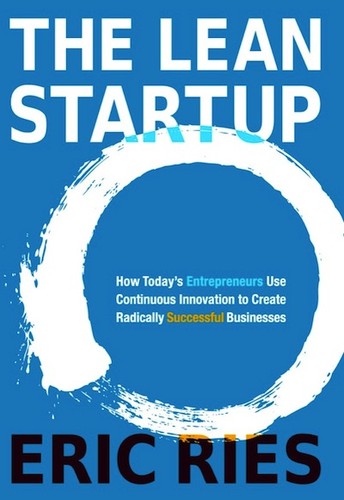
The Lean Startup by Eric Ries is a 2011 business book about entrepreneurship, validated learning, innovation. The build-measure-learn loop is the fundamental unit of startup progress. The goal is to minimize total cycle time, not to maximize the quality of any single release.
Summary
The Lean Startup is Eric Ries's argument that the biggest cause of startup failure is not building the wrong product — it's spending months or years building something before finding out whether anyone wants it. His prescription is a feedback loop he calls build-measure-learn: ship the smallest possible version of an idea, measure how real customers actually behave, learn what to keep or discard, and repeat. The goal is to reduce the time between hypotheses and evidence so that failures happen cheaply and early rather than expensively and late.
The book's central concept is the minimum viable product, or MVP. An MVP is not a rough draft or a beta release — it is the minimum set of features needed to test a specific assumption. Ries gives examples ranging from a simple landing page that measures signup intent to a manual-fulfillment service that looks automated from the outside. The point is to avoid the common trap of building in secret and launching big, which delays real feedback by months and makes course-correction expensive.
Ries draws a sharp line between two kinds of change: a pivot and an optimization. Optimization is tuning what you already do. A pivot is a structured course correction that tests a new fundamental hypothesis about the product, the customer, or the growth model. Most failing startups, he argues, don't pivot soon enough — they persist in hope when the evidence has already indicated a change of direction is needed. Innovation accounting, a framework for tracking validated learning rather than vanity metrics like page views or registered users, is meant to make that decision less emotional.
The book is strongest as a mindset shift for founders who have been trained to treat plans as commitments. It is weaker as an operations manual: some advice is underspecified, and the framework was designed for consumer internet startups in a way that requires translation for hardware companies, professional services, or large enterprises trying to apply lean methods internally. Ries addresses corporate "intrapreneurs" in the later chapters, but the fit is less clean. Still, the core case — that uncertainty demands experimentation, not more planning — holds up across contexts.
Talk to The Lean Startup like its author wrote you back.
Get the ideas that fit your life — not generic summaries.
- Chat with the book
- Audiobook-style main ideas
- Adapts to your life and goals
- Helps you take action
Key takeaways
- 1.
The build-measure-learn loop is the fundamental unit of startup progress. The goal is to minimize total cycle time, not to maximize the quality of any single release.
- 2.
A minimum viable product tests the riskiest assumption in your business as cheaply as possible. It is not an inferior product; it is a learning tool.
- 3.
Vanity metrics (page views, registered users, downloads) make you feel good and tell you nothing about whether the business is working. Measure actionable metrics tied to specific decisions.
- 4.
A pivot is a structured change in strategy based on validated learning — not a failure or a random change of direction. The ability to pivot quickly is a core startup competency.
- 5.
Innovation accounting replaces gut-feel milestones with a framework for tracking progress: establish a baseline, tune the engine toward the ideal, and decide whether to pivot or persevere.
- 6.
Most startup waste comes from building features nobody asked for. Validated learning — evidence that you are making real progress toward a sustainable business — is the unit of startup work.
- 7.
Growth engines (sticky, viral, paid) determine the levers that actually matter for your business. Tactics that work for one engine are irrelevant or counterproductive for another.
- 8.
Large companies can use lean methods through internal innovation teams with dedicated resources, a protected sandbox, and metrics separate from the core business's accounting.
Discussion questions
Use these on your own, with a book club, or as chat starters in Superbook. Book club version, ready to copy or print →
- 1.
Ries argues that the biggest waste in startups is building the wrong thing. Where in your own work — or life — are you executing carefully on an untested assumption?
- 2.
Think of an MVP you could build for a project you're working on right now. What is the single riskiest assumption it needs to test?
- 3.
What is the difference between a pivot and giving up? Has a project you abandoned ever been one when it should have been the other?
- 4.
Ries distinguishes vanity metrics from actionable ones. Which metric in your current work feels important but probably isn't telling you what you think it is?
- 5.
The book argues that a failed experiment is not a failure if it produces validated learning. Does the culture you work in actually treat it that way?
- 6.
Innovation accounting asks you to establish a baseline, then show improvement toward an ideal. What would that baseline look like for something you're trying to change?
- 7.
Ries claims that writing a business plan creates false confidence in predictions that can't yet be tested. When has a plan you wrote turned out to be more fiction than forecast?
- 8.
The five whys technique is meant to connect symptoms to root causes. Think of a recurring problem in your work. What does five layers of 'why' reveal?
- 9.
Which growth engine — sticky, viral, or paid — does a business you're familiar with actually rely on? Does its strategy match that engine?
- 10.
Ries says startups should be willing to pivot but not let that become an excuse for constant thrashing. How do you tell the difference in practice?
- 11.
The book was written for Silicon Valley software startups in 2011. Which ideas translate well to your context, and which require significant adjustment?
- 12.
If you had to apply the build-measure-learn loop to one non-business area of your life — a relationship, a health habit, a skill — how would you design the experiment?
Themes
Frequently asked questions
-
What is The Lean Startup about?
It argues that startups should treat their ideas as experiments: build the smallest testable version, measure real customer behavior, learn what to keep or discard, and repeat. The goal is to find out what actually works before spending time and money on something nobody wants.
-
Is The Lean Startup worth reading?
Yes, especially for anyone building a product or managing a team under uncertainty. The core ideas — MVP, pivot, validated learning — have become foundational vocabulary in the industry. Some sections are dated and the examples skew toward consumer internet startups, but the underlying logic applies broadly.
-
How long does it take to read The Lean Startup?
Around five hours at average reading pace for the 299-page book. The first third sets up the framework; the second two-thirds are applications and case studies. The case studies slow it down but ground the abstract concepts.
-
What is a minimum viable product?
An MVP is the smallest experiment that tests a specific business assumption. Ries is clear it is not a low-quality product — it is a deliberate tool for generating evidence. The landing page that measures signup interest before any product is built is a classic example.
-
Who shouldn't read The Lean Startup?
If your work has no meaningful feedback loop — long-cycle manufacturing, pure research, or regulated industries where iteration is structurally constrained — the prescriptions will feel impractical. The framework also loses some precision when applied to enterprise or hardware contexts.
Similar books
Zero to One: Notes on Startups, or How to Build the Future
Peter Thiel
The Hard Thing About Hard Things
Ben Horowitz
The Innovator's Dilemma
Clayton M. Christensen
The Mom Test
Rob Fitzpatrick
The Lean Startup vs.
Deciding between two books? The Lean Startup vs Zero to One .
