Philosophy · Book club
Intuition Pumps and Other Tools for Thinking book club questions
Here are 12 book club questions for Intuition Pumps and Other Tools for Thinking by Daniel Dennett, ordered to open easily and end somewhere worth arguing about. Copy them, print them, or bring them up one at a time.
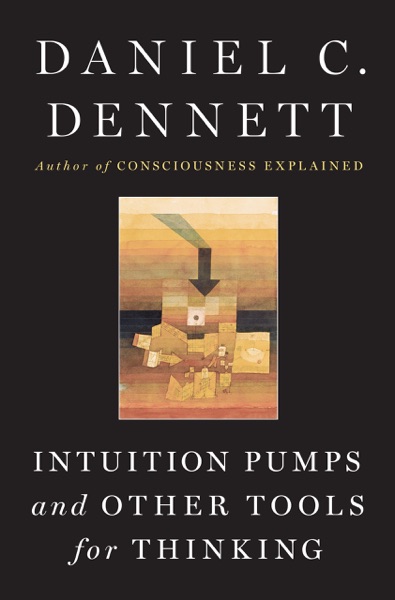
Intuition Pumps and Other Tools for Thinking is Daniel Dennett's handbook for thinking well — a collection of seventy-odd conceptual tools assembled across a long career in philosophy of mind, cognitive science, and evolutionary theory.
Daniel Dennett · 2013 · 8h 0m
Full summary and key takeaways →The 12 questions
- 1.
Dennett distinguishes between intuition pumps that illuminate and ones that mislead. Can you think of a popular thought experiment you find persuasive that might actually be misleading you?
- 2.
Rapoport's Rules ask you to summarize an opponent's view so well they would endorse it. When did you last actually do that — and how often do you see it done in public discourse?
- 3.
The 'deepity' concept is a useful diagnostic. Can you identify a claim in your own professional or personal life that sounds profound but, on examination, turns out to be empty?
- 4.
Dennett defends a compatibilist view of free will — the idea that free will is real and compatible with determinism. Does that position satisfy your intuitions about moral responsibility? Why or why not?
- 5.
The intentional stance treats systems as rational agents for predictive purposes. How do you decide when to apply the intentional stance to an institution, an algorithm, or a market?
- 6.
Dennett argues that consciousness can be explained naturalistically without remainder. Do you think there is something left over that his framework doesn't account for?
- 7.
The book is long and ranges across many domains. Which of Dennett's tools have you found most immediately useful, and which felt most like a solution looking for a problem?
- 8.
Dennett is critical of what he calls 'belief in belief' — the view that religious beliefs should be protected from examination because of their social value. Do you find that criticism fair?
- 9.
Several of Dennett's thought experiments (Quining Qualia, the Philosophical Zombie) are addressed specifically at philosophers. How useful do you find them as a non-specialist?
- 10.
Dennett argues that most philosophical problems about consciousness are generated by confused language rather than genuine mysteries. What would be lost if that view is right?
- 11.
The book was written in part as a counterargument to thinkers like Thomas Nagel and John Searle. Without knowing their work, how does the polemical context affect how you read Dennett?
- 12.
Dennett's tone is confident to the point of sometimes being dismissive. Does the style make the ideas more or less compelling to you?
How to run the discussion
- Pick six to eight, not all of them. An hour of real discussion covers fewer questions than anyone expects, and racing the list is what makes a book club feel like homework.
- Open with what people noticed, not what they concluded. Asking for a verdict first hardens opinions before anyone has heard each other.
- Let the disagreement run. The questions below that split a room are the ones worth the time; the ones everyone answers the same way can be skipped.
- Ask the quiet person a specific question. A direct, narrow question is far easier to answer than an open invitation to contribute.
Themes worth steering toward
If the conversation stalls, these are the threads that usually restart it.
Common questions
What are good book club questions for Intuition Pumps and Other Tools for Thinking?
Here are 12 book club questions for Intuition Pumps and Other Tools for Thinking by Daniel Dennett, ordered to open easily and end somewhere worth arguing about. The strongest openers ask what each reader noticed rather than what they concluded, and the discussion usually turns on critical thinking, philosophy of mind, argumentation.
How long should a book club discussion of Intuition Pumps and Other Tools for Thinking last?
Most groups run 60 to 90 minutes of actual discussion. That is roughly six to eight questions, not all of them, so pick the ones that suit your group rather than working down the list in order.
What are the main themes in Intuition Pumps and Other Tools for Thinking?
Critical thinking, Philosophy of mind, Argumentation, Evolution, Consciousness. Those are the threads most likely to divide a room, which makes them the useful places to steer a discussion that has gone quiet.
Picking the next one? See books like Intuition Pumps and Other Tools for Thinking or questions for other book club picks.
