Health · Book club
Intuitive Eating book club questions
Here are 12 book club questions for Intuitive Eating by Evelyn Tribole, ordered to open easily and end somewhere worth arguing about. Copy them, print them, or bring them up one at a time.
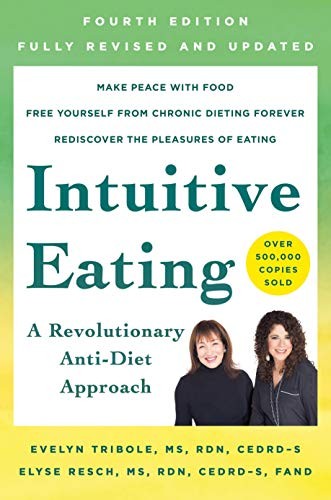
Intuitive Eating, first published in 1995 and now in its fourth edition, is registered dietitian Evelyn Tribole's framework for disengaging from diet culture and relearning to eat in response to hunger and satiety rather than external rules.
Evelyn Tribole · 1995 · 5h 20m
Full summary and key takeaways →The 12 questions
- 1.
Tribole argues that you were an intuitive eater as a child and something changed. When do you think you first started eating by external rules rather than internal signals? What prompted it?
- 2.
The book lists ten principles for intuitive eating. Which one feels most foreign or difficult to you, and what does that tell you about your current relationship with food?
- 3.
She argues that all foods should be permissible. Do you have a category of food that functions as forbidden for you? How does that restriction affect your behavior around that food?
- 4.
The framework distinguishes between physical hunger and emotional hunger. How reliably can you tell the difference in your own experience?
- 5.
Intuitive eating is sometimes criticized for ignoring health. How do you reconcile the argument that eating more freely leads to better long-term health with what you've been told about nutrition?
- 6.
The book's research section reports positive outcomes for intuitive eating compared to restrained eating. Does the evidence shift your priors, or do you remain skeptical?
- 7.
Tribole contrasts movement for joy with movement as punishment. Which category does your current exercise fall into? Does that framing resonate?
- 8.
She covers the 'diet mentality' as a pervasive cultural phenomenon, not just a personal habit. What cultural forces in your life reinforce the idea that weight control should be pursued through restriction?
- 9.
The book is written by dietitians who work in eating disorder treatment. How does that clinical origin shape the framework? Is there anything it might miss for people without eating disorder histories?
- 10.
Body respect is a principle even if you dislike your body. Can you distinguish between respecting your body and being satisfied with it? Is that distinction useful?
- 11.
If you removed all food rules for a month, what do you imagine would happen? Does the imagined scenario reflect the book's predictions or something different?
- 12.
The framework has been adopted by the Health at Every Size movement, which rejects weight loss as a health goal. Do you find that extension of the framework convincing?
How to run the discussion
- Pick six to eight, not all of them. An hour of real discussion covers fewer questions than anyone expects, and racing the list is what makes a book club feel like homework.
- Open with what people noticed, not what they concluded. Asking for a verdict first hardens opinions before anyone has heard each other.
- Let the disagreement run. The questions below that split a room are the ones worth the time; the ones everyone answers the same way can be skipped.
- Ask the quiet person a specific question. A direct, narrow question is far easier to answer than an open invitation to contribute.
Themes worth steering toward
If the conversation stalls, these are the threads that usually restart it.
Common questions
What are good book club questions for Intuitive Eating?
Here are 12 book club questions for Intuitive Eating by Evelyn Tribole, ordered to open easily and end somewhere worth arguing about. The strongest openers ask what each reader noticed rather than what they concluded, and the discussion usually turns on eating disorders, body image, hunger cues.
How long should a book club discussion of Intuitive Eating last?
Most groups run 60 to 90 minutes of actual discussion. That is roughly six to eight questions, not all of them, so pick the ones that suit your group rather than working down the list in order.
What are the main themes in Intuitive Eating?
Eating disorders, Body image, Hunger cues, Diet culture, Self-compassion. Those are the threads most likely to divide a room, which makes them the useful places to steer a discussion that has gone quiet.
Picking the next one? See books like Intuitive Eating or questions for other book club picks.
