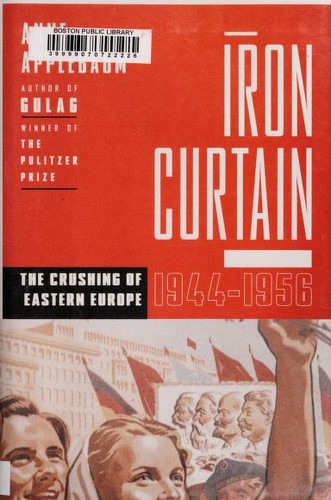
Iron Curtain: The Crushing of Eastern Europe 1944–1956 by Anne Applebaum is a 2012 history book about soviet occupation, totalitarianism, eastern europe. The Soviet imposition of communism on Eastern Europe was not just political conquest but systematic social destruction — eliminating every institution that could support independent life.
Summary
Iron Curtain is Anne Applebaum's account of how the Soviet Union destroyed civil society and imposed communist rule across Eastern Europe between 1944 and 1956. The book focuses primarily on Poland, Hungary, and East Germany, using those three cases to trace the common methods the Soviets and local communist parties employed to dismantle independent institutions and reconstruct societies along Soviet lines. The argument is not just that political systems were imposed but that societies were remade: the goal was to eliminate any space — church, youth group, professional association, neighborhood network — where people could organize independently of the state.
Applebaum organizes the book around the instruments of totalitarianization rather than a strictly chronological narrative. Separate sections address the secret police, the communist youth movements, the treatment of the German population expelled from eastern territories, the assault on the churches, the purges within the communist parties themselves, and the role of radio in shaping public consciousness. This thematic approach lets her trace patterns across the three countries simultaneously and is particularly effective in showing how similar methods produced similar results in very different national contexts.
The secret police chapters are the most disturbing. Applebaum documents how informer networks were built, how confessions were extracted through sleep deprivation and psychological pressure rather than the physical torture characteristic of earlier eras, and how show trials were constructed to implicate not just the accused but their social networks. The postwar purges within the communist parties — in which loyal communists were accused of treason and forced to confess to fabricated crimes — reveal the extent to which the system required the destruction of genuine belief as much as genuine dissent.
The book ends with 1956, when uprisings in Hungary and Poland revealed both the depth of popular resistance and the limits of Soviet willingness to allow reform. Applebaum is clear-eyed about what this history means for contemporary Europe: the countries that lived under Soviet domination for four decades carry its traces in their institutions, their political cultures, and their reflexive suspicion of state power — responses that outsiders frequently misread. Iron Curtain is a demanding but essential book for anyone trying to understand Eastern Europe's political present through its recent past.
Talk to Iron Curtain: The Crushing of Eastern Europe 1944–1956 like its author wrote you back.
Get the ideas that fit your life — not generic summaries.
- Chat with the book
- Audiobook-style main ideas
- Adapts to your life and goals
- Helps you take action
Key takeaways
- 1.
The Soviet imposition of communism on Eastern Europe was not just political conquest but systematic social destruction — eliminating every institution that could support independent life.
- 2.
The secret police were the central instrument. Informer networks were built in factories, neighborhoods, and churches; the goal was to make private trust impossible.
- 3.
Confessions in show trials were obtained through psychological pressure, sleep deprivation, and the leveraging of family threats, not primarily physical torture.
- 4.
The communist youth movements were designed to supplant family loyalty and religious identity with loyalty to the party — a deliberate remaking of personal identity.
- 5.
Purges within the communist parties themselves destroyed loyal believers as well as genuine opponents, creating a system in which no ideological position was safe.
- 6.
Radio was the first mass medium the communists understood and deployed systematically, not just for propaganda but for the calibration of what was publicly thinkable.
- 7.
The 1956 Hungarian Revolution and the Polish October revealed that Soviet-imposed systems were sustained by coercion, not genuine popular support.
- 8.
Eastern European societies carry the institutional and psychological traces of this history in ways that help explain their politics today, including their suspicion of state power and international institutions.
Discussion questions
Use these on your own, with a book club, or as chat starters in Superbook. Book club version, ready to copy or print →
- 1.
Applebaum focuses on Poland, Hungary, and East Germany. How much does her analysis depend on those particular cases, and would other countries have told a different story?
- 2.
She argues the communists tried to remake not just political systems but society — to eliminate the intermediate institutions that make civil life possible. What does that suggest about what civil society is for?
- 3.
The chapters on secret police and informers document how private trust was systematically destroyed. What conditions would need to exist for you to inform on a neighbor or colleague?
- 4.
Show trials required the accused to perform false confessions publicly. What psychological and social mechanisms made that possible?
- 5.
The communist youth movements aimed to replace family and religious loyalty with party loyalty. How successful were they, based on what Applebaum reports?
- 6.
Purges within the communist parties show that ideological loyalty didn't protect anyone. What does that tell us about the inner logic of totalitarian systems?
- 7.
Applebaum ends in 1956. What happened next, and how does knowing the full arc of Soviet domination change how you read the earlier history?
- 8.
She argues that Eastern Europeans' political reflexes today — skepticism of the EU, hostility to immigration, suspicion of state power — make more sense in light of this history. Do you find that convincing?
- 9.
The book describes societies being made, not just governed. How does that compare to the way political systems operate in democracies?
- 10.
Which chapter or case study did you find most revealing, and why?
- 11.
Iron Curtain is partly a corrective to Western historical ignorance about what happened east of the Elbe. How much did you know about this history before reading it?
- 12.
What parallels, if any, do you see between the mechanisms Applebaum describes and contemporary political developments in democracies?
Themes
Frequently asked questions
-
Is Iron Curtain worth reading?
Yes, particularly if you want to understand what Soviet occupation actually meant in practice — not as ideology but as lived experience. Applebaum is an unusually careful historian who draws on archives, memoirs, and interviews to build a detailed picture of societies being deliberately dismantled.
-
How long does it take to read Iron Curtain?
Around 16 to 18 hours for the roughly 600-page text. Like Applebaum's Gulag, it rewards careful reading rather than skimming; the thematic organization means important details are distributed throughout rather than concentrated in a few chapters.
-
What is the book's central thesis?
That the Soviets and their local communist allies systematically destroyed every form of independent social organization in Eastern Europe — churches, voluntary associations, professional groups, independent media — because totalitarian control requires the elimination of any space where people can act without the state.
-
Does the book cover all of Eastern Europe?
It focuses primarily on Poland, Hungary, and East Germany, with some attention to other cases. The three core countries provide enough variation to make the comparisons illuminating. Readers interested in specific countries like Romania, Bulgaria, or Czechoslovakia will need additional sources.
-
How does Iron Curtain relate to Applebaum's other books?
Gulag covers the Soviet camp system as it operated inside the USSR; Iron Curtain covers how similar methods were exported to the satellite states. Together they form a comprehensive account of how Stalinist totalitarianism was constructed and maintained. Twilight of Democracy then examines the long-term consequences.
Similar books
Gulag: A History
Anne Applebaum
The Rise and Fall of the Third Reich
William L. Shirer

Sapiens: A Brief History of Humankind
Yuval Noah Harari
Man's Search for Meaning
Viktor E. Frankl
