History · Book club
Iron Curtain: The Crushing of Eastern Europe 1944–1956 book club questions
Here are 12 book club questions for Iron Curtain: The Crushing of Eastern Europe 1944–1956 by Anne Applebaum, ordered to open easily and end somewhere worth arguing about. Copy them, print them, or bring them up one at a time.
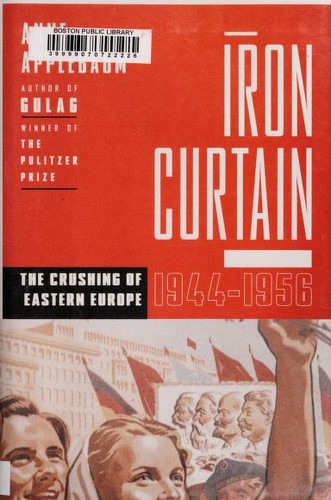
Iron Curtain is Anne Applebaum's account of how the Soviet Union destroyed civil society and imposed communist rule across Eastern Europe between 1944 and 1956.
Anne Applebaum · 2012 · 16h 45m
Full summary and key takeaways →The 12 questions
- 1.
Applebaum focuses on Poland, Hungary, and East Germany. How much does her analysis depend on those particular cases, and would other countries have told a different story?
- 2.
She argues the communists tried to remake not just political systems but society — to eliminate the intermediate institutions that make civil life possible. What does that suggest about what civil society is for?
- 3.
The chapters on secret police and informers document how private trust was systematically destroyed. What conditions would need to exist for you to inform on a neighbor or colleague?
- 4.
Show trials required the accused to perform false confessions publicly. What psychological and social mechanisms made that possible?
- 5.
The communist youth movements aimed to replace family and religious loyalty with party loyalty. How successful were they, based on what Applebaum reports?
- 6.
Purges within the communist parties show that ideological loyalty didn't protect anyone. What does that tell us about the inner logic of totalitarian systems?
- 7.
Applebaum ends in 1956. What happened next, and how does knowing the full arc of Soviet domination change how you read the earlier history?
- 8.
She argues that Eastern Europeans' political reflexes today — skepticism of the EU, hostility to immigration, suspicion of state power — make more sense in light of this history. Do you find that convincing?
- 9.
The book describes societies being made, not just governed. How does that compare to the way political systems operate in democracies?
- 10.
Which chapter or case study did you find most revealing, and why?
- 11.
Iron Curtain is partly a corrective to Western historical ignorance about what happened east of the Elbe. How much did you know about this history before reading it?
- 12.
What parallels, if any, do you see between the mechanisms Applebaum describes and contemporary political developments in democracies?
How to run the discussion
- Pick six to eight, not all of them. An hour of real discussion covers fewer questions than anyone expects, and racing the list is what makes a book club feel like homework.
- Open with what people noticed, not what they concluded. Asking for a verdict first hardens opinions before anyone has heard each other.
- Let the disagreement run. The questions below that split a room are the ones worth the time; the ones everyone answers the same way can be skipped.
- Ask the quiet person a specific question. A direct, narrow question is far easier to answer than an open invitation to contribute.
Themes worth steering toward
If the conversation stalls, these are the threads that usually restart it.
Common questions
What are good book club questions for Iron Curtain: The Crushing of Eastern Europe 1944–1956?
Here are 12 book club questions for Iron Curtain: The Crushing of Eastern Europe 1944–1956 by Anne Applebaum, ordered to open easily and end somewhere worth arguing about. The strongest openers ask what each reader noticed rather than what they concluded, and the discussion usually turns on soviet occupation, totalitarianism, eastern europe.
How long should a book club discussion of Iron Curtain: The Crushing of Eastern Europe 1944–1956 last?
Most groups run 60 to 90 minutes of actual discussion. That is roughly six to eight questions, not all of them, so pick the ones that suit your group rather than working down the list in order.
What are the main themes in Iron Curtain: The Crushing of Eastern Europe 1944–1956?
Soviet occupation, Totalitarianism, Eastern Europe, Cold War, Political control. Those are the threads most likely to divide a room, which makes them the useful places to steer a discussion that has gone quiet.
Picking the next one? See books like Iron Curtain: The Crushing of Eastern Europe 1944–1956 or questions for other book club picks.
