Business · Book club
It Doesn't Have to Be Crazy at Work book club questions
Here are 12 book club questions for It Doesn't Have to Be Crazy at Work by Jason Fried and David Heinemeier Hansson, ordered to open easily and end somewhere worth arguing about. Copy them, print them, or bring them up one at a time.
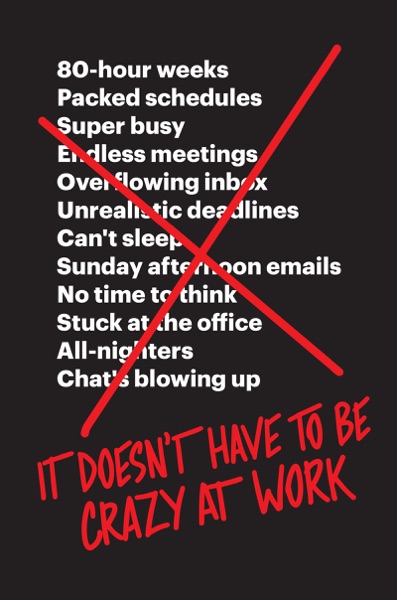
It Doesn't Have to Be Crazy at Work is a direct challenge to the mythology of startup hustle — the idea that long hours, constant urgency, and full-company stress are signs of ambition rather than poor management.
Jason Fried and David Heinemeier Hansson · 2018 · 3h 15m
Full summary and key takeaways →The 12 questions
- 1.
Fried and DHH argue that busyness is often a sign of poor management rather than high ambition. What in your organization is genuinely urgent versus performatively so?
- 2.
They protect uninterrupted work time as a structural matter. What would it actually take to create protected deep-work blocks in your current role?
- 3.
The book argues for setting scope to fit deadlines rather than setting deadlines to fit scope. How do projects in your organization typically handle that tradeoff?
- 4.
What assumptions does your organization make about availability — response times, meeting attendance, being online — that have never been examined or explicitly chosen?
- 5.
The authors say company growth targets shouldn't become everyone's daily emotional burden. Do employees in your organization carry goals that belong to investors? What effect does that have?
- 6.
Small teams, they argue, outperform large ones because coordination overhead grows faster than output. Where in your experience has that been true or false?
- 7.
The book is written by founders who control their company. How much of its advice is available to managers who don't have that authority?
- 8.
Fried and DHH are explicit about Basecamp's policies and reasoning with employees. How does the transparency in your organization compare to the standard they describe?
- 9.
They argue against surveillance of remote workers. What's the actual problem that monitoring tools are supposed to solve, and does monitoring solve it?
- 10.
What does 'treating employees like adults' mean concretely to you? Where does your organization fall short of that standard?
- 11.
The book takes strong positions and doesn't hedge them. Which of its claims do you find most compelling and which feels most inapplicable to your context?
- 12.
If you could implement one idea from this book starting next week, which would it be, and what would stop you?
How to run the discussion
- Pick six to eight, not all of them. An hour of real discussion covers fewer questions than anyone expects, and racing the list is what makes a book club feel like homework.
- Open with what people noticed, not what they concluded. Asking for a verdict first hardens opinions before anyone has heard each other.
- Let the disagreement run. The questions below that split a room are the ones worth the time; the ones everyone answers the same way can be skipped.
- Ask the quiet person a specific question. A direct, narrow question is far easier to answer than an open invitation to contribute.
Themes worth steering toward
If the conversation stalls, these are the threads that usually restart it.
Common questions
What are good book club questions for It Doesn't Have to Be Crazy at Work?
Here are 12 book club questions for It Doesn't Have to Be Crazy at Work by Jason Fried and David Heinemeier Hansson, ordered to open easily and end somewhere worth arguing about. The strongest openers ask what each reader noticed rather than what they concluded, and the discussion usually turns on organizational culture, work-life balance, management.
How long should a book club discussion of It Doesn't Have to Be Crazy at Work last?
Most groups run 60 to 90 minutes of actual discussion. That is roughly six to eight questions, not all of them, so pick the ones that suit your group rather than working down the list in order.
What are the main themes in It Doesn't Have to Be Crazy at Work?
Organizational culture, Work-life balance, Management, Productivity, Leadership. Those are the threads most likely to divide a room, which makes them the useful places to steer a discussion that has gone quiet.
Picking the next one? See books like It Doesn't Have to Be Crazy at Work or questions for other book club picks.
