Art · Book club
Keys to Drawing book club questions
Here are 12 book club questions for Keys to Drawing by Bert Dodson, ordered to open easily and end somewhere worth arguing about. Copy them, print them, or bring them up one at a time.
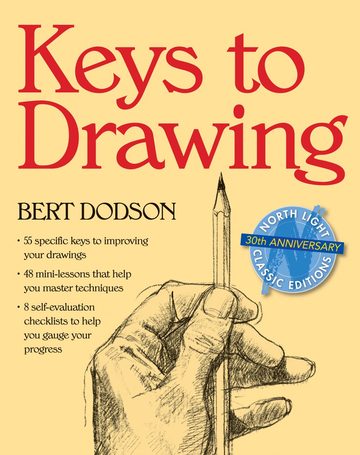
Keys to Drawing rests on a simple, liberating claim: drawing is not a gift a few people are born with but a skill almost anyone can learn.
Bert Dodson · 1985 · 5h 0m
Full summary and key takeaways →The 12 questions
- 1.
Dodson says most beginners draw what they know, not what they see. Where do you notice yourself falling back on a symbol instead of looking?
- 2.
When you make a wrong line, is your instinct to erase it or restate it? What changes if you treat the wrong line as information rather than a mistake?
- 3.
Think of a time you compared one part of a drawing to another to check proportion. How did relative seeing change what you put down?
- 4.
Which of the two abilities — perceiving or representing — feels like the bigger obstacle for you, and why?
- 5.
Blind contour drawing produces clumsy-looking results. What does your discomfort with that tell you about how much you rely on the finished image versus the act of looking?
- 6.
Dodson treats drawing as a skill anyone can learn. What belief about your own talent would you have to give up to take that claim seriously?
- 7.
Pick an everyday object near you. What symbol do you expect to draw for it, and what might you see if you actually studied its edges and shadows?
- 8.
Where does negative space appear in a scene you would like to draw, and how might drawing the gaps help you get the objects right?
- 9.
How does grouping light and shadow into simple masses change the way you would render something round, like a mug or an apple?
- 10.
The book is built to be done, not just read. Which exercises are you tempted to skip, and what does that avoidance reveal?
- 11.
Dodson encourages a searching, experimental line over a careful, timid one. Where else in your creative life do you play it too safe?
- 12.
After working through several exercises, what has shifted in how you look at ordinary things even when you are not drawing?
How to run the discussion
- Pick six to eight, not all of them. An hour of real discussion covers fewer questions than anyone expects, and racing the list is what makes a book club feel like homework.
- Open with what people noticed, not what they concluded. Asking for a verdict first hardens opinions before anyone has heard each other.
- Let the disagreement run. The questions below that split a room are the ones worth the time; the ones everyone answers the same way can be skipped.
- Ask the quiet person a specific question. A direct, narrow question is far easier to answer than an open invitation to contribute.
Themes worth steering toward
If the conversation stalls, these are the threads that usually restart it.
Common questions
What are good book club questions for Keys to Drawing?
Here are 12 book club questions for Keys to Drawing by Bert Dodson, ordered to open easily and end somewhere worth arguing about. The strongest openers ask what each reader noticed rather than what they concluded, and the discussion usually turns on drawing, perception, observational skill.
How long should a book club discussion of Keys to Drawing last?
Most groups run 60 to 90 minutes of actual discussion. That is roughly six to eight questions, not all of them, so pick the ones that suit your group rather than working down the list in order.
What are the main themes in Keys to Drawing?
Drawing, Perception, Observational skill, Art instruction, Deliberate practice. Those are the threads most likely to divide a room, which makes them the useful places to steer a discussion that has gone quiet.
Picking the next one? See books like Keys to Drawing or questions for other book club picks.
