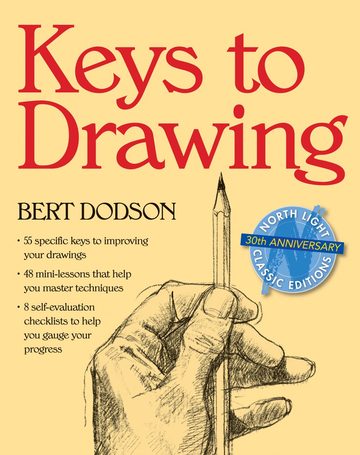
Keys to Drawing by Bert Dodson is a 1985 art book about drawing, perception, observational skill. Drawing is two separable skills — perceiving accurately and representing on paper — and both can be trained. Talent is not the deciding factor.
Summary
Keys to Drawing rests on a simple, liberating claim: drawing is not a gift a few people are born with but a skill almost anyone can learn. Bert Dodson breaks that skill into two abilities — the ability to perceive (to see what is actually in front of you) and the ability to represent (to put marks on paper that correspond to it). Most beginners fail not because their hands can't cooperate but because they draw what they already know — a stored symbol for an eye, a hand, a tree — rather than what is actually in front of them. The book's first job is to break that habit of symbol-making and teach genuine looking.
Dodson's signature method is a loop he calls restating, checking, and correcting. Rather than committing to one confident, perfect line, you draw a searching line, compare it against the subject, and restate it — again and again — until it sits right. Erasing is discouraged; the ghost of the earlier line is information. Alongside this, he trains you to see relationships: to judge every angle, proportion, and size against the others rather than in isolation, because accuracy in drawing is almost always relative.
The book is built around 55 hands-on exercises, and it is meant to be done, not just read. It moves through contour drawing, gesture, proportion and measuring, light and shadow, three-dimensional volume, negative space, texture and pattern, expressive line quality, composition, and finally drawing from imagination and personal expression. Each concept is introduced, demonstrated, and then handed back to you as an exercise, so the skills compound rather than sitting as theory.
It is best suited to beginners and to lapsed drawers who want a warm, encouraging, structured coach rather than a theory of art. Its limits are honest ones: it will not make you skilled in a weekend, and it rewards only those who actually pick up a pencil and repeat the exercises. Readers who want the neuroscience of perception may prefer Betty Edwards; those who want a flexible practice they can grow into for years will find Dodson the friendlier and more forgiving companion.
The two abilities
Dodson’s whole approach hangs on splitting drawing into two skills that can be trained separately:
- Perceiving — seeing what is actually in front of you: the true angle of a shoulder, the real shape of a shadow, how large one thing is next to another.
- Representing — translating that perception into marks on paper.
Most people assume the second is the hard part, the “talent.” Dodson argues the bottleneck is almost always the first. We stop looking too soon and let what we know override what we see.
The habit that blocks beginners: drawing what you know
We each carry a mental library of symbols — a lollipop tree, an almond eye, a mitten hand. Under pressure, the mind reaches for the symbol instead of studying the thing. The result looks generic and slightly wrong because it is a diagram of a concept, not a record of a particular object in particular light. The early exercises exist to interrupt that reflex and put you back in front of the actual subject.
The core method: restate, check, correct
Dodson replaces the myth of the single confident stroke with a loop:
- Restate — lay down a light, searching line rather than one committed line.
- Check — compare it against the subject. Is the angle right? The length? The relationship to its neighbor?
- Correct — restate again, nudging it closer.
Erasing throws away information; the earlier lines show you where you were and guide where to go. A finished drawing is the accumulation of many small corrections, not a lucky first try.
Seeing relationships
Accuracy in drawing is relative, not absolute. You rarely know how long a line “should” be — you know how it compares to the line beside it. Dodson trains comparative seeing: measuring angles against verticals and horizontals, sizes against each other, and using negative space (the gaps around and between forms) as a check, because the empty shapes are often easier to judge honestly than the objects themselves.
What the 55 exercises cover
The book is a graded sequence you work through with a pencil in hand:
- Contour and gesture — moving the pencil in step with the eye; catching the whole action of a pose quickly.
- Proportion and measuring — comparative judgment of size and angle.
- Light and shadow — grouping values into simple masses to build the illusion of form.
- Volume and modeling — making rounded, three-dimensional shapes read as solid.
- Negative space — drawing the gaps to correct distortions.
- Texture, pattern, and line quality — varying pressure and edge (lost and found lines) for expression.
- Composition and imagination — arranging a picture, then drawing from memory and invention toward a personal style.
Who it’s for
Keys to Drawing is for the true beginner and the returning amateur who wants a patient, structured coach. It is not a theory of art and not a shortcut — it is a practice manual whose value is unlocked only by doing the work. Repeat the exercises and the payoff is durable: you start to see edges, values, and relationships in ordinary things even when there is no paper in front of you.
Talk to Keys to Drawing like its author wrote you back.
Get the ideas that fit your life — not generic summaries.
- Chat with the book
- Audiobook-style main ideas
- Adapts to your life and goals
- Helps you take action
Key takeaways
- 1.
Drawing is two separable skills — perceiving accurately and representing on paper — and both can be trained. Talent is not the deciding factor.
- 2.
Beginners draw symbols, not sights. The first breakthrough is drawing what you actually see rather than the stored concept you carry for a thing.
- 3.
Restate rather than erase. Draw a searching line, compare it to the subject, and redraw. The correcting loop, not a single perfect stroke, builds good drawings.
- 4.
Accuracy is relative. Judge every angle, length, and proportion against the others; comparative seeing is what makes a drawing hold together.
- 5.
Contour drawing trains the eye-hand connection by forcing your pencil to move in step with your eye as it travels the edge of a form.
- 6.
Negative space — the shapes around and between objects — is often easier to see accurately than the objects themselves, and drawing it corrects distortions.
- 7.
Light and shadow describe form. Grouping values into simple masses of light and dark turns a flat outline into a believable three-dimensional volume.
- 8.
Skill compounds through the 55 exercises. Reading the book is motion; doing the exercises is the practice that actually changes your seeing.
Discussion questions
Use these on your own, with a book club, or as chat starters in Superbook. Book club version, ready to copy or print →
- 1.
Dodson says most beginners draw what they know, not what they see. Where do you notice yourself falling back on a symbol instead of looking?
- 2.
When you make a wrong line, is your instinct to erase it or restate it? What changes if you treat the wrong line as information rather than a mistake?
- 3.
Think of a time you compared one part of a drawing to another to check proportion. How did relative seeing change what you put down?
- 4.
Which of the two abilities — perceiving or representing — feels like the bigger obstacle for you, and why?
- 5.
Blind contour drawing produces clumsy-looking results. What does your discomfort with that tell you about how much you rely on the finished image versus the act of looking?
- 6.
Dodson treats drawing as a skill anyone can learn. What belief about your own talent would you have to give up to take that claim seriously?
- 7.
Pick an everyday object near you. What symbol do you expect to draw for it, and what might you see if you actually studied its edges and shadows?
- 8.
Where does negative space appear in a scene you would like to draw, and how might drawing the gaps help you get the objects right?
- 9.
How does grouping light and shadow into simple masses change the way you would render something round, like a mug or an apple?
- 10.
The book is built to be done, not just read. Which exercises are you tempted to skip, and what does that avoidance reveal?
- 11.
Dodson encourages a searching, experimental line over a careful, timid one. Where else in your creative life do you play it too safe?
- 12.
After working through several exercises, what has shifted in how you look at ordinary things even when you are not drawing?
Themes
Frequently asked questions
-
Is Keys to Drawing good for complete beginners?
Yes. It assumes no prior skill and starts from how to see, building up through 55 graded exercises. Because Dodson treats drawing as a learnable skill rather than a talent, it is especially reassuring for people who believe they cannot draw.
-
Do I need to do the exercises to get value from the book?
Largely, yes. The concepts are clear on their own, but the book is designed as a practice manual. The 55 exercises are where seeing actually changes; reading without drawing gives you the ideas but not the skill.
-
How is Keys to Drawing different from Drawing on the Right Side of the Brain?
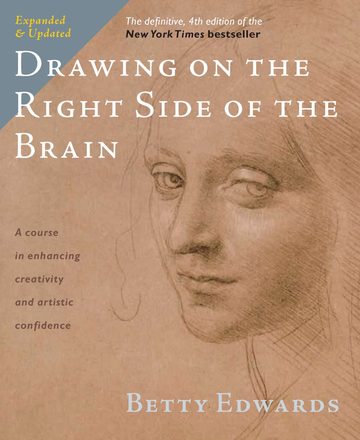
Betty Edwards frames learning to draw around brain hemispheres and perceptual shifts. Dodson skips the theory and focuses on a repeatable working method — restate, check, correct — plus a wide range of exercises. Many artists read both.
-
What does restating mean in Dodson's method?
Restating means redrawing a line by searching for it with several light strokes and correcting as you compare with the subject, instead of erasing and forcing one perfect line. The visible searching marks are part of how the drawing finds its accuracy.
-
What materials do I need to start?
Very little. A pencil and paper are enough for most of the exercises. Dodson keeps the toolset deliberately simple so the focus stays on seeing and mark-making rather than on equipment.